 Seeking LED
LED High Bay Lighting vs Linear Lighting
180LED High Bay Lighting vs Linear Lighting – Which Works Better | SEEKINGLED
View detailsSearch the whole station
In hazardous areas (oil & gas, chemical, mining, pharma, warehouses), explosion-proof lights ensure safety and lighting. Key factors: power (W), lumens (lm), and efficacy (lm/W).
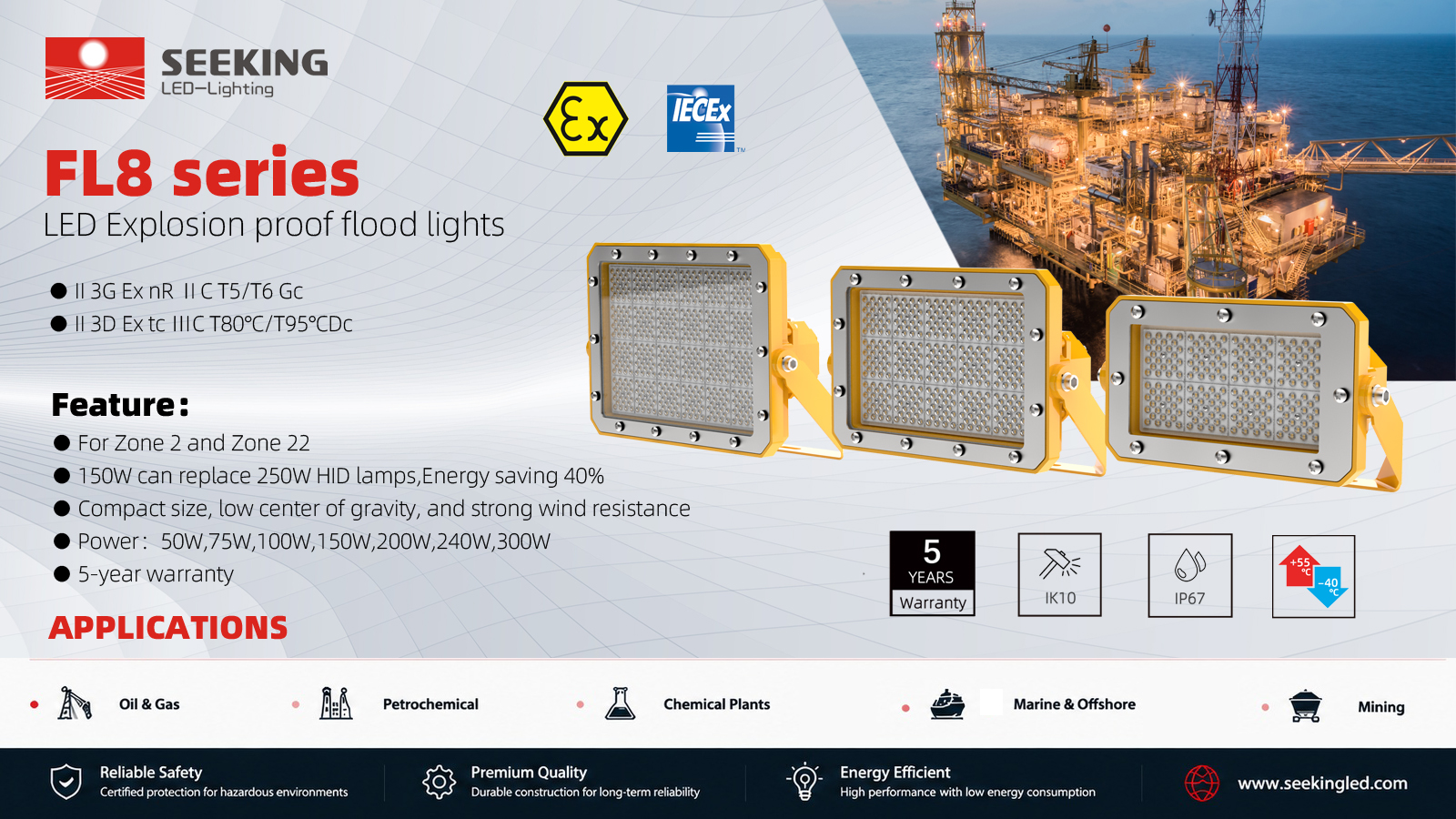
Modern units use LED. Power depends on height, area, and illuminance (50–200 lx).
Quick guide:
2.5–4 m → 20–40 W | 3–6 m → 40–80 W | 6–10 m → 80–150 W | 8–12 m+ → 150–300 W
Use calculation software and maintenance factor in projects.
Lumens ≈ power × efficacy (110–140 lm/W):
A quality 150 W unit ≈ 21,000 lm (replaces 400 W metal halide). CRI ≥70–80, CCT 3000–6500 K.
Mainstream: 100–130 lm/W; premium 120–140 lm/W.
150 lm/W is uncommon. Thick housing, glass, sealing, and T-class limits reduce system efficacy. Lab chips go higher, but certified fixtures rarely exceed 140 lm/W. Check whole-fixture reports, not claims.
LED versions cut energy 50–70 %, last longer, start instantly, and run cooler.
All their explosion-proof lights use LED technology with brand-new LED modules and special constant-current drivers. Every model is designed to deliver more than 150 lm/W. Higher efficiency means more light and less heat, so the temperature class stays at the safer T6 or T5 level.
For more information, please contact
web: www.seekingled.com
Email:dawei@seekingled.com
Visit the product page:Explosion Proof Lighting
LED High Bay Lighting vs Linear Lighting – Which Works Better | SEEKINGLED
View details
Are LED street lights cost effective over time? This guide explains real costs, savings, and when LED street lighting truly makes financial sense.
View details
Flood light lumen needs depend on area, mounting height, beam angle, application, and required illuminance.
View details
Even during the Qingming Festival holiday, SEEKINGLED remains fully committed to production and shipment. 880 units of GSL Series Canopy Lights are currently being loaded into containers and will arrive at a food processing plant in Belgium in two...
View details