By SEEKINGLED Engineering Team · Last updated: November 2026 · ATEX & IECEx certified explosion-proof lighting manufacturer since 2010
Quick Answer: ATEX and IECEx are two separate certification systems for equipment used in explosive atmospheres. ATEX is legally mandatory in the European Union (Directive 2014/34/EU), while IECEx is an international, voluntary certification scheme based on IEC 60079 standards, widely requested for oil & gas, EPC and mining projects worldwide. They use almost identical Ex markings (for example, Ex db IIB T6 Gb) but are NOT automatically interchangeable. Always confirm which scheme your project, insurer or local authority requires — then verify the certificate number against the exact model before you buy.
For B2B buyers sourcing ATEX certified explosion proof lights, certification is the single most consequential line item on the specification sheet. It determines whether a fixture can legally be installed, whether an insurer will cover the site, and — ultimately — whether the people working there are safe. Yet this is also the area where buyers make the most assumptions. This guide explains what each system actually means, how their markings differ, and the five concrete checks that separate a genuine certificate from a misleading one.
ATEX Explained: The European Framework
ATEX refers to the European Union’s regulatory framework for equipment and protective systems intended for use in potentially explosive atmospheres. It takes its name from the French ATmosphères EXplosibles and is governed primarily by Directive 2014/34/EU (the equipment directive), alongside Directive 1999/92/EC covering worker safety. In the EU and the European Economic Area, ATEX compliance is not optional — it is a legal requirement for placing equipment on the market and putting it into service.
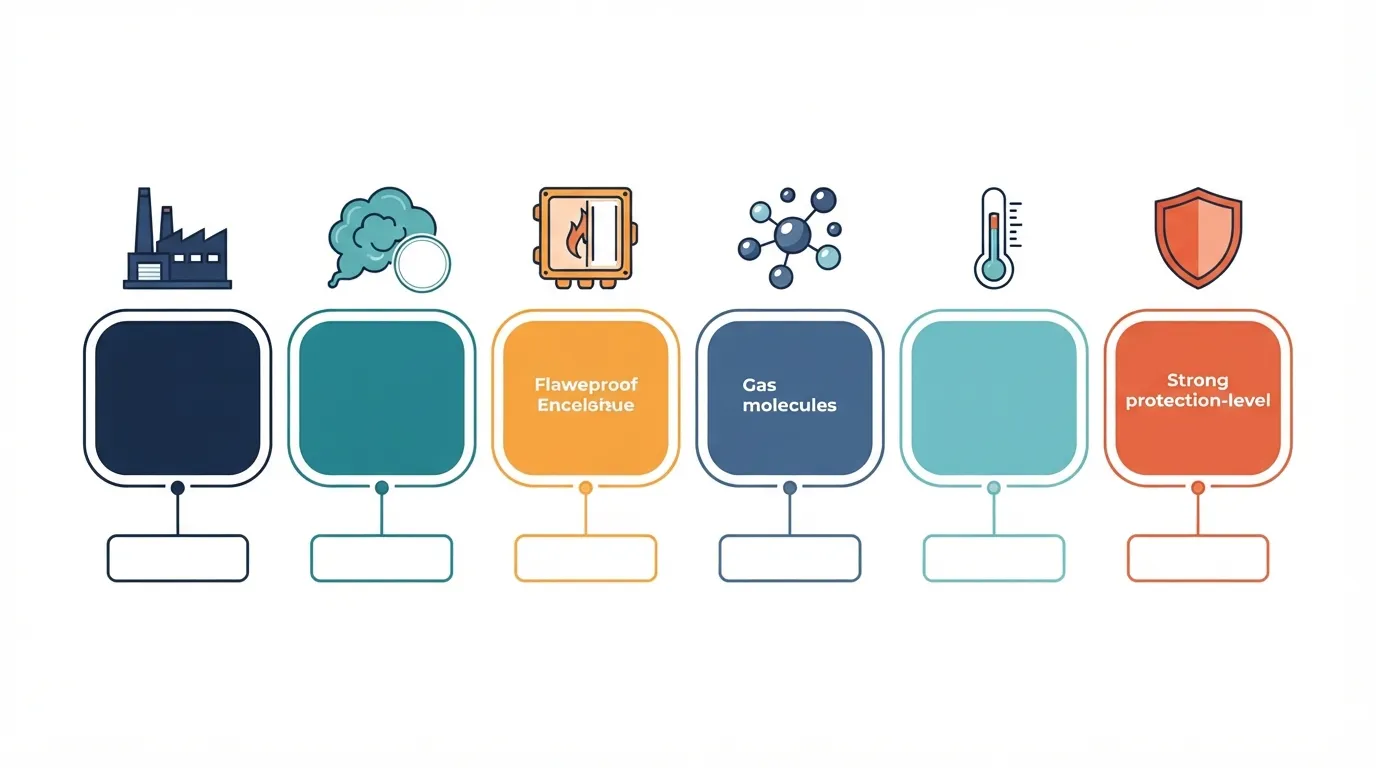
ATEX divides equipment into Group I (mining) and Group II (surface industries), then assigns a category based on the zone: category 1 for Zone 1/21, category 2 for Zone 2/22, and category 3 for Zone 3/23. Gas is marked “G”, dust “D”. A complete ATEX marking might read II 2G Ex db IIB T6 Gb — read left to right:
II — Equipment Group II, for surface (non-mining) industries.
2G — Category 2 equipment for a gas atmosphere, suitable for Zone 1 (and, by extension, Zone 2).
Ex db — Protection concept “flameproof enclosure” (Ex d), protection level “b”.
IIB — Gas group: IIA (e.g. propane) < IIB (e.g. ethylene) < IIC (e.g. hydrogen, acetylene). A higher sub-group covers the lower ones.
T6 — Temperature class; maximum surface temperature 85 °C. T5 is 100 °C, T4 is 135 °C.
Gb — Equipment Protection Level (EPL): “high level of protection” for gas.
ATEX-certified fixtures from SEEKINGLED carry markings such as Ex db IIB T6/T5 Gb for gas areas and Ex tb IIIC T80 °C/T95 °C Db for dust areas. To see how these markings map onto real product choices, see our hazardous area lighting solutions page and the complete buyer’s guide. For the zone definitions behind the categories, read our Zone 1 vs Zone 2 classification guide.
IECEx Explained: The International System
IECEx is the International Electrotechnical Commission’s certification system for equipment used in explosive atmospheres, built on the IEC 60079 series of standards. Unlike ATEX, IECEx is not a legal directive imposed by a region — it is an international conformity-assessment scheme. In practice, however, it is contractually mandatory on many projects: oil & gas operators, EPC contractors, mining companies and authorities across Asia, the Middle East, Australia and Africa commonly specify IECEx certification as a condition of purchase.
The two systems are deliberately aligned. IECEx uses the same zone concept and almost the same Ex marking as ATEX — you will see Ex db IIB T6 Gb on an IECEx certificate just as on an ATEX one. The IECEx certificate, however, is issued under the IECEx Scheme by an accredited certification body and is listed in the public IECEx online certificate database (formerly IECEx COC). Many SEEKINGLED series, including the LO Series linear explosion proof lights, are certified to both ATEX and IECEx so they can serve either market — but holding both is a manufacturer’s choice, not an automatic equivalence.
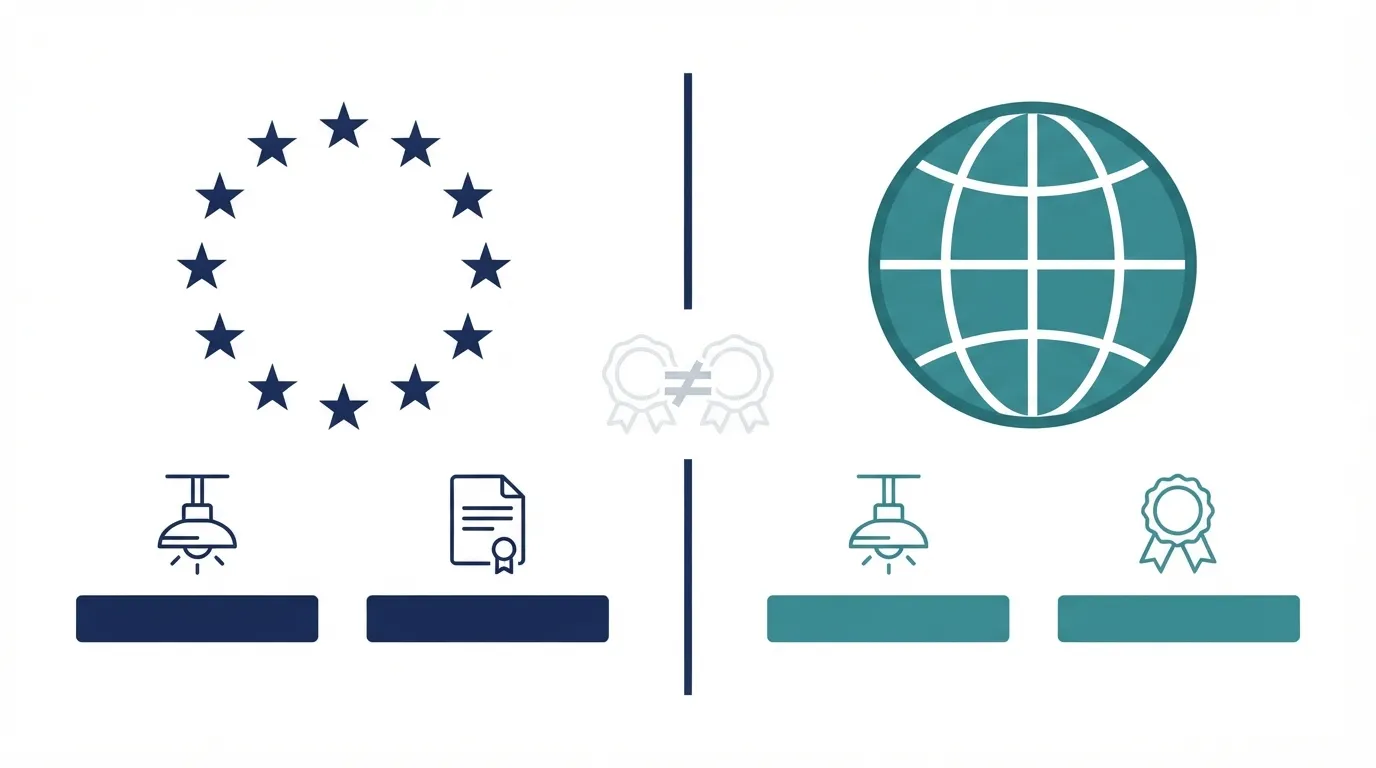
The practical takeaway: ATEX answers “is this legal in Europe?” IECEx answers “is this recognized to the international standard most global projects ask for?” They are complementary, not copies of one another.
ATEX vs IECEx — Side-by-Side Comparison
The table below summarizes the differences that matter when you are comparing supplier claims or reading a project specification.
Aspect
ATEX
IECEx
Nature
Legal directive (mandatory in EU/EEA)
International certification scheme (contractually required on many projects)
Governing rule
Directive 2014/34/EU
IEC 60079 series standards
Region
European Union / EEA
International — Asia, Middle East, Australia, Africa, and others
Classification
Zones (1/2 gas, 21/22 dust), Equipment Categories 1–3, EPL
Zones (1/2 gas, 21/22 dust), EPL
Ex marking
e.g. II 2G Ex db IIB T6 Gb
e.g. Ex db IIB T6 Gb
Mutual recognition
Not automatic. ATEX ≠ IECEx; a project may require one or both. Markings look alike but the certificate and issuing scheme differ.
Typical project requirement
EU installations, CE marking, insurer compliance
Oil & gas / EPC / mining projects, international tenders
Table 1 — ATEX vs IECEx at a glance. Always match the certificate to the destination market and the exact model purchased.
How to Verify a Certificate Is Genuine (5 Checks)
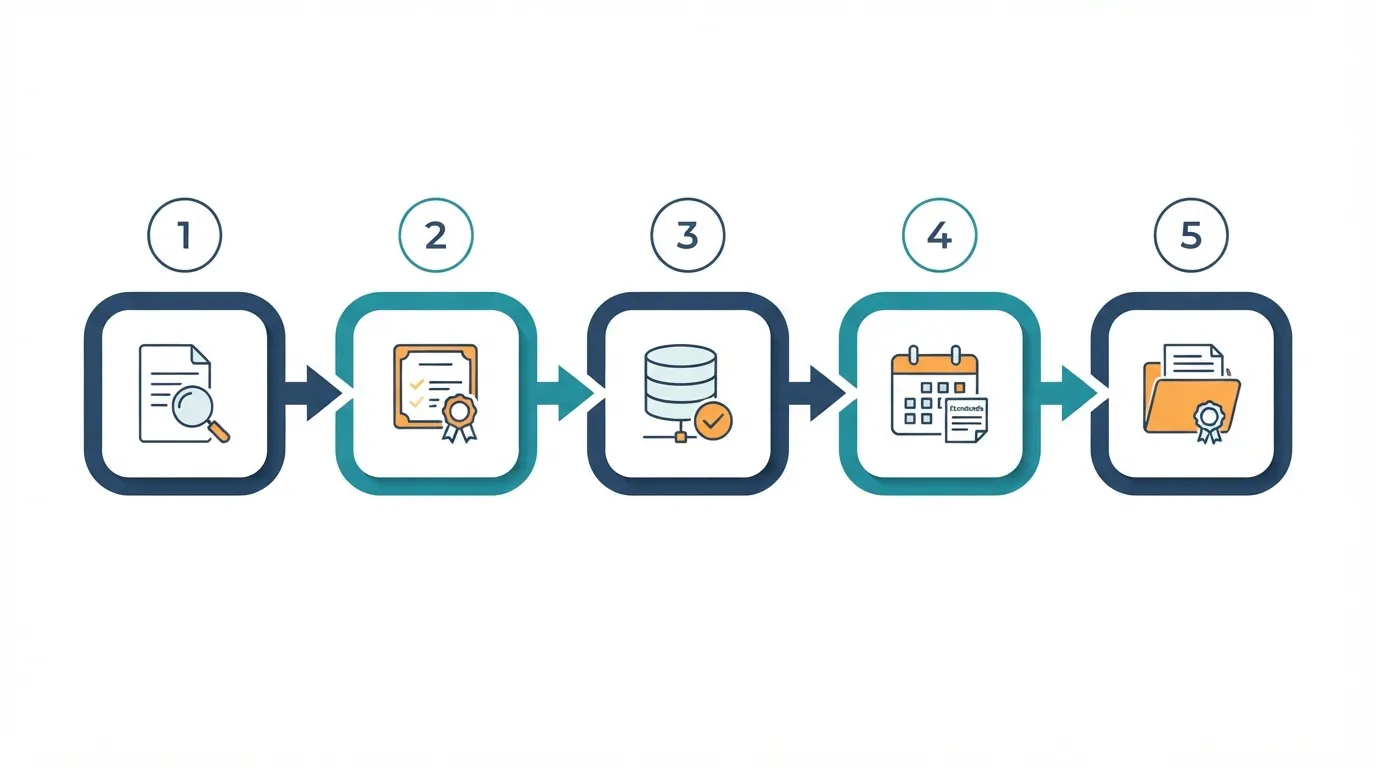
A certificate is only as trustworthy as its match to the physical product you are buying. A common supplier tactic is to display a valid certificate that actually belongs to a different model, an older version, or another manufacturer. Use these five checks every time.
Check 1 — Match the certificate number and the exact model
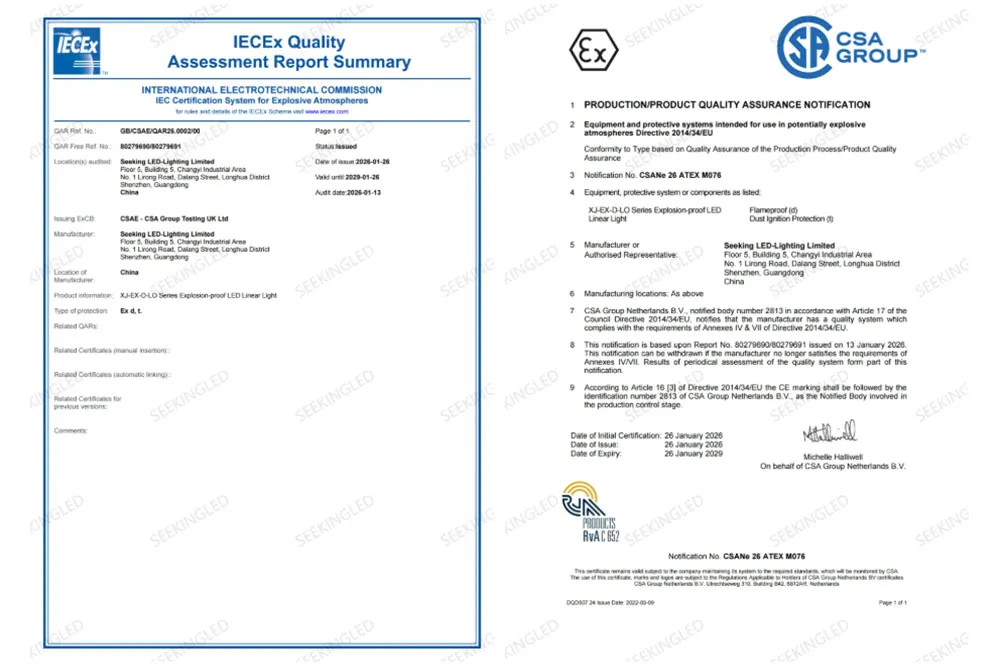
The certificate must list the exact model number you are ordering, not a “similar” one from the same family. Take SEEKINGLED’s ATEX certificate number TÜV CY 26 ATEX 0207611 X as an example: the number identifies a specific certificate issued by TÜV, and the “X” suffix denotes special conditions for safe use that must be followed during installation. On the certificate, confirm the product designation matches the nameplate and datasheet of the fixture in your quote.
Check 2 — Verify manufacturer name, protection marking, gas group and T-class
Read the details, not just the logo. Confirm the manufacturer name on the certificate is the company you are contracting with (or an explicitly named OEM partner). Then cross-check the Ex marking, gas group (IIA/IIB/IIC) and temperature class against the product label. For instance, a certificate stating Ex db IIB T6 Gb does not cover a hydrogen (IIC) area — buying on the assumption that “it’s ATEX” is not enough. Our FL8 Series ATEX flood light and FL7 Series pages show how markings are stated on real products.
Check 3 — Verify with the issuing body
Do not rely on a PDF forwarded by the salesperson. Look up the certificate in the issuing body’s public database — for IECEx, the official online certificate database; for ATEX, the notified body’s own register (TÜV, DEKRA, SGS, CSA, etc.). Enter the number and confirm the status is active and the model details agree. If a supplier cannot provide a verifiable number, treat the claim as unsubstantiated.
Check 4 — Check the scope, standards and issue date
Confirm which standards the certificate references (e.g. EN 60079-1 for Ex d, IEC 60079-0 general requirements) and that they are current. An old certificate referencing withdrawn standards can be invalid for a new installation. Check the issue/expiry dates and any “X” special conditions.
Check 5 — Demand supporting documents and test reports
A genuine manufacturer can supply the full document set: the certificate, the Ex marking label, test reports, IES photometric files, the conformity declaration, and warranty terms. SEEKINGLED backs its ATEX and IECEx lighting with in-house testing and a documented quality system, and will provide the relevant documents for the exact model quoted.
Common Compliance Mistakes
Four errors account for most sourcing problems we see:
Assuming ATEX and IECEx are interchangeable. They are separate schemes. Confirm the exact one your market and contract require — and note that North America uses yet another system (UL844 / Class & Division).
Accepting a certificate that doesn’t match the model. Always verify the exact model number, manufacturer, gas group and T-Class, as described above.
Treating IP rating as explosion protection. IP66/IP69K describe resistance to dust and water, not explosion containment. Only a recognized Ex certificate and marking prove explosion protection — see our explosion-proof lighting safety guide.
Ignoring the gas group and temperature class. A fixture certified for IIB cannot be used in an IIC (hydrogen) area; a T4 fixture is unsafe where T6 is required. Match both to the substance present.
Avoiding these mistakes is more valuable than a small unit-price saving. Request samples and test reports before bulk production — SEEKINGLED accepts small-batch sample orders, with samples typically ready in about one week and bulk orders in 2–3 weeks.
Certification cost & lead time — industry reference figures
Buyers and distributors often ask what certification costs and how long it takes. The figures below are industry reference ranges for orientation only, not a SEEKINGLED quotation — actual cost and timing depend on the product family, test scope and certification body:
Item
Industry reference range
Notes
ATEX certification (per product family)
USD 8,000–25,000
Includes testing & notified-body fees; varies by scope
IECEx certification (per product family)
USD 10,000–30,000
Similar to ATEX; additional scheme & QMS audit fees
Typical certification lead time
6–16 weeks
From sample submission to certificate issue
Quality-system (QAN/QMS) audit
Annual
Required to maintain production conformity
Table 2 — Industry reference figures for planning only. Contact the certification body or your supplier for accurate figures.
Get Certified Lighting — Talk to Our Team
If you need ATEX or IECEx certified explosion proof lighting for an industrial project, SEEKINGLED can help you specify the right fixture and provide the documentation to back it up. We have manufactured hazardous-area lighting since 2010, export to 70 countries, and hold ATEX, IECEx and ISO 9001 certifications with products tested by TÜV and CSA. Our 5,000 m² facility, in-house laboratory and 15-person R&D team support OEM/ODM, small-batch samples and a 5-year warranty.
Download our certification verification checklist PDF to use with any supplier, or send us your zone, gas group, T-Class and target market for a fast, documented recommendation.
Need the right explosion proof light for your hazardous area?
Get a certified recommendation, datasheets & a quote within 12 hours.
Not as a legal substitute. In the EU/EEA, ATEX compliance (with CE marking) is the legal requirement for equipment in explosive atmospheres. An IECEx certificate demonstrates international conformity but does not by itself replace ATEX for a European installation. Many products, including SEEKINGLED fixtures, are certified to both systems.
Can one product have both ATEX and IECEx certification?
Yes. Manufacturers often certify the same model to both schemes so it can serve European and international markets. Check that both certificates list your exact model — holding one does not automatically mean the other exists.
How do I read an Ex marking like II 2G Ex db IIB T6 Gb?
II = equipment group for surface industries; 2G = category 2 for gas (Zone 1); Ex db = flameproof enclosure protection; IIB = gas group; T6 = maximum surface temperature 85 °C; Gb = equipment protection level (high protection for gas). Each segment tells you where the fixture may safely be used.
Does an IP rating replace explosion certification?
No. IP66/IP69K rate resistance to dust and water ingress only. Explosion protection must be proven by certification to an Ex standard (ATEX, IECEx, UL844) and a matching Ex marking. An IP-rated light without Ex certification must not be installed in a classified hazardous area.
How long is an ATEX certificate valid?
An ATEX EC-type examination certificate generally has no fixed expiry date and remains valid while the design, applicable standards and manufacturing conditions stay unchanged. However, production is subject to ongoing quality-assurance (QAN) audits, and a certificate can become invalid if standards are withdrawn or the product is modified. Always confirm current status with the issuing body.
Conclusion
ATEX and IECEx are the two certification systems you will encounter most often in hazardous-area lighting, and they are not interchangeable. ATEX is the legal framework in Europe; IECEx is the international scheme most global oil & gas and EPC projects request. Their Ex markings look nearly identical — which is exactly why you must look past the marking and verify the document.
Remember the five checks: match the certificate number and exact model, confirm the manufacturer and Ex details, verify with the issuing body, check the standards and dates, and demand the full document set. Avoid the common mistakes of assuming equivalence, accepting a mismatched certificate, confusing IP with Ex, and ignoring gas group and T-Class. With ATEX and IECEx certified products, TÜV/CSA testing and exports to 70 countries, SEEKINGLED is ready to support your specification.
explosion proof light fixtures engineered for Zone 1 & 2 hazardous areas. ATEX & IECEx certified, energy-efficient, durable and built for oil, gas and chemical safety by SEEKINGLED.
How to install LED flood light correctly for outdoor and industrial applications. Learn wiring, mounting height, safety tips, and common installation mistakes.
 Seeking LED