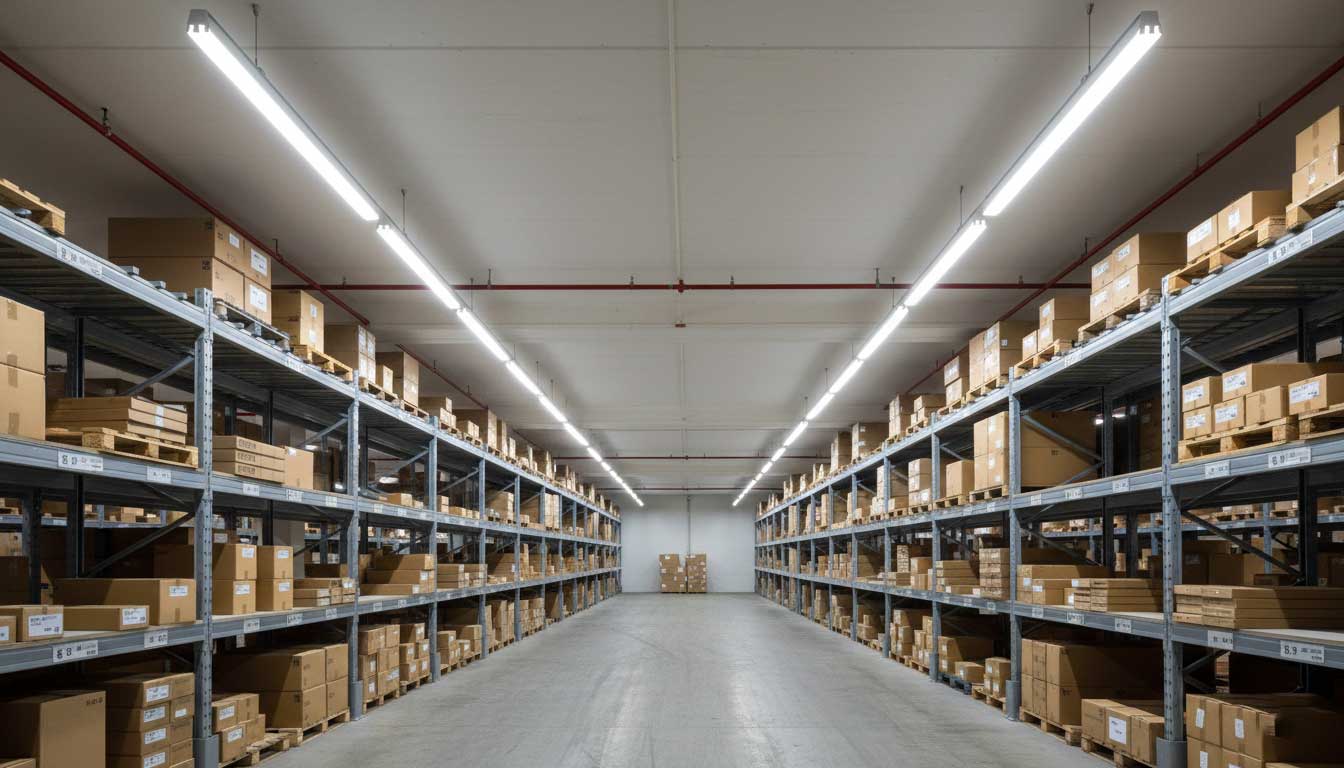
High-quality LED drivers help control non linear load effects in large lighting installations.
Answer
Yes, LED lights are considered a non linear load, but this often causes confusion in real projects. The LED itself is not the main reason. The key factor is the electronic driver that powers it.
Unlike traditional lamps that draw current smoothly, LED drivers convert AC power into DC using internal rectifiers and switching components. Because of this process, the current is drawn in short pulses instead of following the voltage waveform. From an electrical point of view, this behavior classifies LED lighting as a non linear load.
In small installations, this usually goes unnoticed. In larger systems, especially linear lighting layouts, it becomes something designers and contractors need to understand.
Why LED Lighting Behaves Differently From Traditional Loads
In older lighting systems such as fluorescent with magnetic ballasts or incandescent lamps, current and voltage rise and fall together. LEDs work through power electronics, and that changes how electricity is taken from the grid.
This is why LED lighting can introduce harmonics into the system if the driver quality is poor. In real-world terms, this may show up as unnecessary stress on cables, transformers, or neutral conductors when many fixtures are connected to the same circuit.
That said, non linear does not automatically mean problematic. The outcome depends heavily on driver design.
Does Non Linear Load Mean LED Lights Are Unsafe for Large Projects?
No. In fact, most modern commercial and industrial buildings today are already full of non linear loads, from computers to automation equipment.
What matters is whether the LED system is designed for professional use. For example, the SEEKINGLED HLS Series LED Linear Light uses a high-quality TRIDONIC driver with a power factor of ≥0.95 and controlled harmonic distortion. In daily operation, this keeps the electrical behavior stable, even when long rows of fixtures are installed.
For warehouses, production halls, offices, and supermarkets, this makes a clear difference compared to low-cost lighting that focuses only on lumen output.
Are LED Linear Lights Worse Than Other LED Fixtures?
Not really. LED linear lights are still non linear loads, but their advantage lies in consistency.
In a linear trunking system, the same driver type, wiring method, and load pattern are repeated across the installation. This makes it easier for electrical engineers to plan circuits and avoids surprises during commissioning. Randomly mixed fixtures from different suppliers are far more likely to cause issues than a well-designed linear system.
That’s one reason linear lighting is widely used in logistics centers and large commercial interiors.
When Should Non Linear Load Be Considered During Design?
It becomes relevant when a project includes long lighting runs, three-phase distribution, dimming control, sensors, or emergency backup. In these cases, choosing LED lights with clear power factor and driver specifications is far more important than chasing the highest lm/W figure on paper.
A stable electrical profile is often what determines whether a lighting system performs well five years later.
Practical Conclusion
So, are LED lights a non linear load? Yes, by definition they are. But with proper driver selection and system design, this characteristic is fully manageable.
For projects that require clean ceiling lines, fast installation, and predictable electrical performance, professional solutions like the SEEKINGLED HLS Series LED Linear Light are built with these realities in mind, not just lab conditions.
Ex lighting fixtures ensure safe operation in hazardous zones. Learn certifications, materials, and real-world selection tips for industrial environments.
Where is hazardous area LED lighting used? Discover how explosion-proof LED lighting protects oil, gas, marine, mining, and chemical facilities safely.
 Seeking LED