 Seeking LED
ex proof lamp for Hazardous Areas – Engineered for Real-World Risk
141ex proof lamp by SEEKINGLED delivers ATEX & IECEx certified flameproof protection for Zone 1 & 21 hazardous areas with high efficiency and 100,000h life.
View detailsSearch the whole station
Direct answer :
Class 1 Division 1 lighting is designed for hazardous locations where flammable gases, vapors, or liquids may exist under normal operating conditions. These fixtures use certified protection methods to prevent electrical equipment from igniting the surrounding atmosphere and are selected according to the applicable hazardous-location classification.
Class 1 Division 1 lighting is lighting equipment intended for locations classified as Class I, Division 1 (C1D1) under the North American hazardous-location system.
The important part is not simply that the fixture is “explosion proof.” The location classification comes first.
Under NFPA 70, National Electrical Code (NEC) Article 500, Class I locations involve flammable gases or vapors. Division 1 indicates a location where an ignitable concentration of gas or vapor can exist under normal operating conditions, or where frequent maintenance or repair operations may release such material.
That distinction matters on an actual project.
I have seen lighting specifications become unnecessarily complicated because “hazardous area” was treated as one generic category. It is not. A C1D1 fixture selected for an oil-and-gas process area cannot automatically be treated as appropriate for every hazardous location.
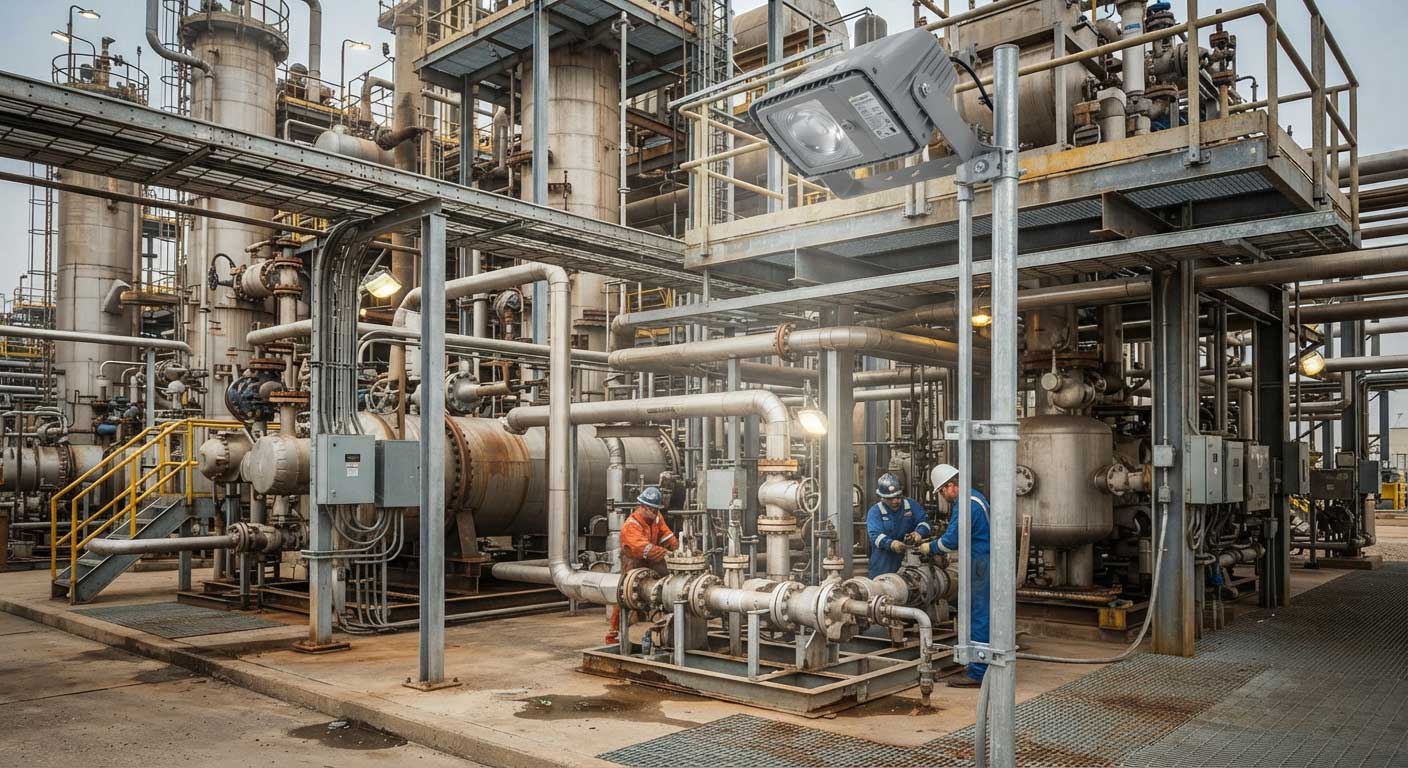
The practical question is:
Could an ignitable gas or vapor atmosphere be present during normal operation?
If the answer is yes, Division 1 may apply, depending on the specific conditions and the facility’s electrical classification.
Typical environments can include:
The exact boundary must come from the facility’s hazardous-location classification and applicable electrical code requirements—not from the lighting manufacturer’s marketing description.
A useful way to understand C1D1 lighting is to separate Class, Division, and Group.
| Classification | What it identifies |
|---|---|
| Class I | Flammable gases, vapors, or liquids |
| Division 1 | Ignitable concentrations may exist under normal operating conditions or specified abnormal conditions |
| Group A–D | Specific gas or vapor characteristics |
The group designation is especially important when specifying equipment.
Under the NEC group system, Class I hazardous atmospheres are divided into Groups A, B, C, and D.
Examples include:
The group should not be guessed from the industry name.
A natural-gas facility, for example, does not mean every luminaire can simply be selected as “Group D” without checking the actual classified atmosphere and equipment certification.
For procurement teams, this is one of the easiest specifications to get wrong.
The difference between C1D1 and C1D2 is fundamentally about the likelihood and conditions under which the hazardous atmosphere can be present.
| Feature | Class 1 Division 1 | Class 1 Division 2 |
|---|---|---|
| Hazardous atmosphere | Can exist during normal operation | Normally contained; may appear under abnormal conditions |
| Application severity | Higher | Lower than Division 1 |
| Fixture selection | C1D1-rated equipment required where specified | C1D2-rated equipment may be appropriate where permitted |
| Typical concern | Continuous, intermittent, or routine release | Accidental release or equipment failure |
| Design approach | More stringent hazardous-location requirements | Different protection requirements |
This does not mean that C1D1 is simply a “brighter” or “stronger” version of C1D2 lighting.
The electrical protection method is the critical issue.
For that reason, replacing a specified C1D1 luminaire with a cheaper C1D2 fixture because the wattage and lumen output look similar is not an acceptable substitution.
The fixture has to address a much more serious problem than ordinary industrial lighting.
An electrical luminaire contains potential ignition sources: wiring connections, drivers, switching components, terminals, and other energized parts. In a hazardous environment, the design has to prevent those sources from igniting the surrounding atmosphere under the conditions covered by its certification.
This is where enclosure construction, thermal performance, electrical components, seals, wiring methods, and certification all become relevant.
Many C1D1 luminaires use an explosion-proof enclosure approach.
The objective is not necessarily to prevent an internal fault from occurring. Rather, the equipment is designed so that an internal ignition does not ignite the surrounding hazardous atmosphere, within the limits of the applicable certification.
That is a very different engineering objective from simply making a fixture “heavy duty.”
Another specification that should never be skipped is the fixture’s temperature classification.
A luminaire operating in a hazardous location must have an appropriate T-code / temperature classification for the gases or vapors present.
The maximum surface temperature of the equipment matters because the fixture itself must not become an ignition source.
For example, selecting equipment solely by lumen output while ignoring its temperature classification leaves out one of the most important parts of the hazardous-location specification.
When I review a hazardous-area lighting specification, I do not start with wattage.
I start with the location.
Identify:
The facility’s electrical engineer or qualified hazardous-location professional should establish the classification.
Do not rely on phrases such as:
Those descriptions are not enough by themselves.
Look for the actual certification and marking information applicable to the intended installation.
In the United States, OSHA‘s hazardous-location requirements reference approved equipment for classified locations, while product certification is commonly evaluated through recognized testing and certification organizations.
For a commercial project, the certification marking should be checked against the project specification—not just the product brochure.
A refinery lighting installation can involve heat, corrosive chemicals, vibration, dust, moisture, and outdoor exposure at the same time.
That means hazardous-location certification is only one part of the selection process.
Consider:
A technically certified fixture can still be a poor choice if its environmental performance does not match the installation.
LED technology has changed industrial lighting substantially.
Compared with older HID systems, LED luminaires can provide high light output from a relatively compact fixture and can avoid some of the warm-up and restrike behavior associated with traditional discharge lighting.
For maintenance teams, that can be significant.
A light that starts immediately after power restoration is particularly useful in facilities where visibility is part of safe maintenance and operating procedures.
But there is an important caveat: LED does not automatically mean hazardous-location rated.
A standard LED high bay is not transformed into C1D1 equipment simply because its housing is metal or because the manufacturer describes it as “industrial.”
Oil and gas applications are among the most recognizable C1D1 environments, but the lighting requirements vary considerably across a facility.
A process area may have very different classification boundaries from an administrative building, warehouse, control room, or maintenance shop.
In field applications, I pay particular attention to areas around:
The luminaire should be selected based on the classified area where it will actually be installed.
This sounds obvious. On projects, it is one of the details most likely to become blurred between engineering, procurement, and installation teams.
For SEEKINGLED, hazardous-area lighting should be approached as a specification-driven product selection rather than a generic high-bay purchase.
The fixture’s certification, hazardous-location marking, temperature classification, electrical characteristics, mounting configuration, and environmental rating should all be verified against the project requirements before ordering.
For an OEM or project quotation, the useful information to provide the lighting manufacturer includes:
That information allows the manufacturer to recommend equipment based on the actual installation rather than guessing from the facility type.
For C1D1 lighting specifications, authoritative references are more valuable than generic lighting blogs.
Key references include:
For U.S. projects, the NEC classification and the product’s actual certification marking should be checked together. Upload a photo
A C1D1 luminaire should be selected from the actual hazardous-area classification, gas group, temperature class, ambient conditions, and certification marking—not simply from wattage or lumen output. OSHA requires equipment in hazardous locations to be approved for the specific location and the ignitable properties of the material present.
On a real industrial project, this distinction becomes obvious when the lighting schedule reaches the installation stage. The electrician is not asking whether a fixture “looks explosion proof.” They need to know exactly what the marking permits. <h3>Read the Product Marking Before Ordering</h3>
For class 1 division 1 lighting, the product marking should be compared directly with the project hazardous-location specification.
Important information can include:
OSHA specifically states that approved equipment must be suitable not only for the class of location but also for the ignitable properties of the specific gas or vapor. Equipment markings must identify the applicable class, group, and operating temperature or temperature range in the circumstances specified by the regulation.
That is why a purchasing request such as “100W explosion-proof LED light” is incomplete.
A better request is closer to:
100W LED luminaire + Class I, Division 1 + applicable Group + temperature classification + required certification + project voltage.
That gives the manufacturer something technically useful to work with.
Class I, Division 1 locations can occur in petroleum and chemical processing environments, among other facilities. OSHA specifically identifies petroleum and chemical processing plants among occupancies where hazardous classified locations may be found.
However, the entire facility is not automatically C1D1.
OSHA states that each room, section, or area is considered individually when determining its classification.
That matters when lighting a large plant.
A control room may have a different electrical classification from a pump room. A maintenance area may differ from the process zone outside the building. A storage area can have different requirements again.
Depending on the facility’s engineering classification, C1D1 equipment may be required around areas such as:
OSHA’s formal definition includes locations where ignitable concentrations may exist during normal operation, locations where they may occur frequently because of leakage or maintenance, and certain locations where equipment failure could simultaneously release an ignitable concentration and cause electrical equipment failure.
This is more specific than simply calling an area an “explosive environment.”
A fixture can have the correct Division rating and still be unsuitable for a particular application if the rest of the hazardous-location marking does not match.
UL Solutions describes the North American Division system as combining the Class, Division, and Group concepts. For Class I, the groups identify different gas or vapor characteristics, including Group A acetylene, Group B hydrogen, Group C ethylene, and Group D propane.
The temperature classification is equally important.
The fixture’s operating temperature cannot exceed the ignition temperature applicable to the specific gas or vapor encountered. OSHA’s requirements specifically address operating temperature and ambient temperature markings for approved equipment.
This is one of the areas where an experienced lighting specification saves time.
Do not select a fixture first and try to make the hazardous-location paperwork fit afterward.
Start with the classified atmosphere.
Hazardous-location certification comes first, but lighting performance still matters.
A fixture installed 20 feet above a process floor has a very different optical requirement from one mounted beneath a low pipe rack. Two luminaires with the same wattage can produce noticeably different illumination on the working plane because of beam angle, mounting height, optics, spacing, and surface reflectance.
For a C1D1 LED lighting project, review:
| Specification | Why it matters |
|---|---|
| Wattage | Determines electrical load |
| Lumens | Indicates total light output |
| Efficacy | Helps compare electrical efficiency |
| Beam angle | Controls light distribution |
| Mounting height | Affects illumination at floor level |
| Color temperature | Influences visual conditions |
| CRI | Relevant where color recognition matters |
| Ambient temperature | Determines suitable operating range |
| Surge protection | Important for industrial electrical environments |
| IP rating | Relevant to water and dust exposure |
| Certification | Determines hazardous-location suitability |
One common mistake is to compare only lumens.
In a refinery or processing plant, a 150W fixture with the wrong optic may perform worse at the working plane than a lower-wattage fixture with better distribution.
The fixture does not exist in isolation from the maintenance team.
Before selecting a hazardous-location luminaire, consider how technicians will access it, how frequently inspection is expected, whether the mounting arrangement allows safe servicing, and whether replacement components are available.
OSHA requires hazardous-location equipment and wiring to use approved protection approaches appropriate to the classified location. Its requirements also address installation details such as wiring methods, connections, sealing, grounding, and other electrical components.
For a plant operator, the practical question is simple:
Can this lighting system remain compliant after years of operation and maintenance?
That question is often more useful than asking for the highest lumen rating.
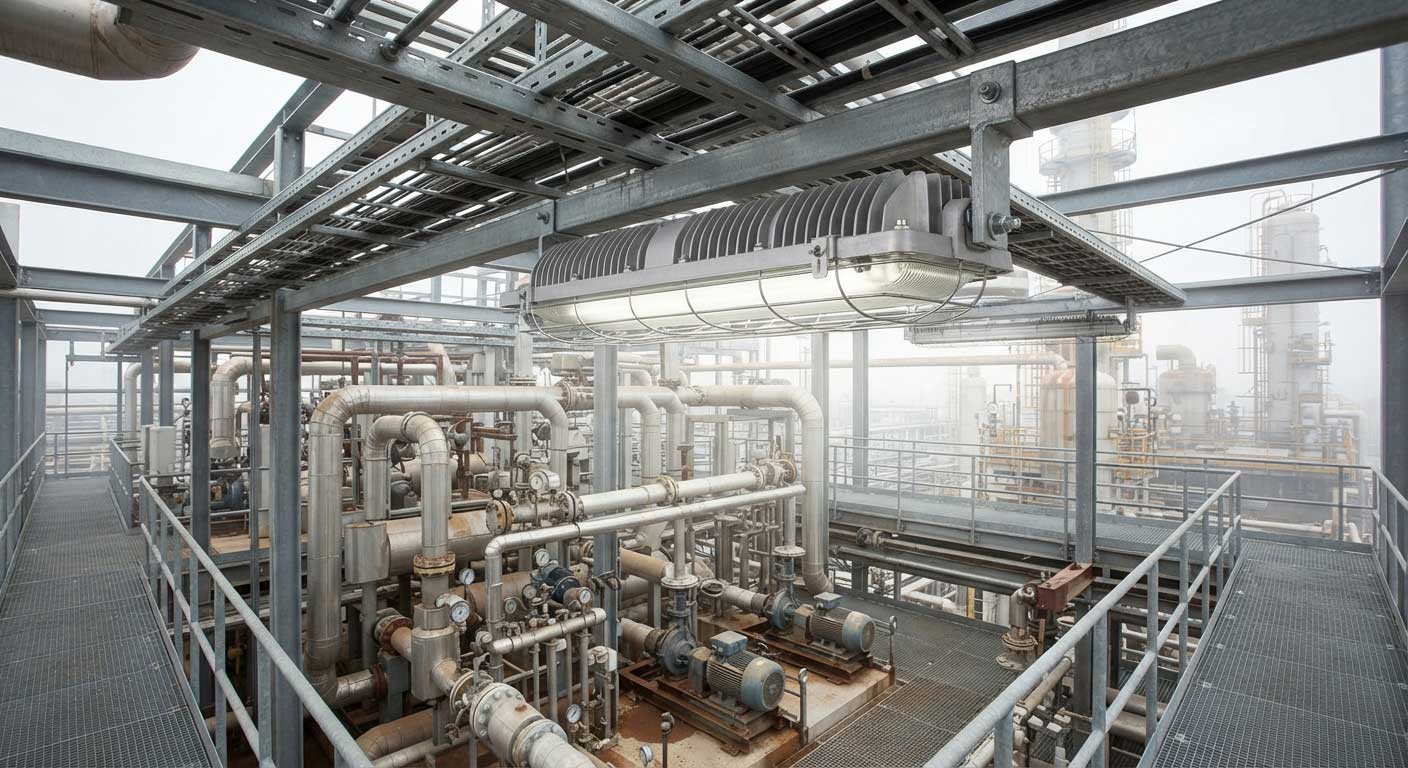
International projects often use the Zone system rather than the traditional North American Division system.
UL Solutions identifies the Division system and Zone system as two hazardous-area classification approaches used in North America.
OSHA also permits the Class I Zone 0, Zone 1, and Zone 2 system as an alternative to the Division system under specified requirements.
That means an international EPC project may ask for Class I, Division 1, while another project may specify Zone 1 equipment.
These terms should not be casually treated as interchangeable.
The certification marking has to match the project’s regulatory framework and equipment requirements.
For multinational lighting manufacturers such as SEEKINGLED, this is particularly important because one product family may be evaluated against several regional certification systems. The correct selection depends on the actual market, project specification, and certification required by the authority having jurisdiction.
Before sending a purchase order, confirm these points:
This checklist looks basic, but it prevents one of the most expensive mistakes in industrial lighting: discovering during submittal review that the selected fixture does not match the hazardous-location specification.
Class 1 Division 1 lighting is electrical lighting equipment approved for specified Class I, Division 1 hazardous locations where ignitable concentrations of flammable gases or vapors can exist under normal operating conditions or other conditions defined by the classification.
Not exactly. C1D1 describes the hazardous location classification. “Explosion-proof” describes one permitted protection technique. OSHA specifically recognizes explosion-proof apparatus for Class I, Division 1 and Division 2 locations when it is approved for the location.
Yes, where the equipment is approved for the same class and group. OSHA states that equipment approved for a Division 1 location may be installed in a Division 2 location of the same class and group.
The traditional North American system uses Groups A, B, C, and D for Class I gases and vapors. UL Solutions identifies acetylene as Group A, hydrogen as Group B, ethylene as Group C, and propane as Group D.
The applicable equipment marking requirements include operating temperature or temperature range in the circumstances specified by OSHA. The temperature rating must be suitable for the material present and operating conditions.
No—not merely because it is an LED high bay. Equipment installed in hazardous classified locations must be approved or otherwise demonstrated suitable for the specific hazardous location under the applicable requirements.
Provide the hazardous-area classification, gas group, temperature classification, required certification, voltage, wattage or illumination target, mounting method, installation environment, ambient temperature, and quantity. With these details, the lighting specification can be evaluated against the actual project rather than a generic “explosion-proof” requirement.
Class 1 Division 1 lighting should never be selected by wattage or appearance alone. The correct fixture starts with the hazardous-location classification, then matches the gas or vapor group, temperature classification, certification, electrical requirements, mounting conditions, and environmental exposure.
For oil and gas, petrochemical, chemical, and other hazardous industrial projects, these details determine whether a luminaire is actually suitable for the installation. SEEKINGLED can evaluate project requirements around the complete specification rather than treating C1D1 lighting as a generic “explosion-proof” product category.
For procurement teams and engineers, the safest approach is straightforward: confirm the classified location first, verify the certification marking second, and evaluate lighting performance and installation conditions after that. This avoids costly substitutions and helps ensure the selected class 1 division 1 lighting fits the actual application.
ex proof lamp by SEEKINGLED delivers ATEX & IECEx certified flameproof protection for Zone 1 & 21 hazardous areas with high efficiency and 100,000h life.
View details
ATEX LED light solutions for hazardous areas. Real-world insights, certified safety, and durable performance for oil, gas, and industrial environments by SEEKINGLED.
View details
SEEKINGLED delivers a high-efficiency linear high bay lighting solution for South Africa’s first Walmart-branded store, achieving low glare, high lux levels, and 65% energy savings.
View details
Some flood lights have motion sensors, but not all. Motion-controlled models activate when movement is detected and are useful where lighting demand is inter...
View details