 Seeking LED
How to Avoid Sunk Cost in LED High Bay Lighting Projects
167How to avoid sunk cost in LED high bay lighting projects starts with design decisions, not fixtures. Learn how to stop throwing money at bad layouts.
View detailsSearch the whole station
Explosive atmospheres in hazardous locations typically arise from the presence of release sources of flammable substances. These release sources can take various forms: they may involve continuous emissions, intermittent leaks during normal operations, or occasional releases only under fault conditions. As a result, the likelihood of an explosive atmosphere forming varies across different areas of an industrial site, depending on the type of release source and the distance from it.
At the same time, explosion-protected equipment employing different protection techniques achieves varying levels of safety, with corresponding differences in cost. Requiring the highest level of explosion protection throughout an entire facility — regardless of the actual risk — would be neither technically necessary nor economically justified. Moreover, many types of equipment cannot feasibly achieve the highest protection levels due to their design and construction.
For these reasons, the fundamental principle of explosion protection is to classify hazardous locations into zones according to the level of risk, to define the spatial extent of each zone, and then to select equipment with an appropriate level of protection for each zone.
Hazardous Area Zones
For application purposes, hazardous locations are broadly divided into two main categories: mining (underground coal mines) and non-mining.
Non-mining locations are further subdivided into those with explosive gas atmospheres and those with explosive dust atmospheres.
If the probability of an explosive atmosphere is less than 1 hour per year, the location is generally considered a non-hazardous (safe) area.
Dust atmospheres follow a similar classification: Zone 20, Zone 21, and Zone 22, corresponding to Zones 0, 1, and 2 for gases.
Mining (coal mine) hazardous areas are not subdivided spatially into zones in the same way.
The following example illustrates the concept (as shown in the accompanying diagram of a storage tank):
Inside the storage tank, in the space above the liquid gasoline surface, gasoline vapours are continuously present, creating a persistent explosive atmosphere — therefore this is classified as Zone 0.
Above the tank there is a vent through which gasoline vapours can be released. In an open outdoor environment, however, the vapours can disperse freely, so an explosive atmosphere is only likely to occur intermittently (when the concentration reaches the lower explosive limit). For this reason, the area within a 3-metre radius of the vent is typically classified as Zone 1.
Because gasoline vapours are heavier than air, they may spread along the outside of the tank wall. Consequently, the area within 3 metres of the tank’s external wall is usually classified as Zone 2.
This example is simplified to help general readers understand the zoning principle intuitively. In practice, actual classifications are often more complex and depend on detailed risk assessments, ventilation conditions, release rates, and other site-specific factors.
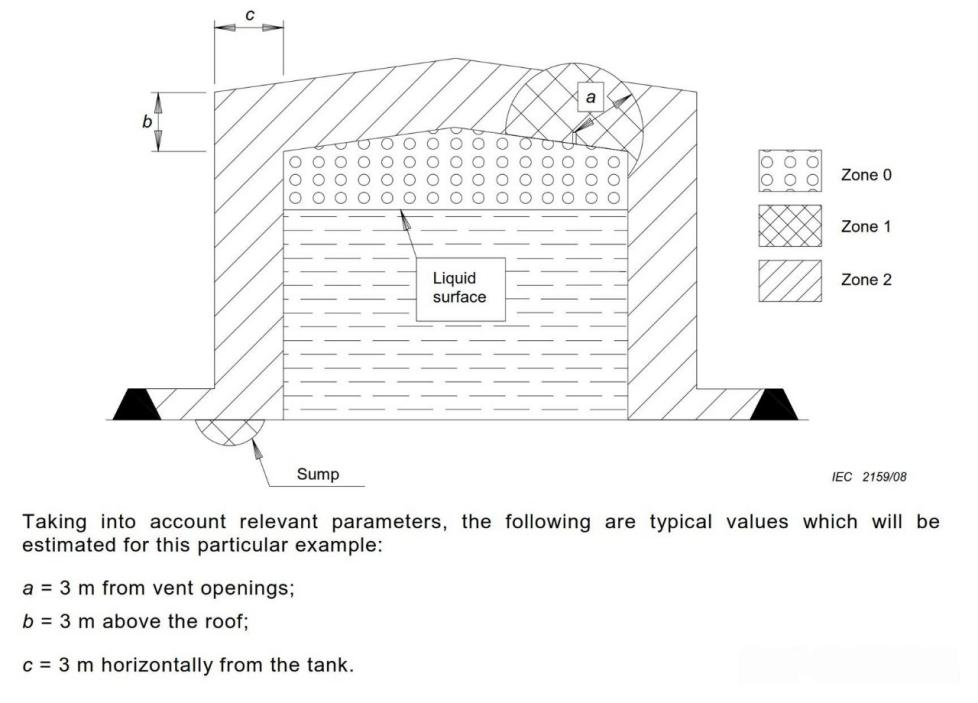
(Image source: IEC 60079-10-1:2008)
The classification is based on the standards IEC 60079-10-1 (for gases) and IEC 60079-10-2 (for dusts).
IEC 60079-10-1:2015 Explosive atmospheres – Part 10-1: Classification of areas – Explosive gas atmospheres
IEC 60079-10-2:2015 Explosive atmospheres – Part 10-2: Classification of areas – Explosive dust atmospheres
The primary method for zoning involves identifying and analysing release sources, then assessing the probability of an explosive atmosphere occurring in each area. Zoning requires consideration of numerous factors, such as the properties of the released substance (flammability, lower explosive limit, relative density to air, etc.); the production process; the type of release from the source; whether the release occurs inside a room or equipment, or externally; the presence of any obstructions; for outdoor releases, local climate conditions, wind direction and wind speed; and for indoor or internal equipment releases, the presence of natural ventilation, forced extraction, dilution measures, or spatial compartmentalisation.
Due to the complexity and high risk involved, zoning work demands highly qualified personnel. Those performing the classification must possess solid theoretical knowledge of explosion protection and area classification, extensive practical experience, strong learning and communication skills, the ability to retrieve and read reference materials, and the capacity to liaise effectively with equipment developers and process engineers to quickly understand the production process.
Equipment Classification
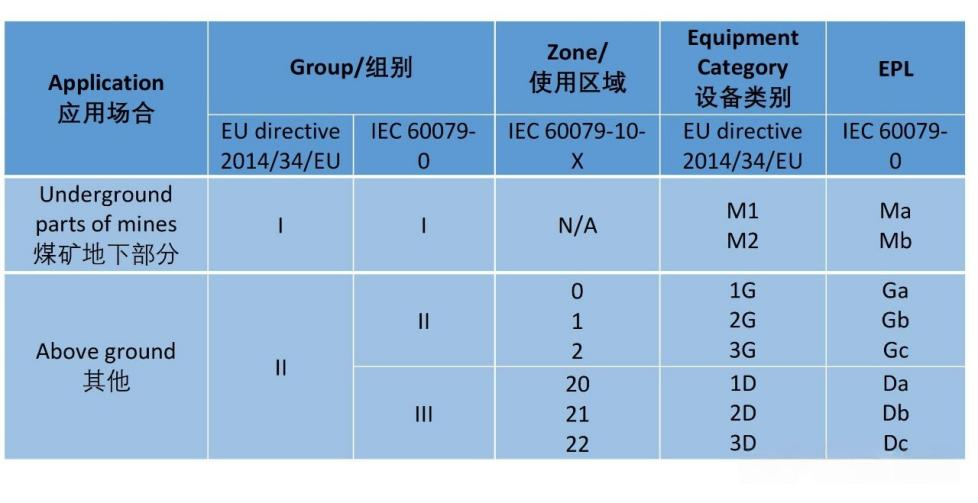
Explosion-protected equipment is divided into two groups: mining and non-mining. Under the ATEX directive, these are denoted by Roman numerals I and II, while in the Chinese industry, non-mining equipment is commonly referred to as factory-use equipment. The IEC further subdivides factory-use equipment into Group II (gases) and Group III (dusts).
The ATEX directive classifies factory-use equipment into three categories according to safety level: Category 1, Category 2, and Category 3 equipment, with G and D indicating gas and dust respectively. Category 1 equipment offers the highest safety level. Category 1, 2, and 3 equipment may be installed or used in Zones 0/20, 1/21, and 2/22 respectively, and can also be used in lower-risk zones (downward compatibility).
In the IEC system, equipment categories are expressed as Equipment Protection Levels (EPL), using a, b, and c to correspond to equipment suitable for Zones 0/20, 1/21, and 2/22.
Mining (coal mine) hazardous areas are not classified spatially into zones. Mining equipment is divided into two categories depending on its intended use: equipment that can be de-energised and stopped when methane levels exceed limits (typically production equipment) is classified as M2 or EPL Mb; equipment that must remain operational even when methane exceeds limits (e.g., alarm equipment, ventilation equipment, life-saving equipment) is classified as M1 or EPL Ma.
From a risk perspective, M1 equipment has the same risk level as Category 1 equipment, while M2 equipment has the same risk level as Category 2 equipment.
References
ATEX Directive 1999/92/EC Guideline Non-binding guide to good practice for implementing the European Parliament and Council Directive 1999/92/EC on minimum requirements for improving the safety and health protection of workers potentially at risk from explosive atmospheres
ATEX Directive 2014/34/EU guideline, Ed. 3 Guide to application of the directive 2014/34/EU of the European Parliament and of the Council of 26 February 2014 on the harmonization of the law of the member states relating to equipment and protective systems intended for use in potentially explosive atmospheres
This article is a republished Chinese translation version. Author: 听海临风 (from China) Link: https://zhuanlan.zhihu.com/p/537035270 Copyright belongs to the author.

How to avoid sunk cost in LED high bay lighting projects starts with design decisions, not fixtures. Learn how to stop throwing money at bad layouts.
View details
How long do LED street lights last in real outdoor projects? Learn what affects LED street light lifespan and how SEEKINGLED STB Series is designed for long-term road lighting.
View details
High bay LED light fixtures designed for harsh industrial environments. SEEKING HBK Ultua Series supports stable lighting from -40°C to +70°C for heavy industry and high-temperature plants.
View details
LED flood light waterproof explained from real outdoor projects. Learn IP ratings, sealing risks, and long-term reliability standards with SEEKINGLED.
View details