Q: how long can led lights last?
Long enough that you stop thinking about replacements.
But not so long that you can ignore everything else.
That’s the honest answer.
You’ll see numbers like 50,000 hours thrown around. Sometimes even higher. And yes—under the right conditions, LEDs can reach that.
But the keyword there is conditions.
A moment that changes how you look at it
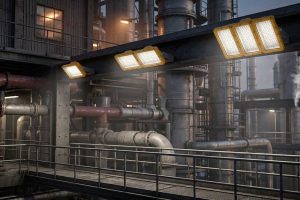
We had a site inspection in a processing facility. Lighting had been upgraded to LED about three years earlier.
On paper, everything should have been fine.
Most fixtures were.
But a few rows? Noticeably dimmer. Not dead. Just… tired.
Same installation batch. Same usage hours.
The difference came down to environment. Those rows sat above equipment that ran hot almost all day.
That heat didn’t kill the lights immediately. It just shortened their useful life.
So when asking how long can led lights last, you have to look beyond the number.
What lifespan really means (and what it doesn’t)
LEDs don’t fail like traditional bulbs.
They don’t just switch off one day.
They lose output gradually.
Industry standard defines lifespan using “L70” — when brightness drops to 70% of original.
So technically, the light is still working.
Practically, it might no longer be acceptable.
That gap matters.
Real-world lifespan ranges
Let’s keep it realistic.
- residential LED bulbs: around 15,000–25,000 hours
- commercial fixtures: 30,000–50,000 hours
- industrial-grade systems (like SEEKINGLED): often 50,000+ hours
But these aren’t guarantees.
They’re expectations—assuming decent conditions.
What actually limits LED lifespan
This is where most of the story is.
Heat
Always the main factor.
LEDs are efficient, but not heat-free. Poor thermal design or enclosed spaces trap heat, and that accelerates degradation.
I’ve seen fixtures in sealed housings age twice as fast as identical ones with proper airflow.
Driver performance
The LED chip usually outlives the driver.
When the driver fails, the light goes out—even if the LEDs are still functional.
Inconsistent current also leads to dimming issues over time.
Usage pattern
Running lights continuously vs intermittently changes everything.
A 50,000-hour rating sounds impressive.
But at 24/7 operation, that’s less than six years.
In a typical 8-hour daily use scenario, it stretches far longer.
Environment
Dust, moisture, vibration—none of these help.
Dust blocks cooling surfaces.
Moisture affects electronics.
Vibration weakens connections.
Each factor alone is manageable. Together, they shorten lifespan.
Why LEDs still last longer than traditional lighting
Even with all these limitations, LEDs still outperform older technologies.
According to the U.S. Department of Energy, LED lighting significantly reduces both energy consumption and replacement frequency compared to incandescent and fluorescent systems.
Typical comparison:
- incandescent: ~1,000 hours
- halogen: ~2,000–4,000 hours
- fluorescent: ~10,000–20,000 hours
- LED: 25,000–100,000 hours
That difference is the reason LEDs dominate modern installations.
When things don’t last as expected
If LED lights fail early, it’s rarely because “LED doesn’t last.”
It’s usually something else:
- poor heat management
- low-quality driver
- unstable power supply
I’ve seen projects where all three were present.
And the lifespan dropped fast.
Extending LED lifespan — what actually works
Nothing complicated here.
Just practical choices:
- use fixtures with proper heat dissipation
- avoid fully enclosed installations unless designed for it
- select reliable driver systems
- match the fixture to the environment
Skipping these steps? That’s where problems start.
Where SEEKINGLED fits in
With SEEKINGLED, lifespan isn’t treated as a headline number.
It’s built into how the product performs over time.
That includes:
- controlled thermal design
- stable electrical components
- durability for industrial environments
Because long lifespan only matters if performance stays consistent.
A small but important point
People often focus on maximum lifespan.
What matters more is usable lifespan.
If a light is still on but noticeably dim, it’s already a problem.
That’s something spec sheets don’t always highlight.
More answers
Final thought
So, how long can led lights last?
Long enough to reduce maintenance cycles and operating costs—if everything around the LED is done right.
Not nearly as long as expected—if it isn’t.
And that difference… usually comes down to design, not the LED itself.
LED flood light Recommendations
 Seeking LED