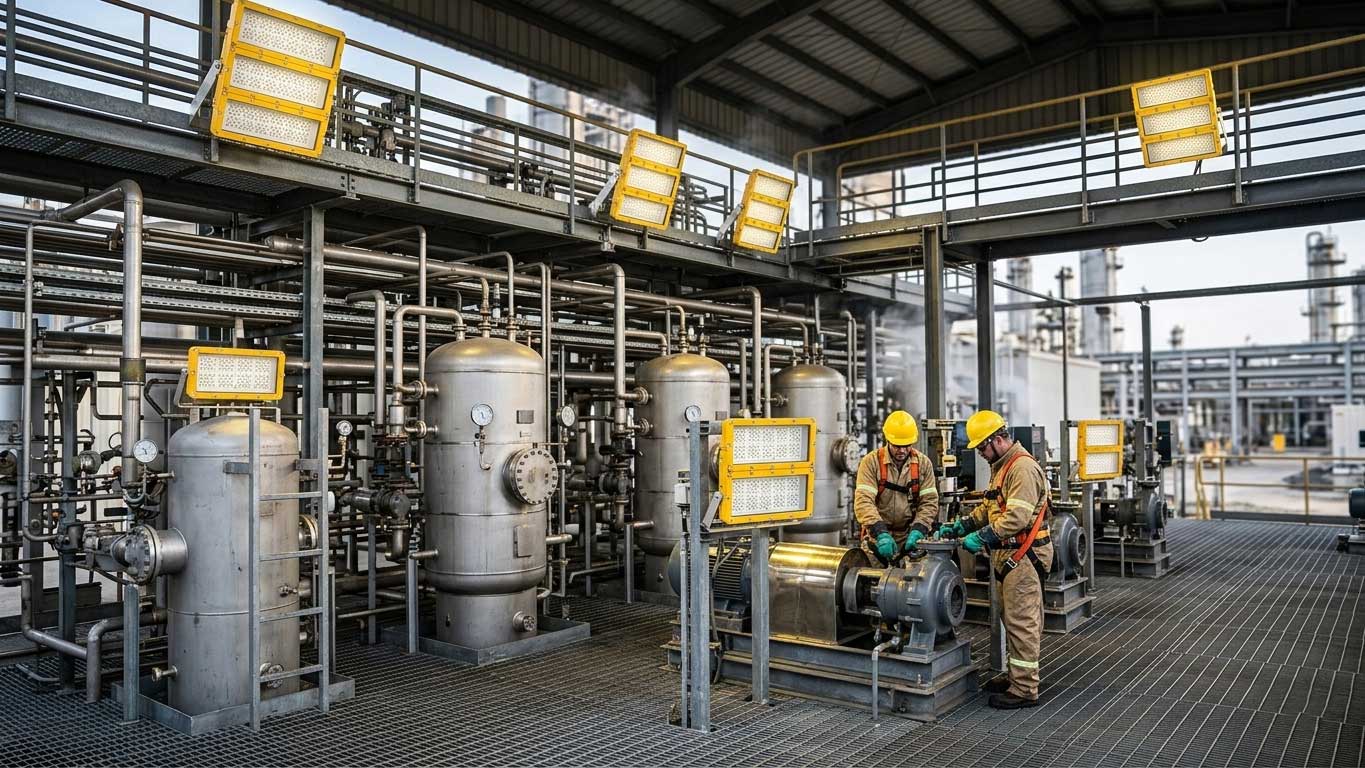
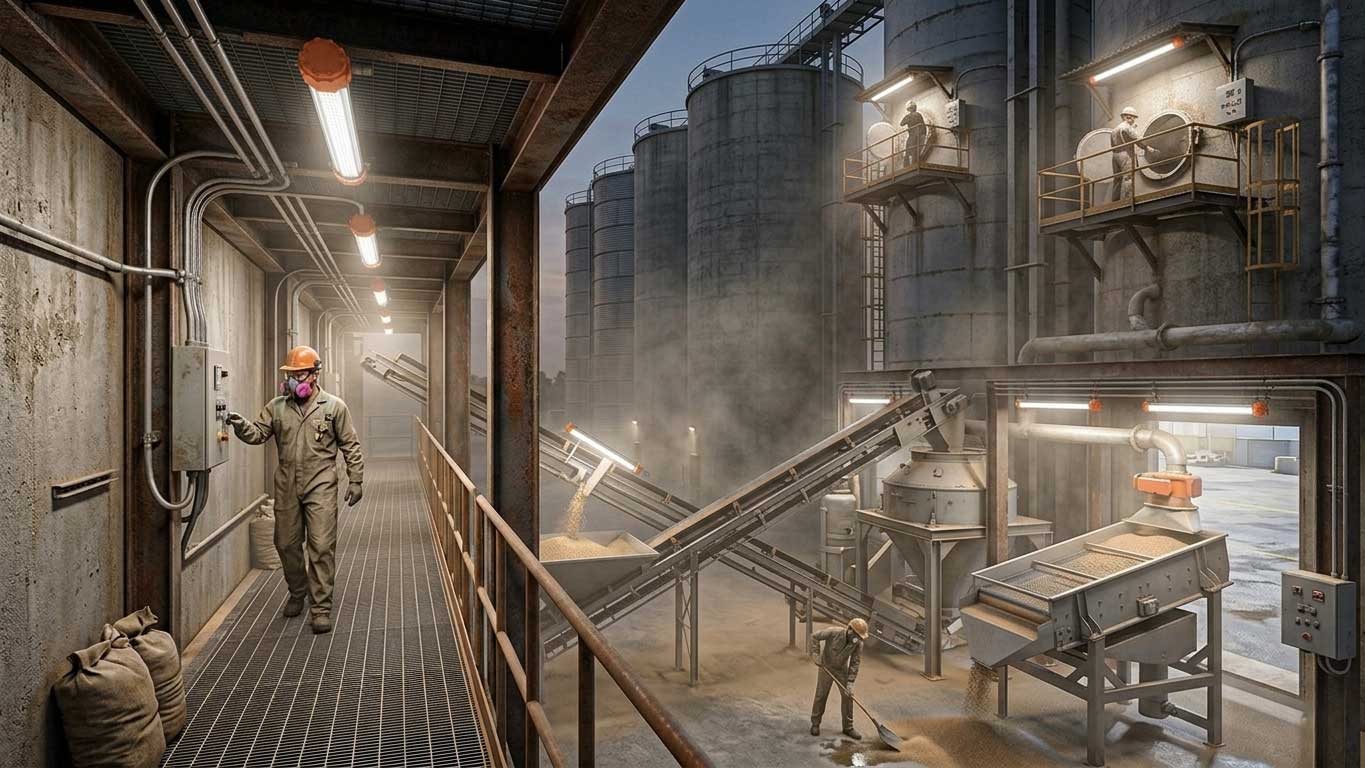
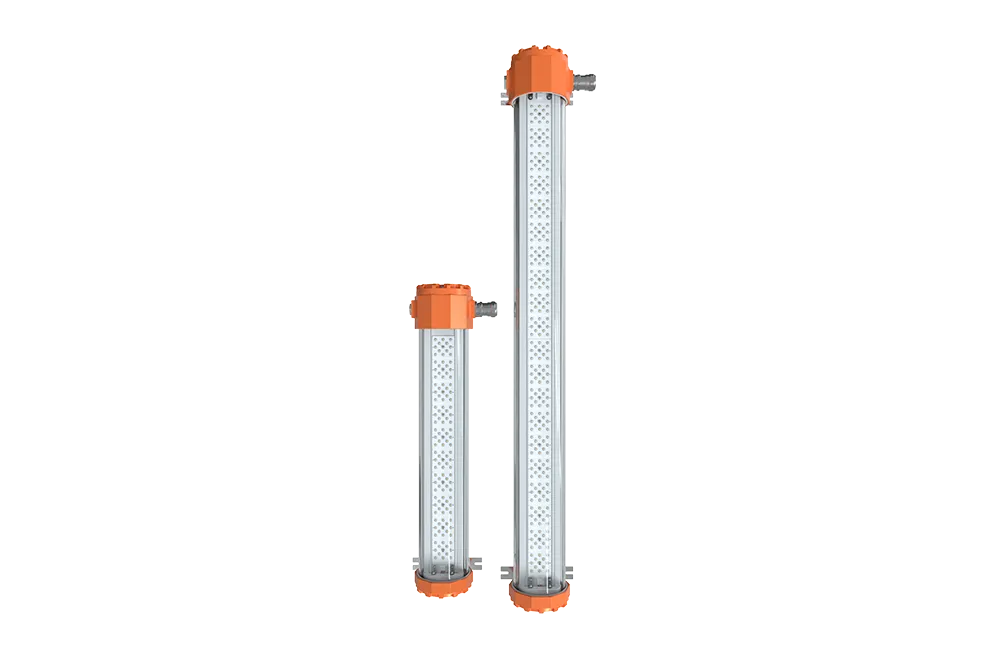
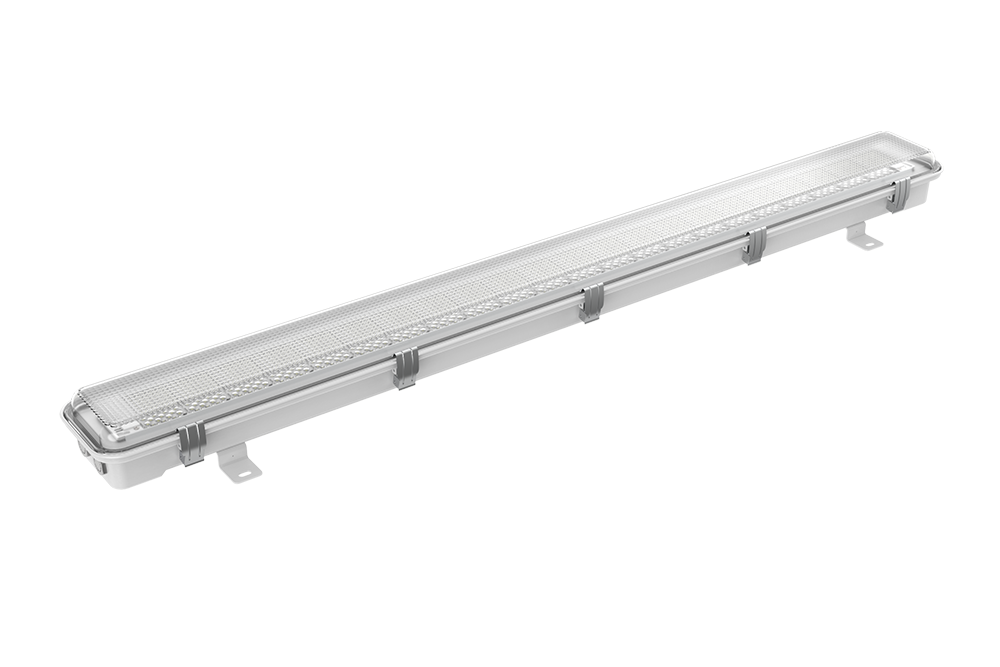
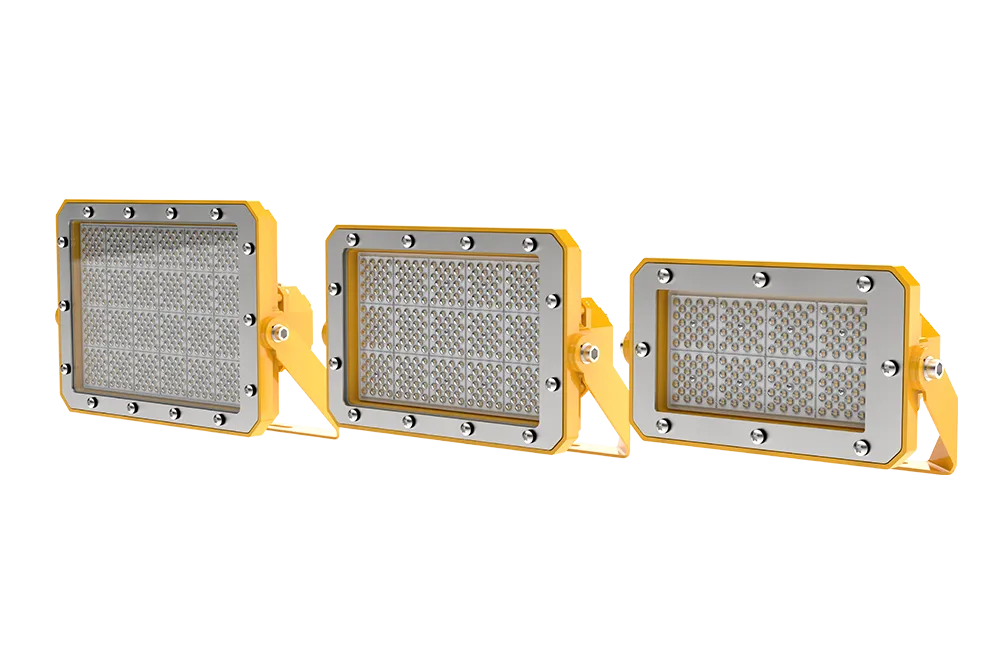
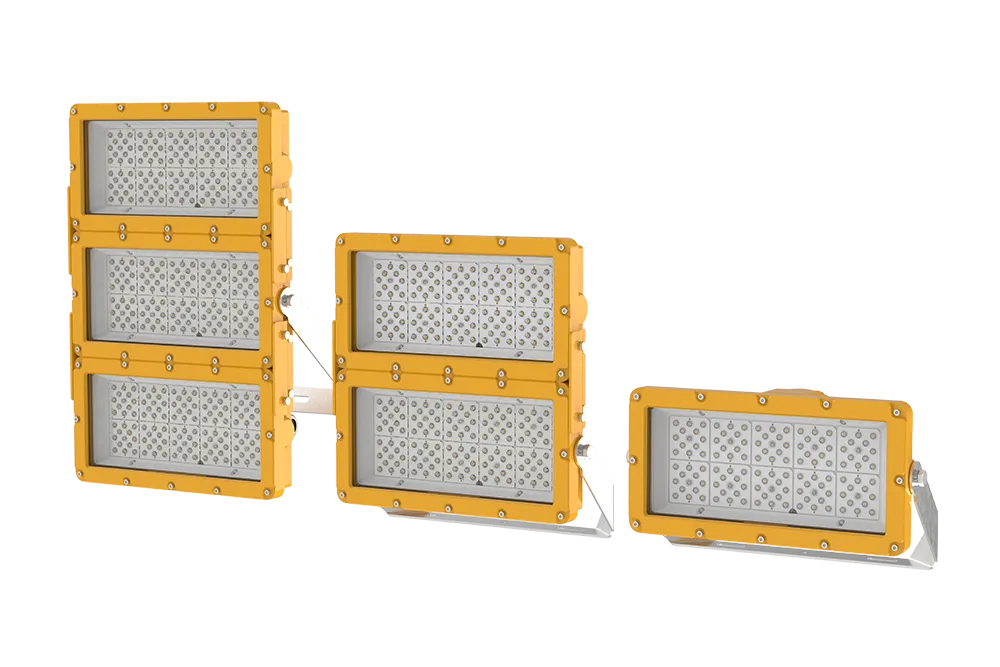
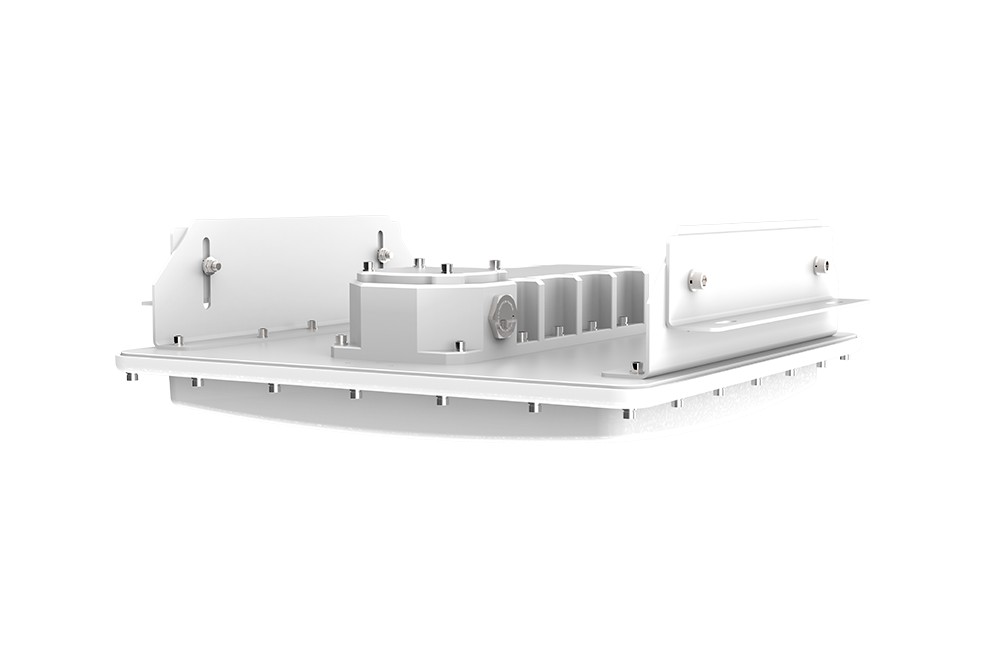
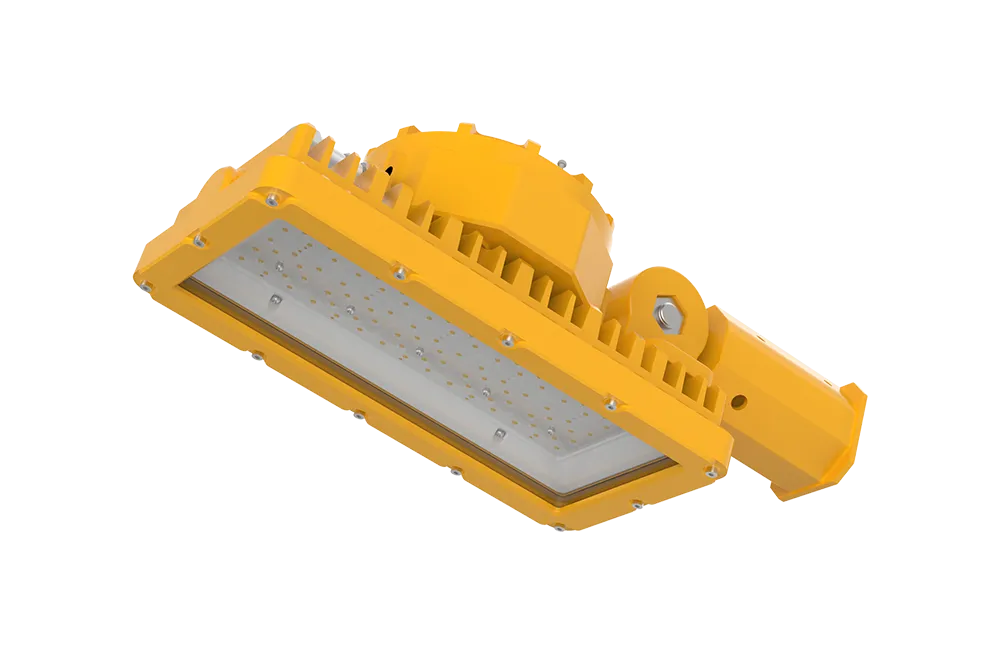
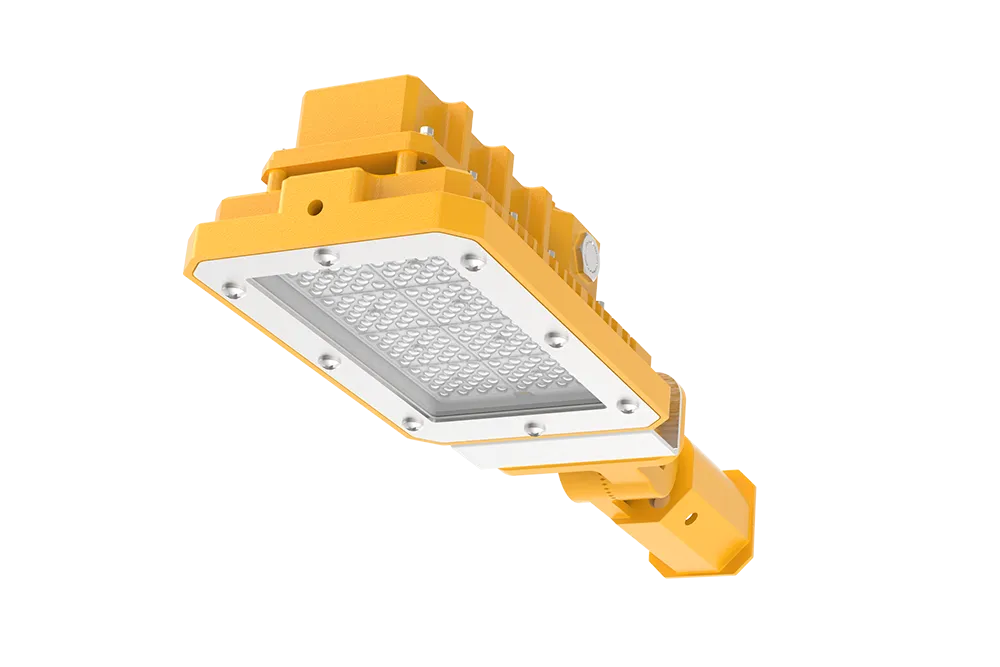
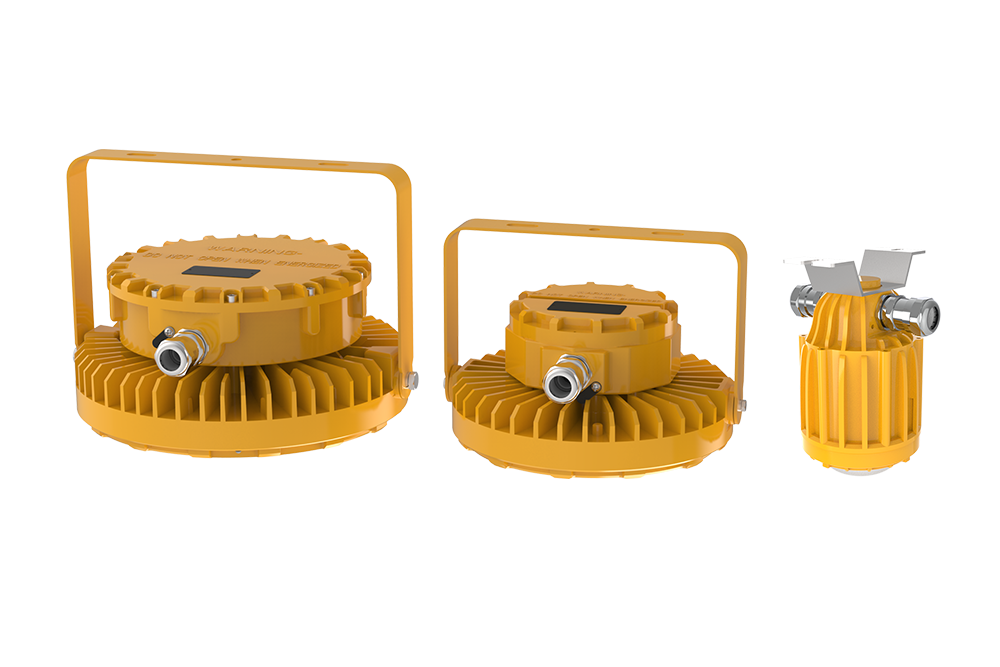
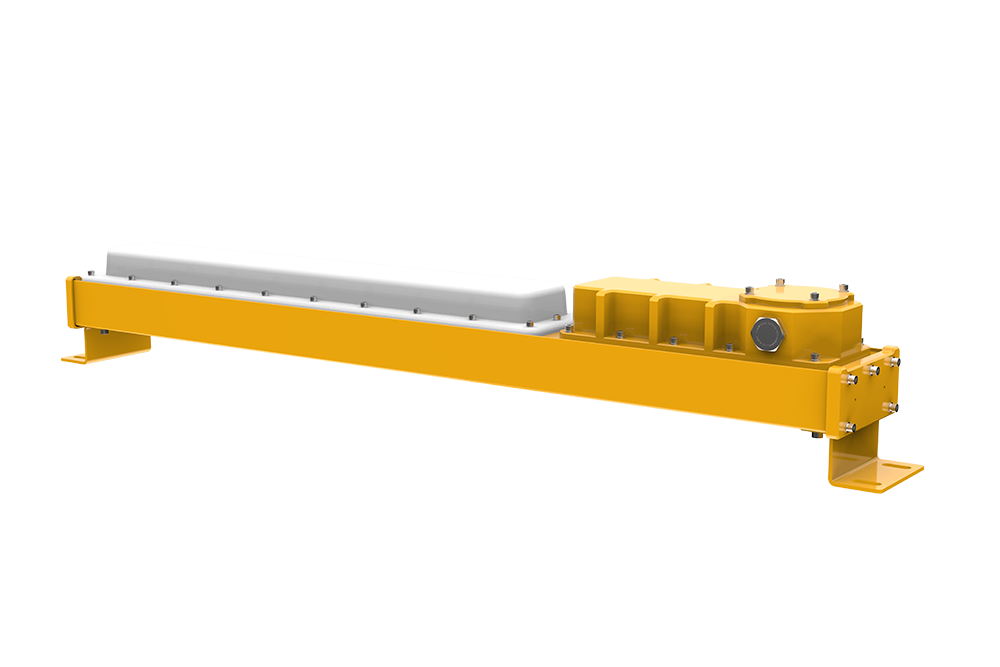
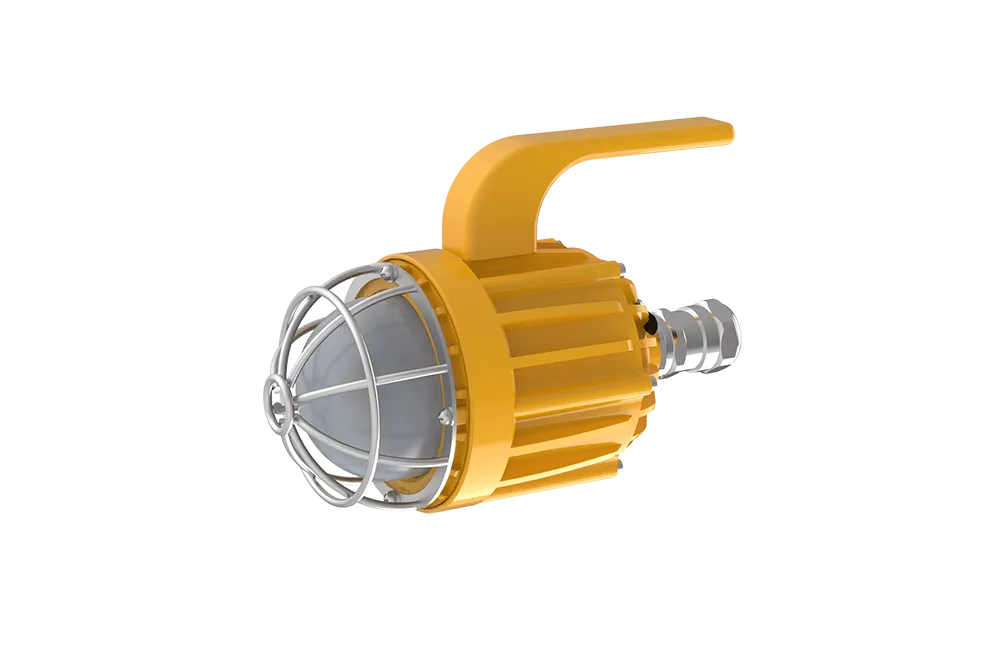
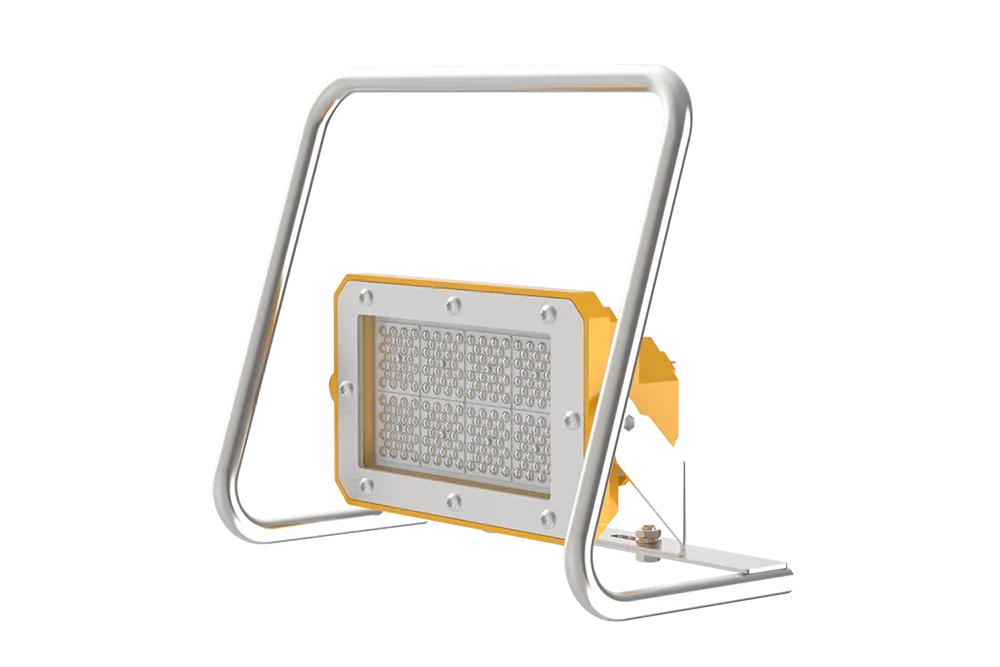
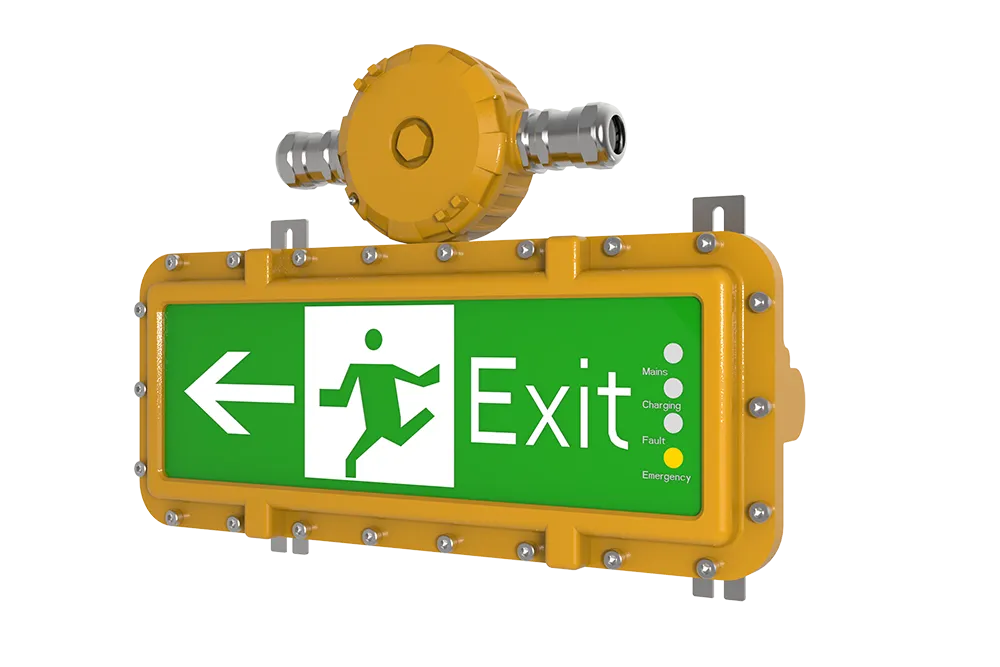
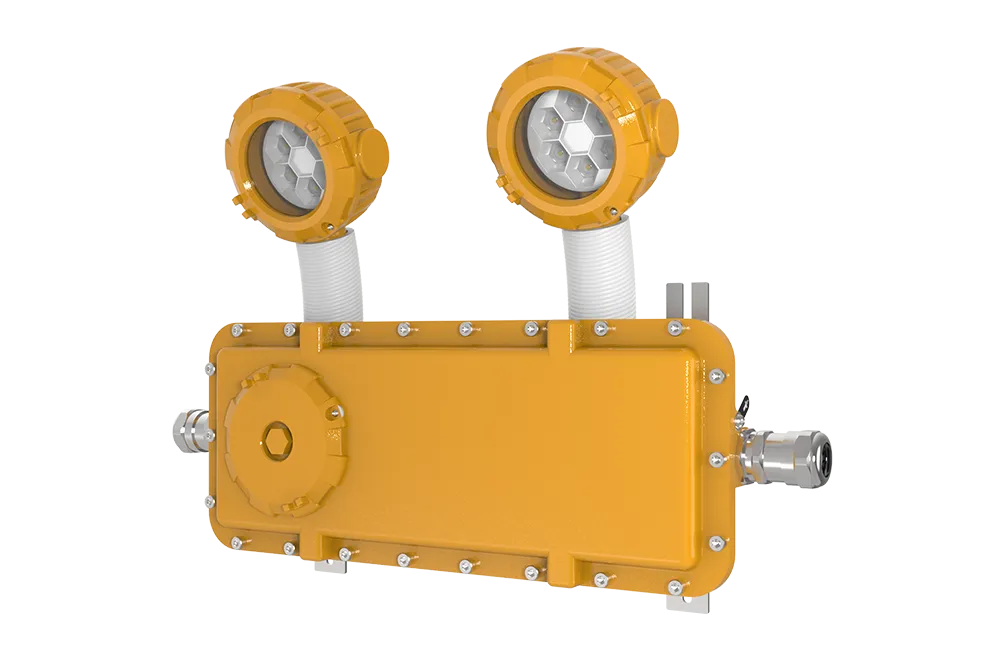
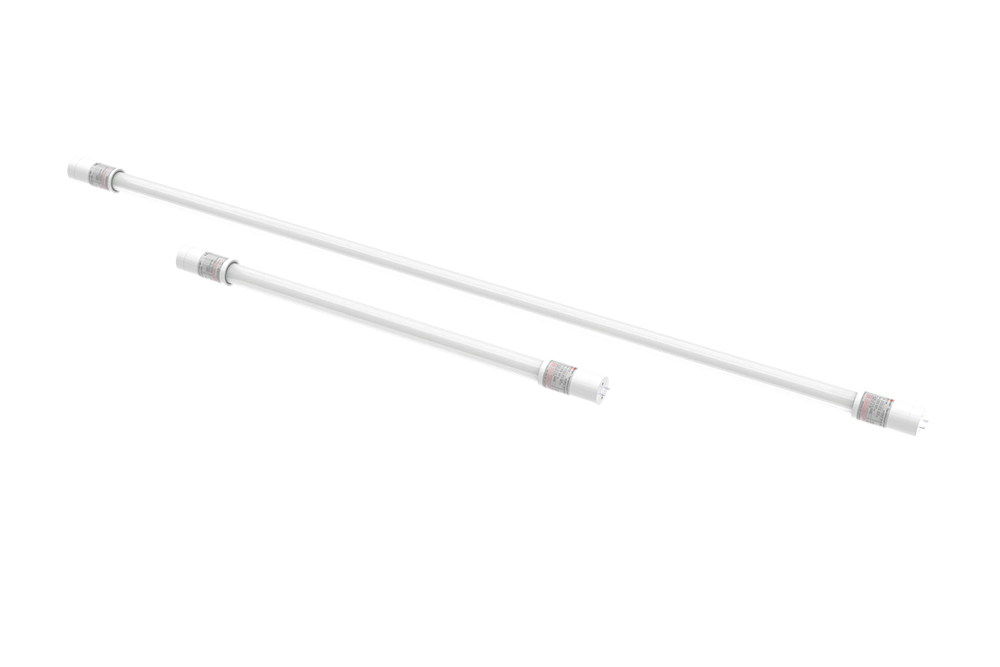
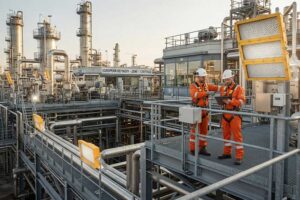
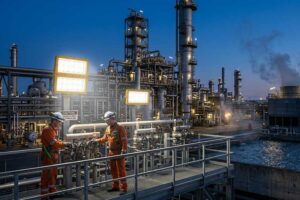
Hazardous LED lighting fixtures are specialized industrial luminaires designed for environments where flammable gases, combustible dust, or ignitable vapors may be present. They are engineered and certified to prevent the fixture from becoming an ignition source while providing reliable illumination in hazardous locations such as refineries, chemical plants, grain facilities, and fuel terminals.
A surprising number of people assume hazardous lighting is simply a tougher version of a normal industrial light.
It isn’t.
I’ve spent more than a decade working with hazardous-area lighting projects across petrochemical plants, LNG terminals, offshore platforms, and chemical manufacturing facilities. One lesson appears repeatedly: the most dangerous environments often look completely ordinary.
A fuel loading rack on a quiet afternoon doesn’t appear hazardous.
Neither does a grain conveyor.
The risk exists because of what may be present in the air, not what you can see with your eyes.
That’s why hazardous LED lighting fixtures exist.
Why Are Hazardous LED Lighting Fixtures Necessary?
The simplest answer is safety.
In hazardous locations, a small electrical spark, excessive surface temperature, or equipment failure can become an ignition source.
According to the Occupational Safety and Health Administration (OSHA), hazardous locations are areas where fire or explosion hazards may exist due to flammable gases, vapors, liquids, combustible dust, or ignitable fibers.
Ordinary lighting fixtures are not designed for these conditions.
Hazardous LED lighting fixtures are.
They incorporate specialized engineering features such as:
Sealed enclosures
Controlled surface temperatures
Corrosion-resistant housings
Certified cable entry systems
Impact-resistant construction
Hazardous-area certifications
Years ago, during an inspection at a chemical processing facility, a maintenance supervisor pointed toward a row of fixtures above a solvent storage area.
“They’ve been there for almost eight years,” he said.
That comment stayed with me.
Not because eight years is unusual.
Because nobody had talked about brightness, wattage, or color temperature.
They talked about reliability.
In hazardous environments, reliability becomes a safety feature.
What Makes a Hazardous LED Lighting Fixture Different?
Many industrial fixtures are durable.
Hazardous fixtures go beyond durability.
The goal isn’t simply surviving the environment.
The goal is ensuring the fixture never contributes to an ignition event.
That changes the entire design philosophy.
Typical design features include:
Feature
Purpose
Explosion-resistant housing
Contains internal faults
Thermal management system
Controls surface temperature
Sealed construction
Prevents contaminant intrusion
Corrosion-resistant materials
Extends service life
Certified components
Meets hazardous-area requirements
One of the biggest misconceptions I encounter is that an IP66 or IP67 fixture automatically qualifies for hazardous locations.
It doesn’t.
Waterproofing and hazardous-area certification solve different problems.
A fixture can be completely waterproof and still be unsuitable for a hazardous location.
Where Are Hazardous LED Lighting Fixtures Used?
The answer is broader than many people expect.
Oil and Gas Facilities
Oil and gas operations remain one of the largest users of hazardous-area lighting.
Typical applications include:
Refineries
Tank farms
Loading terminals
Offshore platforms
Compressor stations
On offshore projects, corrosion often becomes as important as certification.
Salt air has a remarkable ability to expose weaknesses.
Not immediately.
Over time.
Chemical Manufacturing Plants
Chemical facilities create a unique combination of challenges:
Corrosive vapors
Temperature fluctuations
Moisture exposure
Hazardous gases
I once inspected a facility where the LED chips remained functional while the housing hardware had already started deteriorating.
That project reinforced an important lesson.
The light source is only one part of the fixture.
Long-term reliability depends on the entire system.
Grain and Food Processing Facilities
Combustible dust hazards are frequently underestimated.
According to the U.S. Chemical Safety Board (CSB), combustible dust incidents have caused numerous industrial explosions across manufacturing and processing industries.
Suspended in the air, it behaves very differently.
Why Has LED Technology Become the Preferred Choice?
Ten years ago, many hazardous locations still relied heavily on metal halide or high-pressure sodium lighting.
Today, LED technology dominates most new installations.
There are practical reasons.
According to the U.S. Department of Energy, LED lighting can reduce energy consumption significantly compared with traditional lighting technologies while offering longer service life.
But in my experience, maintenance reduction is often the bigger advantage.
Replacing a fixture mounted 12 meters above a refinery process unit isn’t a simple task.
Reducing replacement frequency matters.
A lot.
What Certifications Should Buyers Look For?
Certification requirements vary by region and industry.
Common certifications include:
Certification
Region
UL844
North America
Class I Division 1
North America
Class I Division 2
North America
ATEX
European Union
IECEx
International Markets
One piece of advice I frequently give buyers:
Don’t just ask whether a fixture is certified.
Ask for the certification documentation.
There is a difference.
How Do Experienced Engineers Evaluate Hazardous Lighting?
Interestingly, most experienced engineers don’t start with lumen output.
Their questions usually sound different.
How does the fixture manage heat?
What housing materials are used?
How does it perform in corrosive environments?
What driver protection is included?
What certifications apply?
Brightness matters.
Reliability matters more.
The longer I work in industrial lighting, the more obvious that becomes.
FAQ:What Are Hazardous LED Lighting Fixtures?
Are hazardous LED lighting fixtures explosion proof?
Many hazardous LED lighting fixtures are available in explosion-proof configurations depending on the required hazardous-area classification.
Can hazardous LED lighting fixtures be used outdoors?
Yes. Many hazardous fixtures are specifically designed for outdoor environments such as refineries, offshore platforms, and fuel terminals.
What industries commonly use hazardous LED lighting fixtures?
Oil and gas, chemical processing, mining, marine operations, grain handling, and food manufacturing are among the most common industries.
How long do hazardous LED lighting fixtures last?
High-quality industrial fixtures often achieve operating lifespans between 50,000 and 100,000 hours depending on operating conditions.
Are hazardous LED lighting fixtures energy efficient?
Yes. LED technology typically consumes significantly less energy than traditional HID lighting while providing longer service life and reduced maintenance requirements.
Final Thoughts
So, what are hazardous LED lighting fixtures?
They are far more than industrial lights with stronger housings.
They are purpose-built safety devices engineered for environments where equipment failure carries consequences beyond simple downtime.
The best hazardous LED lighting fixtures rarely attract attention.
They simply continue operating year after year above pipelines, storage tanks, processing units, and hazardous work areas.
In facilities where safety and reliability are inseparable, that’s exactly what operators expect from hazardous LED lighting fixtures.
SEEKINGLED LED Linear Explosion Proof Light and Explosion Proof lighting is ATEX and IECEx certified for Zone 1, Zone 2, Zone 21 and Zone 22 hazardous locations, built for long-term industrial use.
LED Linear Explosion Proof Lights and EX Proof lights for Zone 1, Zone 2, Zone 21 and Zone 22 hazardous areas. ATEX & IECEx certified explosion proof LED linear lighting with emergency function, adjustable power and IP67 protection by SEEKINGLED.
SEEKINGLED LED Explosion Proof Flood Lights are ATEX certified for Zone 2 and Zone 22 hazardous areas, offering high efficiency, adjustable power and integrated junction box.
SEEKINGLED LED Explosion Proof Flood Lights are flameproof ATEX and IECEx certified for Zone 1 and Zone 2 hazardous areas, offering high power, adjustable output and long service life.
SEEKINGLED LED Gas Station Canopy Lights are ATEX certified for Zone 2 and Zone 22 hazardous areas, featuring adjustable power and built-in explosion-proof junction box.
ATEX: Ex II 2G Ex db IIB T6/T5 GbEx II 2D Ex tb IIIC T80°C/ T95°C Db IECEx Ex db IIB T6 Gb;Ex tb IIIC T80°C Db Feature: ● For Zone 1,2 and Zone 21,22● Flameproof type, the strongest● 100W can replace 250W HID,energy saving● Power:60W,80W,100W Application: Oil and gas, marine, Chemical, pharmaceutical, semiconductor,mining,military industr…
ATEX: II 3G Ex nR ⅡC T5/T6 GcII 3D Ex tc ⅢC T80℃/T95℃Dc ATEX Certificate NO: TÜV CY 26 ATEX 0207611 X Feature: ● For Zone 2 and Zone 22● 150W can replace 250W HID lamps,Energy saving● Power:50W,75W,100W,150W,200W Application: Oil and gas, marine, Chemical, pharmaceutical, semiconductor,mining,military industry, paint booth,power plant ETC…
LED explosion proof high bay lights are designed for Zone 1, Zone 2, Zone 21 and Zone 22 hazardous areas. This page introduces the HB21 Series from SEEKING, including certifications, power options and real application considerations.
LED Linear Explosion Proof Lights from SEEKINGLED. LU Series Flame Proof lights ATEX-certified explosion proof LED linear lighting for Zone 2 gas and Zone 22 dust areas, IP69K, IK10, long lifetime and flexible power options.
Certified explosion proof work lights for Zone 1 & 21 hazardous areas. Portable, ATEX & IECEx approved, built for oil, gas and chemical plants by SEEKINGLED.
ATEX: II 3G Ex nR ⅡC T6 GcII 3D Ex tc ⅢC T80℃ Dc ATEX Certificate NO: TÜV CY 26 ATEX 0207611 X Feature: ● For Zone 2 and Zone 22● Accepts battery-powered supply● indestructible● Power:AC input:50W,75W,100WDC input:15W,25W,35W Application: Oil and gas, marine, Chemical, pharmaceutical, semiconductor,mining,military industry, paint booth,po…
ATEX: Ex II 2G Ex db IIB T6 GbEx II 2D Ex tb IIIC T80°C Db IECEx Ex db IIB T6 Gb;Ex tb IIIC T80°C Db Feature: ● For Zone 1,2 and Zone 21,22● Flameproof type, the strongest Application: Oil and gas, marine, Chemical, pharmaceutical, semiconductor,mining,military industry, paint booth,power plant ETC hazardous area. Technical Specifications:…
ATEX: Ex II 2G Ex db IIB T6 GbEx II 2D Ex tb IIIC T80°C Db IECEx Ex db IIB T6 Gb;Ex tb IIIC T80°C Db Feature: ● For Zone 1,2 and Zone 21,22● Flameproof type, the strongest Application: Oil and gas, marine, Chemical, pharmaceutical, semiconductor,mining,military industry, paint booth,power plant ETC hazardous area. Technical Specifications:…
ATEX: Ex II 2G Ex d e IIB T6 Gb ATEX: Ex d e IIB T6 Gb; Feature: ● For Zone 1,2● 9W can replace 18W fluorescent lamps,50% Energy saving Application: Oil and gas, marine, Chemical, pharmaceutical, semiconductor,mining,military industry, paint booth,power plant ETC hazardous area. Technical Specifications: Standards:60079-0, 60079-1, 60079…
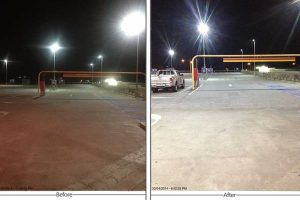
LED Flood Lighting for Parking Lot Safety was implemented in an Australian parking lot after on-site sample testing. This project record documents the replacement of metal halide lamps with XJ-FL100W flood lights.
Learn professional atex lights installation methods for hazardous areas. Explore safety requirements, certification considerations, and expert guidance from SEEKINGLED.
Hazardous area lighting fixtures provide certified protection in explosive environments. Learn how to select, install, and maintain ATEX and LED fixtures safely.
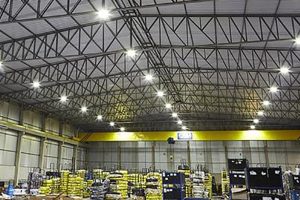
In 2024, a European warehouse installed 120 pcs of SEEKING XJ-HBF200W LED High Bay Light, reaching 200 lm/W, 300+ LUX average illuminance and over 0.7 uniformity, cutting energy use compared to traditional metal halide high bays.
 Seeking LED