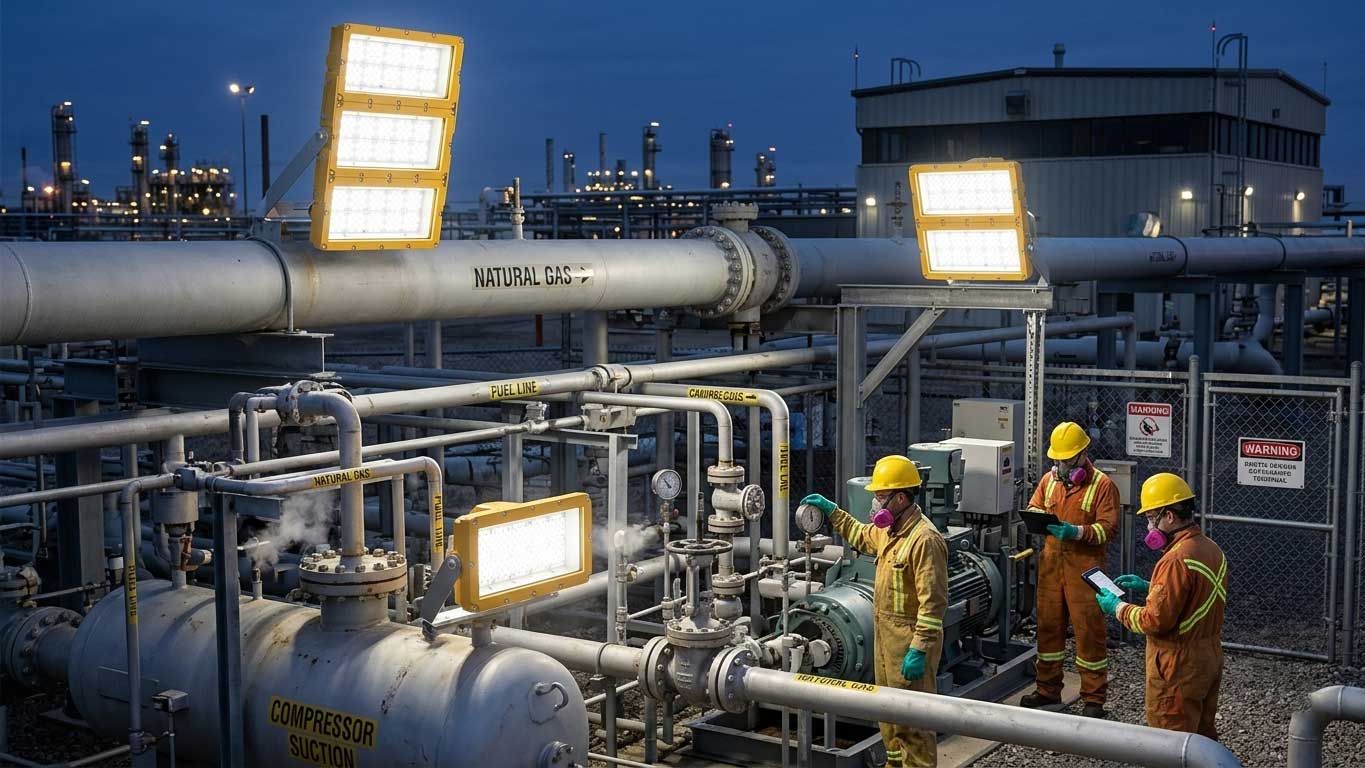
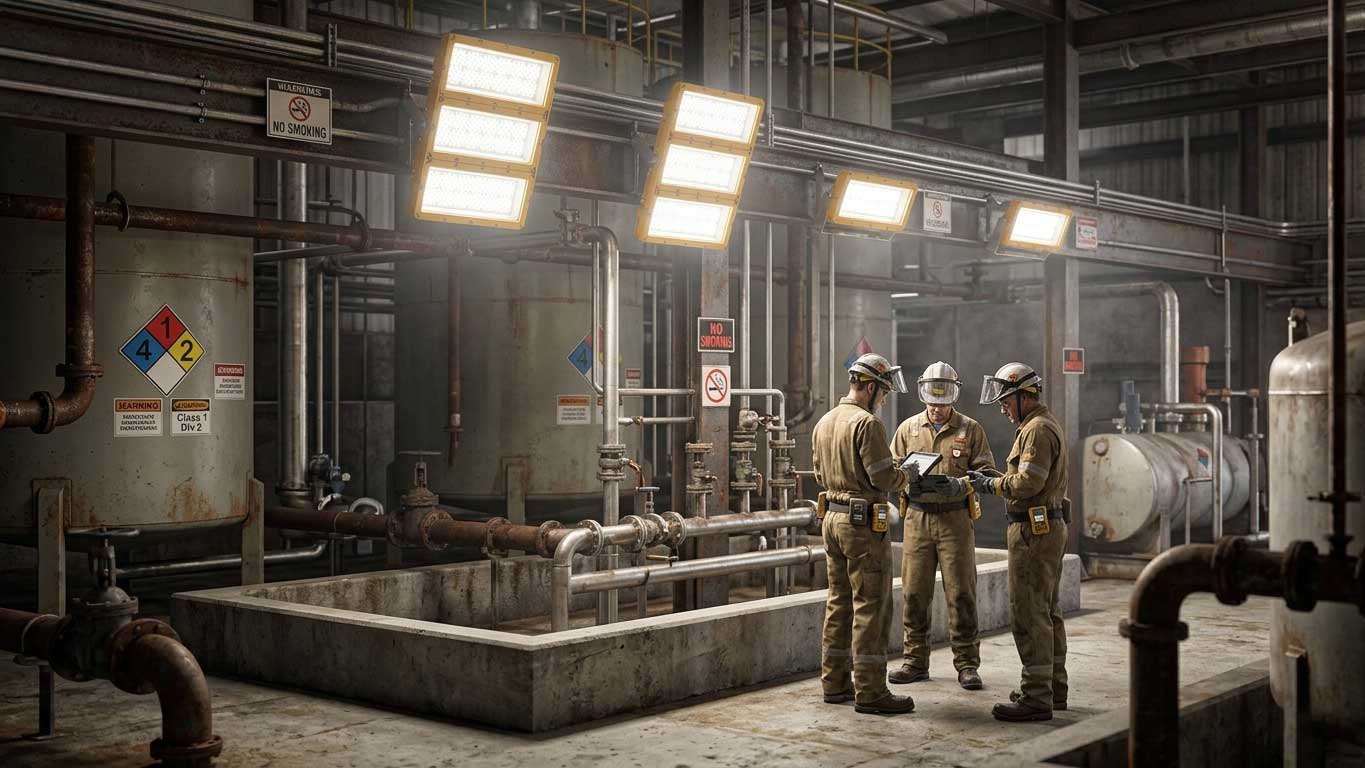
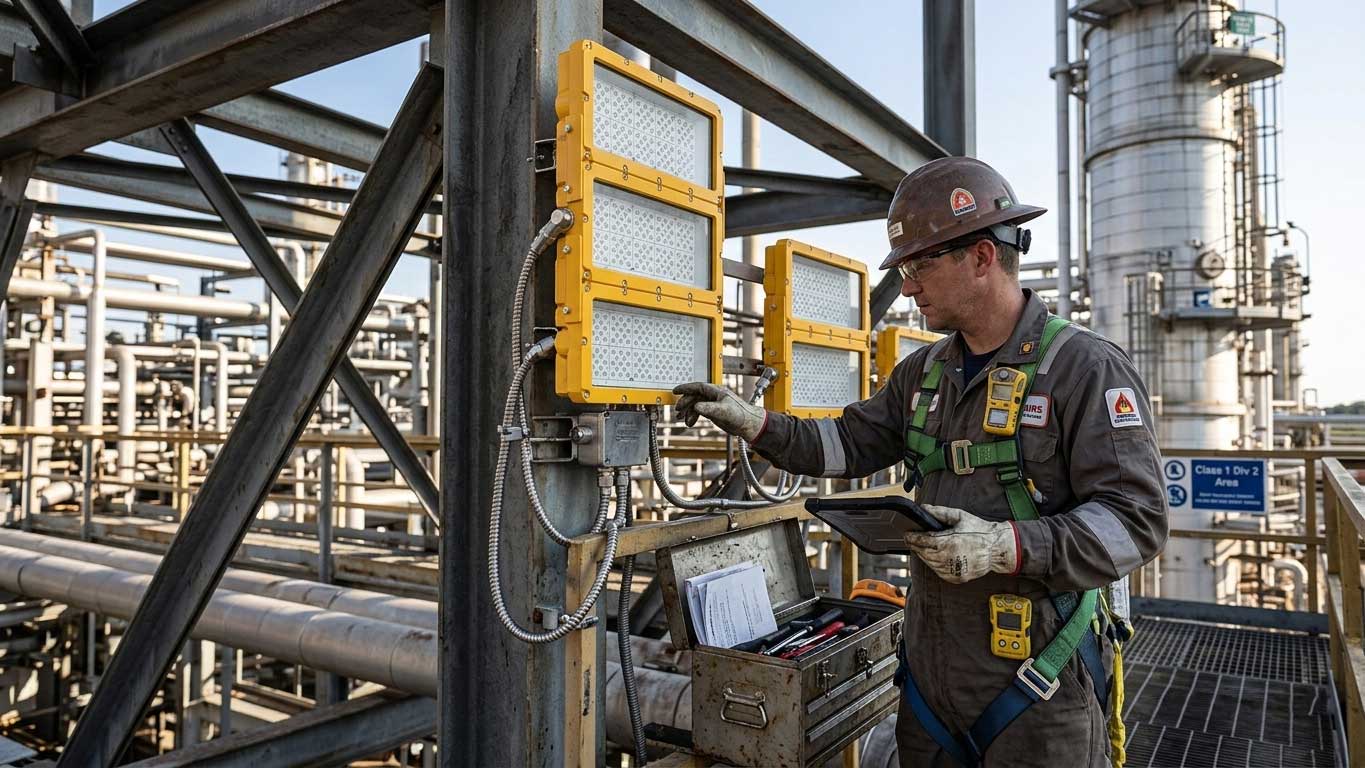
Class 1 Div 2 LED lighting is hazardous-location lighting certified for environments where flammable gases or vapors are not normally present during routine operation but may appear under abnormal conditions such as leaks, equipment failure, or system malfunction.
That distinction sounds subtle at first. On industrial sites, though, it changes how facilities design entire electrical systems.
I first noticed this during a pipeline terminal retrofit where two neighboring process areas used completely different lighting specifications. One required Class 1 Div 1 fixtures. The other used Class 1 Div 2 LED lighting because explosive vapors would only exist if containment systems failed.
The equipment looked similar from a distance. The engineering philosophy behind them was not.
Understanding the meaning of Class 1 Div 2
The Class/Division system comes from the National Electrical Code (NEC) used in North America.
Class 1
Refers to environments containing flammable gases or vapors.
Common examples include:
Propane
Methane
Hydrogen
Gasoline vapor
Solvent fumes
Division 2
Means hazardous gases are not normally present during regular operating conditions but could appear accidentally.
That usually includes:
Equipment leaks
Abnormal ventilation failure
Seal breakdown
Pipe rupture
Valve malfunction
According to OSHA, hazardous locations are classified based on the probability and concentration of flammable substances present within the environment.
This classification system helps engineers select lighting that matches actual risk levels instead of overspending or under-protecting facilities.
Why Class 1 Div 2 LED lighting is widely used
Not every industrial environment requires full Division 1 protection.
Many facilities contain hazardous materials only during unusual operating conditions.
That makes Class 1 Div 2 LED lighting extremely common in:
Oil terminals
Gas compressor stations
Chemical storage areas
Pipeline monitoring stations
Fuel loading facilities
Wastewater treatment plants
One refinery maintenance supervisor once described Division 2 areas to me like this:
“Most days, nothing dangerous is in the air. But if something fails, the lighting still cannot become the problem.”
That explanation has always felt accurate.
Difference between Div 1 and Div 2 lighting
This is one of the most misunderstood topics in hazardous-area lighting.
Quick comparison
Classification
Hazard Presence
Class 1 Div 1
Hazard exists during normal operation
Class 1 Div 2
Hazard exists only during abnormal conditions
Division 1 fixtures generally require:
Heavier enclosures
More robust flame containment
Higher protection standards
Stricter sealing systems
Division 2 fixtures still require hazardous-location certification, but the expected exposure frequency is lower.
That distinction affects:
Fixture design
Installation cost
Maintenance planning
Electrical infrastructure
Using Div 2 lighting inside Div 1 areas violates safety compliance and creates unnecessary ignition risks.
How Class 1 Div 2 LED lighting works
Class 1 Div 2 fixtures are engineered to reduce the possibility of ignition under abnormal conditions.
Depending on design type, protection methods may include:
Sealed electrical compartments
Controlled operating temperatures
Non-sparking components
Reinforced wiring systems
Vapor-resistant enclosures
Unlike ordinary industrial fixtures, these systems are tested specifically for hazardous environments.
Real hazardous-location engineering focuses heavily on containment and temperature control.
I’ve opened low-cost imported “hazardous-style” fixtures before and found ordinary commercial drivers inside with minimal sealing protection. From the outside, they looked convincing. Internally, they absolutely were not.
That gap between appearance and certification matters enormously.
Where Class 1 Div 2 LED lighting is commonly installed
Oil and gas facilities
This remains the largest application sector.
Typical installation points include:
Pump stations
Pipe rack corridors
Fuel transfer zones
Gas metering stations
Loading terminals
Compressor buildings
These areas may only become hazardous if leakage or abnormal operation occurs.
Wastewater treatment plants
Many people overlook wastewater facilities when discussing hazardous environments.
But methane and hydrogen sulfide gases are common byproducts in treatment systems.
Class 1 Div 2 LED lighting is frequently installed around:
Digester tanks
Sludge processing systems
Pump rooms
Gas recovery areas
One wastewater engineer once described methane buildup as “invisible until instrumentation reminds you otherwise.”
That comment stuck with me.
Chemical storage facilities
Storage areas containing solvents or volatile chemicals often use Division 2 classifications because vapors are normally sealed within containment systems.
However, abnormal leaks can still create dangerous conditions.
That’s exactly why Class 1 Div 2 lighting exists.
Why LED technology improved Division 2 lighting
Older hazardous-location facilities relied heavily on:
Metal halide fixtures
Fluorescent hazardous lighting
High-pressure sodium lamps
Those systems produced:
More heat
Higher maintenance costs
Shorter lifespan
Increased energy consumption
LED technology improved hazardous-area lighting significantly.
According to the U.S. Department of Energy, LED lighting systems can reduce industrial energy consumption by approximately 50–70% compared with traditional HID technologies.
In large industrial facilities operating hundreds of fixtures continuously, those savings become operationally important surprisingly fast.
I’ve seen LED conversions reduce enough electrical demand that older facilities postponed infrastructure upgrades for several years.
That operational impact rarely appears in specification sheets.
Temperature ratings still matter
Brightness alone does not determine safety.
Hazardous-location fixtures must also control maximum surface temperature.
Common T-ratings
Temperature Rating
Maximum Surface Temperature
T1
450°C
T2
300°C
T3
200°C
T4
135°C
T5
100°C
T6
85°C
Certain gases ignite at relatively low temperatures.
That means even a fully operational fixture may become hazardous if thermal management fails.
Many oil and gas operators now prefer T4-rated Class 1 Div 2 LED lighting for additional safety margins.
Maintenance mistakes that compromise Division 2 protection
This topic rarely gets enough attention.
Class 1 Div 2 fixtures can lose compliance after improper maintenance.
Common problems include:
Replacing certified cable glands
Damaging enclosure seals
Installing incorrect fasteners
Using incompatible drivers
Opening energized fixtures
Ignoring corrosion near entry points
I once saw contractors repaint enclosure joints heavily during a coastal maintenance shutdown. The fixtures looked newer afterward, but the sealing performance around several joints became questionable.
In hazardous environments, cosmetic improvements can accidentally create technical problems.
Class 1 Div 2 vs ordinary industrial lighting
Feature
Class 1 Div 2 LED Lighting
Standard Industrial Lighting
Hazardous Gas Certification
Yes
No
Controlled Surface Temperature
Yes
Limited
Vapor Protection
Yes
Minimal
Certified Testing
Mandatory
Optional
Ignition Risk Reduction
Engineered
Not designed for hazardous areas
From outside the fixture, differences may appear small.
Internally, the engineering standards are completely different.
FAQ:What is Class 1 Div 2 LED lighting?
What is Class 1 Div 2 LED lighting used for?
Class 1 Div 2 LED lighting is used in hazardous industrial environments where flammable gases or vapors are only present under abnormal operating conditions, such as oil terminals, chemical plants, and wastewater facilities.
Is Class 1 Div 2 lighting explosion proof?
Some Class 1 Div 2 fixtures use explosion-proof designs, while others rely on alternative protection methods approved for Division 2 environments.
Can Div 2 lighting be used in Div 1 areas?
No. Division 2 fixtures are not certified for environments where explosive gases are continuously present during normal operation.
Why are LED fixtures preferred in Division 2 areas?
LED technology offers lower operating temperatures, reduced maintenance, longer lifespan, and significantly lower energy consumption compared with older HID systems.
Final thoughts from real industrial environments
After enough time around hazardous industrial facilities, one reality becomes obvious: dangerous environments rarely announce themselves dramatically.
Most of the time, operations appear normal.
Pipelines stay pressurized. Valves remain sealed. Ventilation systems work quietly in the background.
But hazardous-location engineering exists for the moments when something stops working the way it should.
That’s the real meaning behind What is Class 1 Div 2 LED lighting.
It’s lighting engineered not for routine conditions alone, but for abnormal situations where failure cannot safely become ignition.
SEEKINGLED develops Class 1 Div 2 LED lighting systems for industrial operators who require certified hazardous-location protection, reliable performance, and long-term durability in demanding environments.
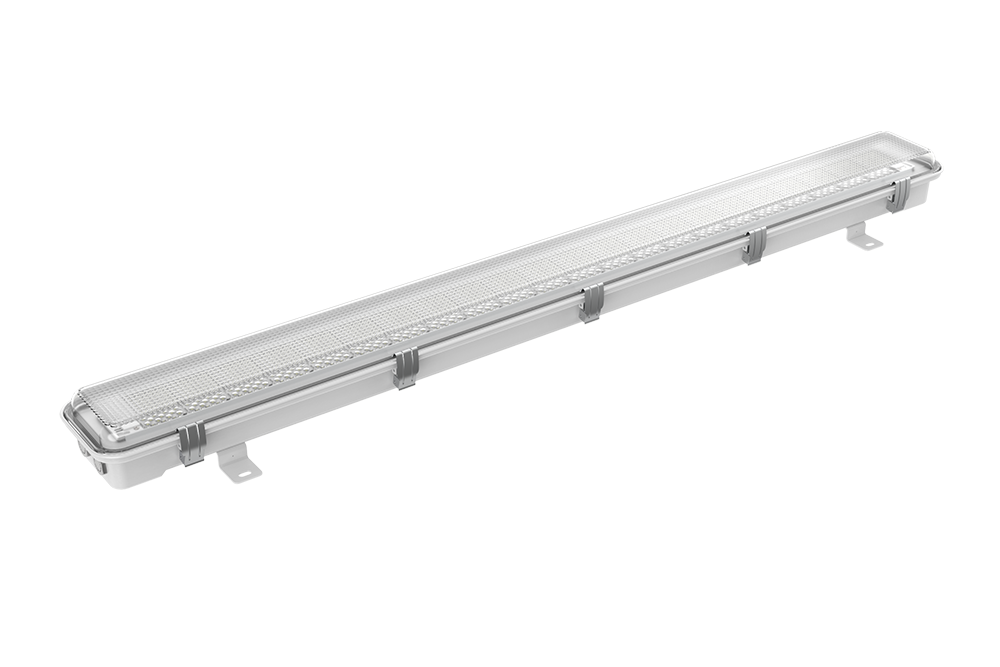
SEEKINGLED LED Linear Explosion Proof Light and Explosion Proof lighting is ATEX and IECEx certified for Zone 1, Zone 2, Zone 21 and Zone 22 hazardous locations, built for long-term industrial use.
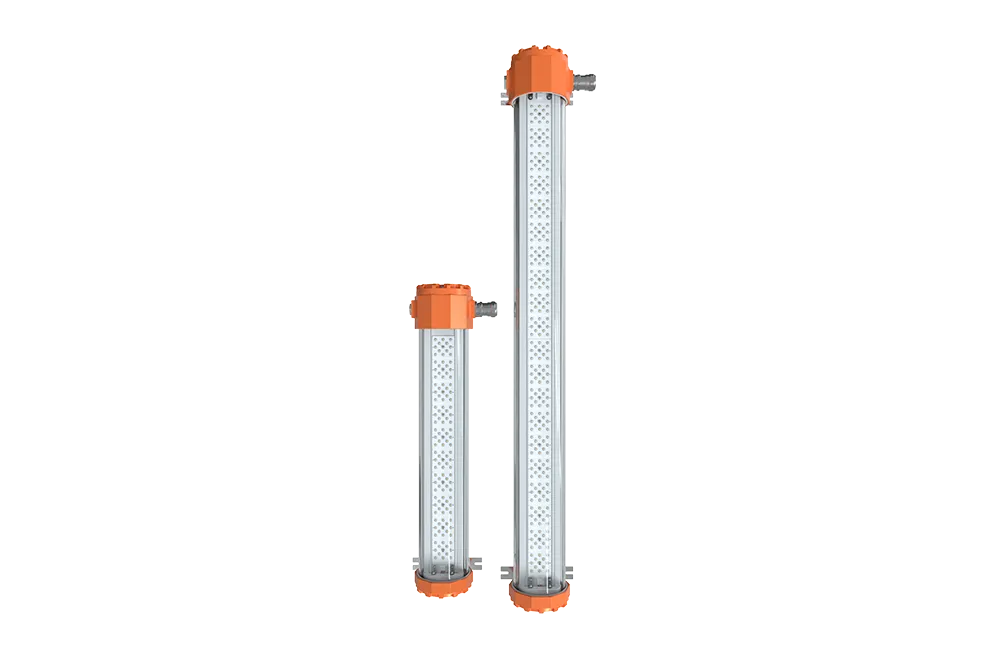
LED Linear Explosion Proof Lights and EX Proof lights for Zone 1, Zone 2, Zone 21 and Zone 22 hazardous areas. ATEX & IECEx certified explosion proof LED linear lighting with emergency function, adjustable power and IP67 protection by SEEKINGLED.
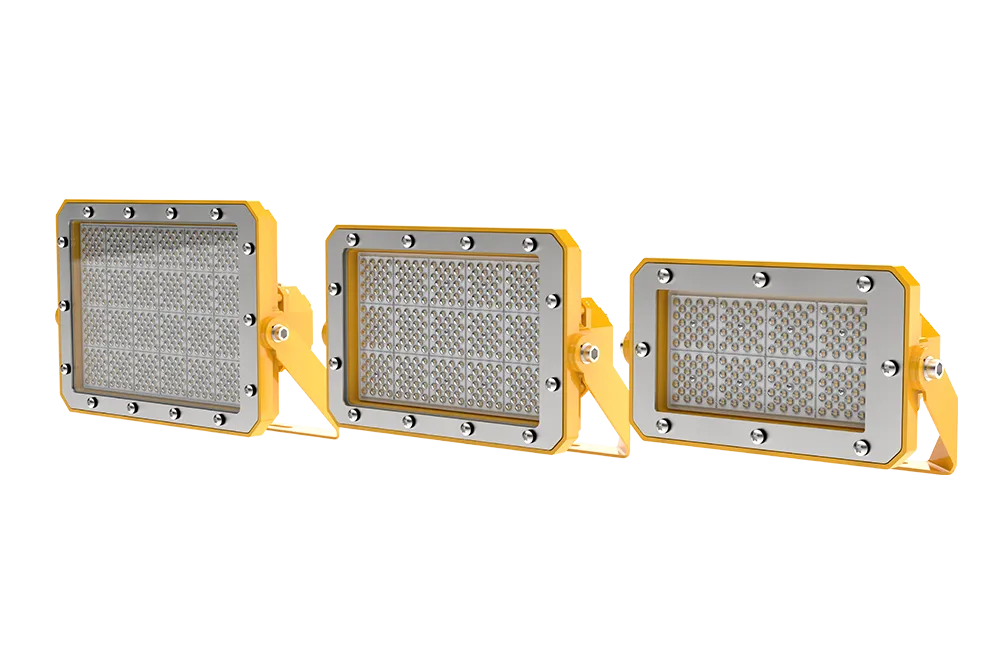
SEEKINGLED LED Explosion Proof Flood Lights are ATEX certified for Zone 2 and Zone 22 hazardous areas, offering high efficiency, adjustable power and integrated junction box.
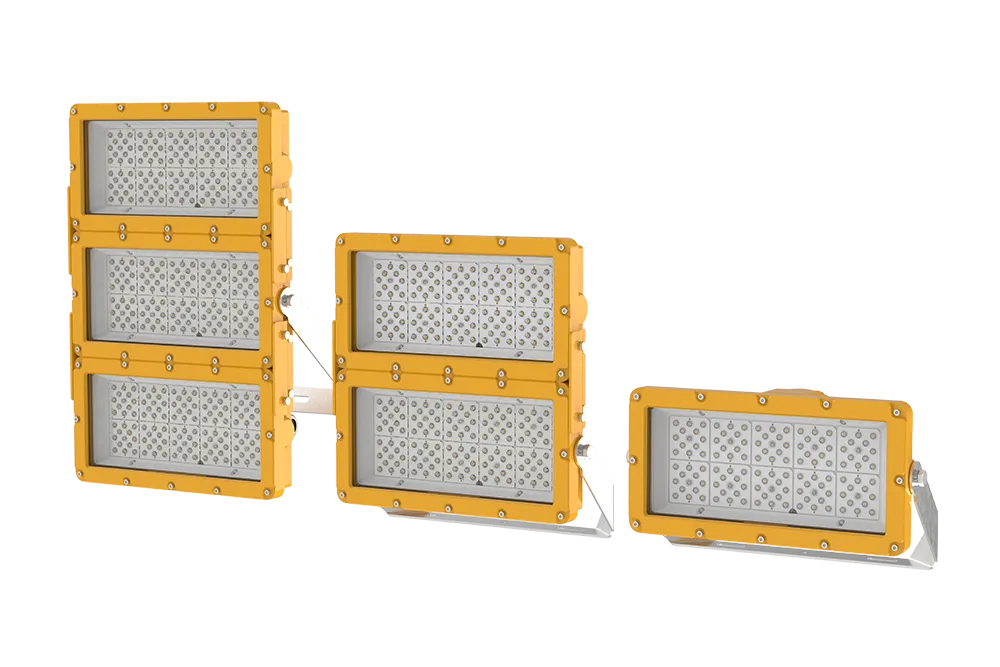
SEEKINGLED LED Explosion Proof Flood Lights are flameproof ATEX and IECEx certified for Zone 1 and Zone 2 hazardous areas, offering high power, adjustable output and long service life.
SEEKINGLED LED Gas Station Canopy Lights are ATEX certified for Zone 2 and Zone 22 hazardous areas, featuring adjustable power and built-in explosion-proof junction box.
ATEX: Ex II 2G Ex db IIB T6/T5 GbEx II 2D Ex tb IIIC T80°C/ T95°C Db IECEx Ex db IIB T6 Gb;Ex tb IIIC T80°C Db Feature: ● For Zone 1,2 and Zone 21,22● Flameproof type, the strongest● 100W can replace 250W HID,energy saving● Power:60W,80W,100W Application: Oil and gas, marine, Chemical, pharmaceutical, semiconductor,mining,military industr…
ATEX: II 3G Ex nR ⅡC T5/T6 GcII 3D Ex tc ⅢC T80℃/T95℃Dc ATEX Certificate NO: TÜV CY 26 ATEX 0207611 X Feature: ● For Zone 2 and Zone 22● 150W can replace 250W HID lamps,Energy saving● Power:50W,75W,100W,150W,200W Application: Oil and gas, marine, Chemical, pharmaceutical, semiconductor,mining,military industry, paint booth,power plant ETC…
LED explosion proof high bay lights are designed for Zone 1, Zone 2, Zone 21 and Zone 22 hazardous areas. This page introduces the HB21 Series from SEEKING, including certifications, power options and real application considerations.
LED Linear Explosion Proof Lights from SEEKINGLED. LU Series Flame Proof lights ATEX-certified explosion proof LED linear lighting for Zone 2 gas and Zone 22 dust areas, IP69K, IK10, long lifetime and flexible power options.
Certified explosion proof work lights for Zone 1 & 21 hazardous areas. Portable, ATEX & IECEx approved, built for oil, gas and chemical plants by SEEKINGLED.
ATEX: II 3G Ex nR ⅡC T6 GcII 3D Ex tc ⅢC T80℃ Dc ATEX Certificate NO: TÜV CY 26 ATEX 0207611 X Feature: ● For Zone 2 and Zone 22● Accepts battery-powered supply● indestructible● Power:AC input:50W,75W,100WDC input:15W,25W,35W Application: Oil and gas, marine, Chemical, pharmaceutical, semiconductor,mining,military industry, paint booth,po…
ATEX: Ex II 2G Ex db IIB T6 GbEx II 2D Ex tb IIIC T80°C Db IECEx Ex db IIB T6 Gb;Ex tb IIIC T80°C Db Feature: ● For Zone 1,2 and Zone 21,22● Flameproof type, the strongest Application: Oil and gas, marine, Chemical, pharmaceutical, semiconductor,mining,military industry, paint booth,power plant ETC hazardous area. Technical Specifications:…
ATEX: Ex II 2G Ex db IIB T6 GbEx II 2D Ex tb IIIC T80°C Db IECEx Ex db IIB T6 Gb;Ex tb IIIC T80°C Db Feature: ● For Zone 1,2 and Zone 21,22● Flameproof type, the strongest Application: Oil and gas, marine, Chemical, pharmaceutical, semiconductor,mining,military industry, paint booth,power plant ETC hazardous area. Technical Specifications:…
ATEX: Ex II 2G Ex d e IIB T6 Gb ATEX: Ex d e IIB T6 Gb; Feature: ● For Zone 1,2● 9W can replace 18W fluorescent lamps,50% Energy saving Application: Oil and gas, marine, Chemical, pharmaceutical, semiconductor,mining,military industry, paint booth,power plant ETC hazardous area. Technical Specifications: Standards:60079-0, 60079-1, 60079…
100W LED flood light delivers powerful, energy-efficient outdoor lighting. See real lumen output, installation tips, and expert insights to choose the right solution with SEEKINGLED.
3th-8th-March-2024 Booth NO.:10.2 A61F At Light+Building Frankfurt 2024, we unveiled our new H-Line series product. The H-Line series LED linear trunking system offers a versatile solution for various applications includin...
Can I Replace Flood Lights with LED? Learn how LED flood light replacement improves efficiency, reduces maintenance, and upgrades outdoor lighting performance.
 Seeking LED