Q: how long does led lights last?
Longer than most people think.
Shorter than what some brochures suggest.
That’s the honest middle ground.
You’ll often see numbers like 30,000, 50,000, even 100,000 hours. Those figures are based on controlled testing. Clean environments. Stable power. Ideal conditions.
Real life doesn’t look like that.
What “lifespan” actually means
Here’s something many people miss.
LED lights don’t usually fail suddenly.
They fade.
The industry standard is what’s called “L70” — the point where brightness drops to 70% of its original level.
So when asking how long does led lights last, you’re not asking when it dies.
You’re asking when it stops performing well enough.
A real example from site work
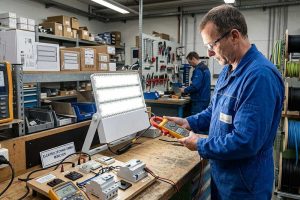
We had a warehouse retrofit a few years back. Old fixtures replaced with LED high bays. Everything looked solid during installation.
Two years later, we checked performance.
Most lights? Still strong.
A few? Noticeably dimmer.
Same model. Same install period.
The difference came down to location.
Units near the ceiling corners — poor airflow, higher heat — aged faster.
That’s when you stop trusting just the number on the datasheet.
Typical lifespan ranges (realistic, not ideal)
Let’s put it into practical terms:
- basic residential LED: 15,000–25,000 hours
- commercial-grade LED: 30,000–50,000 hours
- industrial LED systems (like SEEKINGLED): 50,000+ hours
But those numbers only hold if conditions are reasonable.
Push the environment too hard, and lifespan drops.
What actually shortens LED life
This matters more than the rated hours.
Heat
This is the biggest factor. Always.
LEDs generate heat. If it’s not dissipated properly, components degrade faster.
I’ve seen perfectly good fixtures fail early just because heat had nowhere to go.
Driver quality
Most failures don’t come from the LED chips.
They come from the driver.
Cheap drivers struggle with voltage fluctuations. Over time, output becomes unstable—or stops completely.
Operating time
Running lights 24/7 is different from using them 8 hours a day.
A 50,000-hour rating sounds long.
At continuous use, that’s under 6 years.
Usage patterns matter more than people expect.
Environment
Dust. Moisture. Vibration.
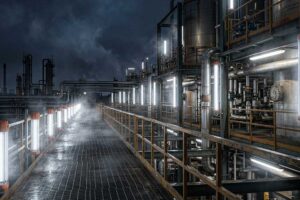
Industrial environments are not gentle.
Dust blocks heat sinks. Moisture affects electronics. Vibration loosens connections.
Each one chips away at lifespan.
LED vs traditional lighting
This part is clear.
According to the U.S. Department of Energy, LED lighting significantly outlasts traditional sources.
Typical comparison:
- incandescent: ~1,000 hours
- halogen: ~2,000–4,000 hours
- fluorescent: ~10,000–20,000 hours
- LED: 25,000–100,000 hours
That’s not a small difference.
It’s why most industrial and commercial projects have already shifted to LED.
When lifespan claims don’t match reality
It happens more often than it should.
You install LED lighting expecting long life… and it fails early.
Usually, the problem isn’t LED technology itself.
It’s:
- poor thermal design
- low-quality driver
- unstable power conditions
I’ve seen all three. Sometimes in the same project.
How to make LED lights last longer
Nothing complicated here. Just decisions that matter.
- choose fixtures with proper heat dissipation
- avoid enclosed, poorly ventilated spaces
- use reliable drivers
- match the product to the environment
Simple, but often overlooked.
Where SEEKINGLED comes in
At SEEKINGLED, lifespan isn’t treated as a marketing number.
It’s built into the design.
That means:
- better thermal management
- stable driver performance
- durable construction for industrial use
Because in real applications, longevity isn’t about reaching a number.
It’s about staying consistent over time.
A quick reality check
If an LED fails early, don’t assume “LEDs don’t last.”
Look deeper.
In most cases, something around the LED failed first.
Fix that—and the lifespan question looks very different.
More answers
Final thought
So, how long does led lights last?
Long enough to reduce maintenance cycles significantly—if the system is built right.
Not nearly as long as expected—if it isn’t.
That gap between expectation and reality…
that’s where most lighting problems begin.
LED flood light Recommendations
 Seeking LED