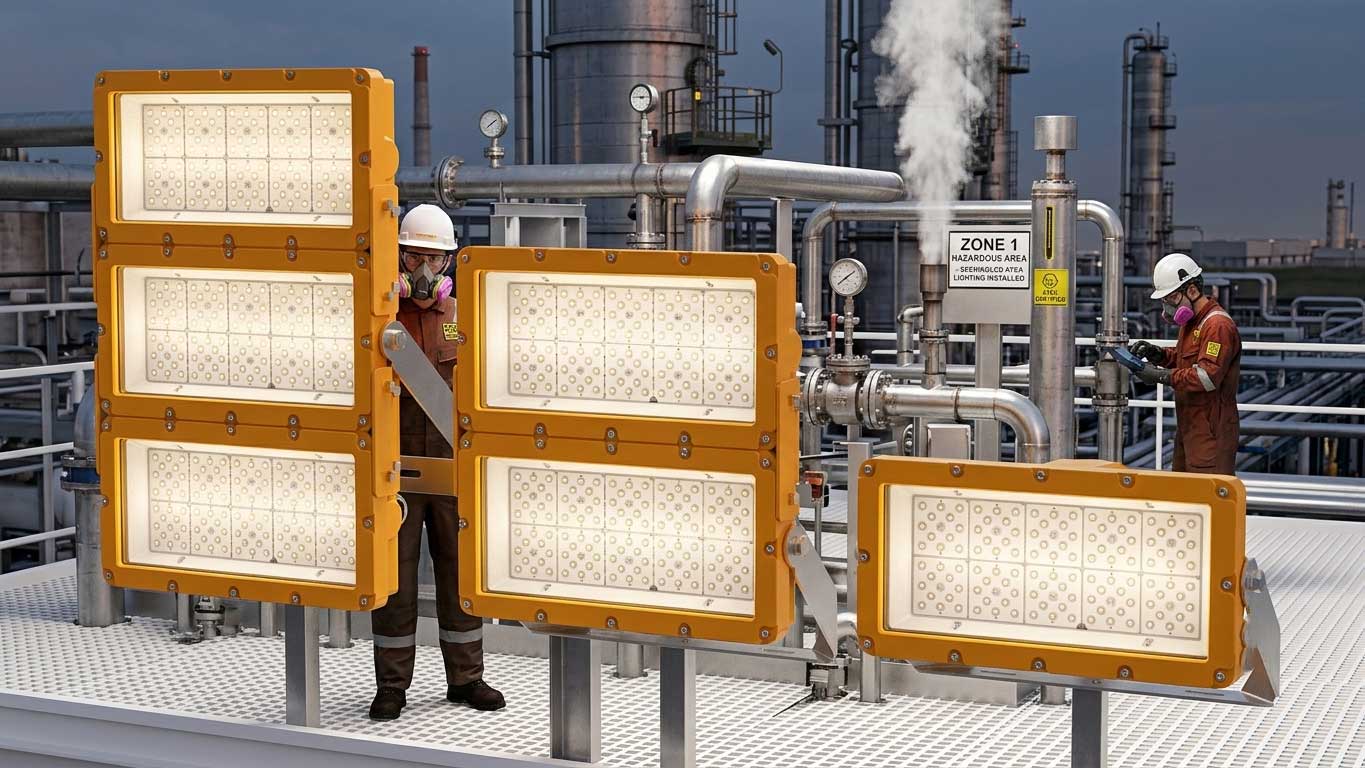
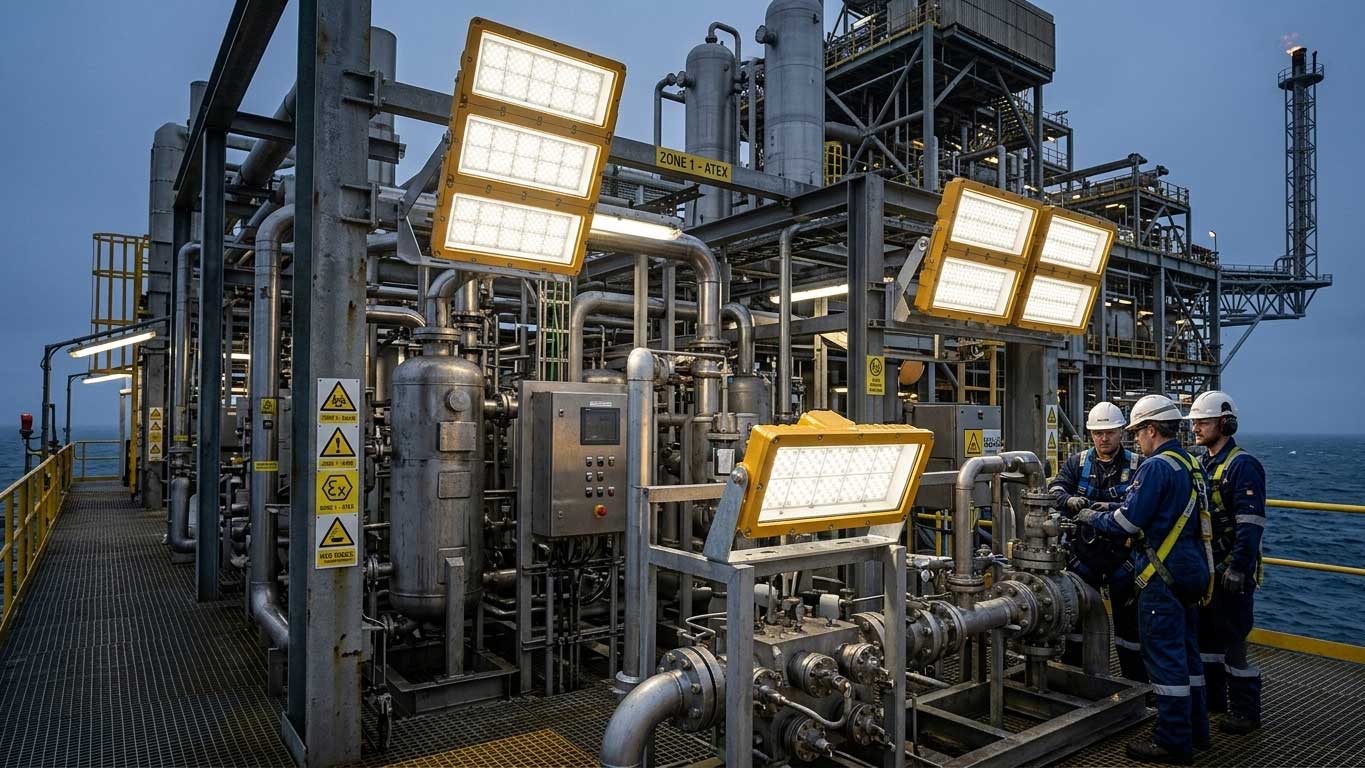
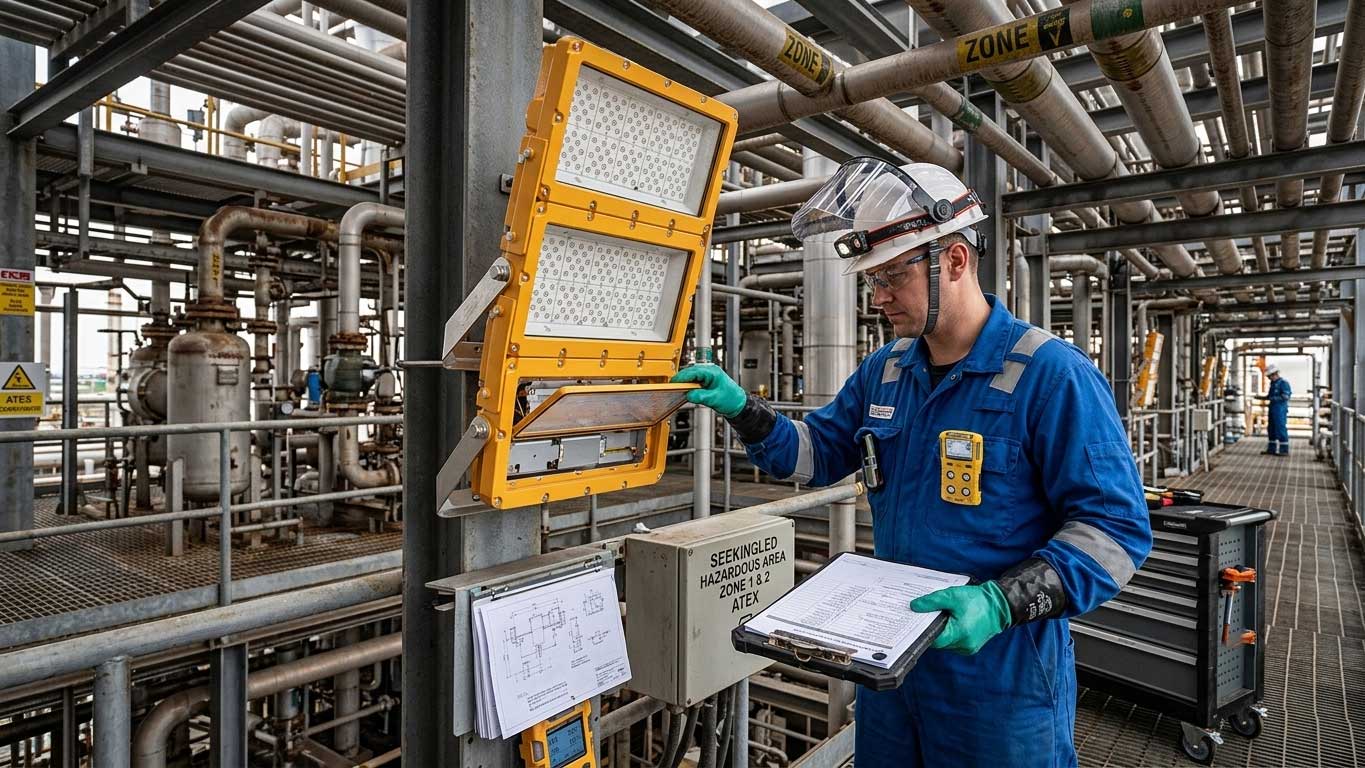
How to Select the Right Hazardous Area – Zone 1 & 2 ATEX Lighting?
To select the right hazardous area – Zone 1 & 2 ATEX lighting, first verify the zone classification, gas group, temperature class, and environmental conditions. Then choose certified ATEX luminaires that match both safety requirements and long-term operational demands.
That answer takes less than a minute to read.
Getting it wrong can create problems for years.
I’ve been involved in industrial lighting projects ranging from chemical processing facilities to fuel storage terminals and offshore platforms. Interestingly, the most expensive lighting mistakes rarely involved buying poor-quality fixtures. Most problems started much earlier—during specification.
The fixture itself was often fine.
The application wasn’t.
One refinery project I reviewed had dozens of newly installed luminaires removed during inspection. Nothing was physically wrong with the products. The issue was that the area classification required Zone 1 equipment while the installed fixtures carried Zone 2 certification.
The result?
Delays, additional labor costs, replacement purchases, and unnecessary downtime.
Selecting the correct hazardous area lighting starts long before comparing wattage, lumen output, or price.
Start with Hazardous Area Classification
The first question should never be:
“What light fixture should I buy?”
It should be:
“What type of hazardous area am I lighting?”
Everything else depends on that answer.
Under the ATEX framework, hazardous locations are categorized according to the likelihood of explosive gas atmospheres being present.
Zone
Description
Zone 0
Explosive atmosphere continuously present
Zone 1
Explosive atmosphere likely during normal operation
Zone 2
Explosive atmosphere unlikely during normal operation and present only briefly
For most industrial lighting projects, Zone 1 and Zone 2 are the primary focus.
The distinction matters because certification requirements change significantly between the two.
A Zone 2 fixture cannot simply be upgraded by wishful thinking and installed in Zone 1.
The certification itself must match the classification.
Understand the Gas Group Before Selecting a Fixture
Not all hazardous gases behave the same way.
Some ignite more easily than others.
ATEX standards divide gases into groups:
Gas Group
Typical Examples
IIA
Propane
IIB
Ethylene
IIC
Hydrogen, Acetylene
The higher the group, the more demanding the certification requirements.
Many facility owners prefer IIC-certified lighting because it can generally be used across a wider range of hazardous applications.
This flexibility often simplifies future maintenance and expansion projects.
Why Gas Group Matters More Than Many Buyers Realize
I once reviewed a chemical plant expansion project where engineers intentionally selected IIC-certified luminaires even though the current application only required IIB protection.
Their reasoning was practical.
Future process modifications could introduce different gases.
Selecting a higher certification level upfront eliminated the need for future lighting replacements.
Sometimes spending slightly more today prevents much larger costs later.
Temperature Class Is Often Overlooked
When engineers discuss hazardous area lighting, conversations frequently focus on certification.
Temperature class receives less attention.
That can be a mistake.
Every flammable gas has an ignition temperature.
If a fixture surface becomes too hot, it may create a hazard even without producing a spark.
ATEX temperature classifications help control this risk.
Temperature Class
Maximum Surface Temperature
T1
450°C
T2
300°C
T3
200°C
T4
135°C
T5
100°C
T6
85°C
Many petrochemical and gas processing facilities require T4, T5, or T6-rated equipment.
The stricter the temperature class, the lower the allowable surface temperature.
Environmental Conditions Matter as Much as Certification
Certification alone does not guarantee long-term reliability.
A fixture operating inside a clean industrial building faces very different challenges than one installed offshore.
Consider:
Salt spray
Corrosive chemicals
High humidity
UV exposure
Temperature fluctuations
Mechanical vibration
I’ve inspected offshore installations where LED chips remained functional after years of service while external hardware showed severe corrosion because environmental protection had been underestimated.
The certification was correct.
The material selection was not.
Check IP Ratings Carefully
Ingress Protection (IP) ratings indicate resistance to dust and water.
Common ratings include:
IP Rating
Protection Level
IP66
Dust-tight and resistant to powerful water jets
IP67
Temporary immersion protection
IP68
Extended immersion protection
For most hazardous-area applications, IP66 and IP67 are the most commonly specified ratings.
Higher isn’t always better.
Appropriate is better.
Evaluate Fixture Construction Quality
When reviewing product specifications, pay attention to construction details.
The following often determine service life more than lumen output.
Housing Material
Preferred options include:
Marine-grade aluminum
Copper-free aluminum
Stainless steel
Lens Material
Look for:
Tempered glass
Impact-resistant optics
UV-resistant materials
Hardware
Corrosion-resistant fasteners significantly extend fixture lifespan in harsh environments.
These details rarely dominate marketing brochures.
Maintenance teams, however, notice them immediately.
Why Certification Documentation Should Never Be Ignored
Experienced inspectors often ask for paperwork before examining the fixture itself.
Every ATEX luminaire should be supported by:
ATEX Certificate
Declaration of Conformity
Product Datasheet
Installation Instructions
Certification Marking Details
If documentation cannot be produced quickly, project approvals may be delayed.
That reality surprises many first-time buyers.
Consider Long-Term Operating Costs
Initial purchase price tells only part of the story.
According to the International Energy Agency (IEA), LED technology continues to be the most energy-efficient mainstream lighting solution available today.
So, How to Select the Right Hazardous Area – Zone 1 & 2 ATEX Lighting?
The answer begins with understanding the environment before evaluating the product. Zone classification, gas group, temperature class, environmental exposure, and certification documentation all play critical roles in selecting the correct solution.
At SEEKINGLED, we work closely with engineers, contractors, and facility operators to ensure every hazardous-area lighting project balances safety, compliance, durability, and long-term operational value. Choosing the correct How to Select the Right Hazardous Area – Zone 1 & 2 ATEX Lighting solution today often prevents costly maintenance, compliance issues, and operational disruptions tomorrow.
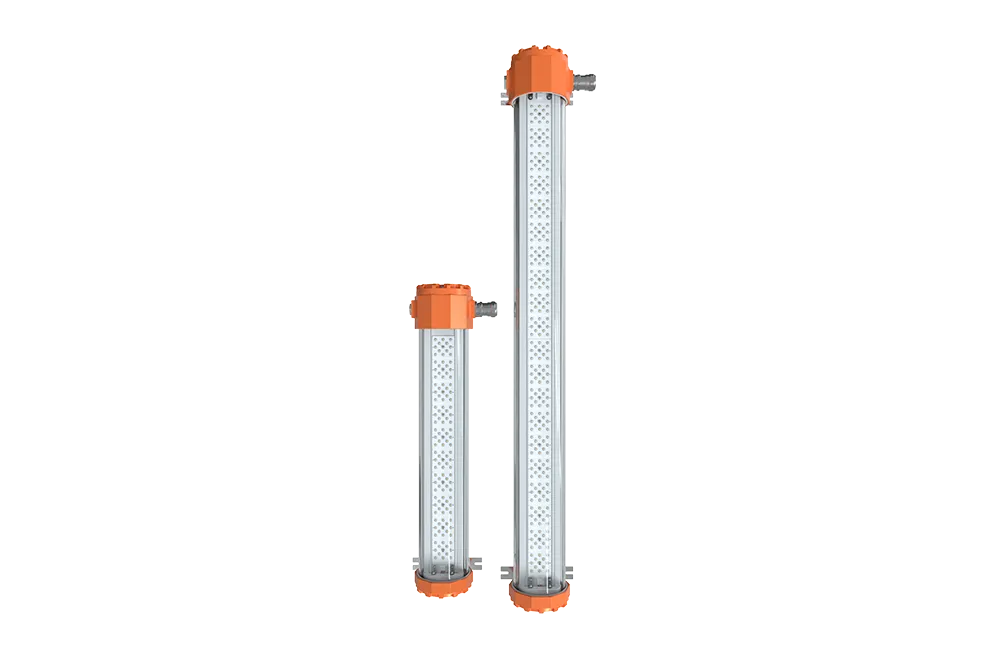
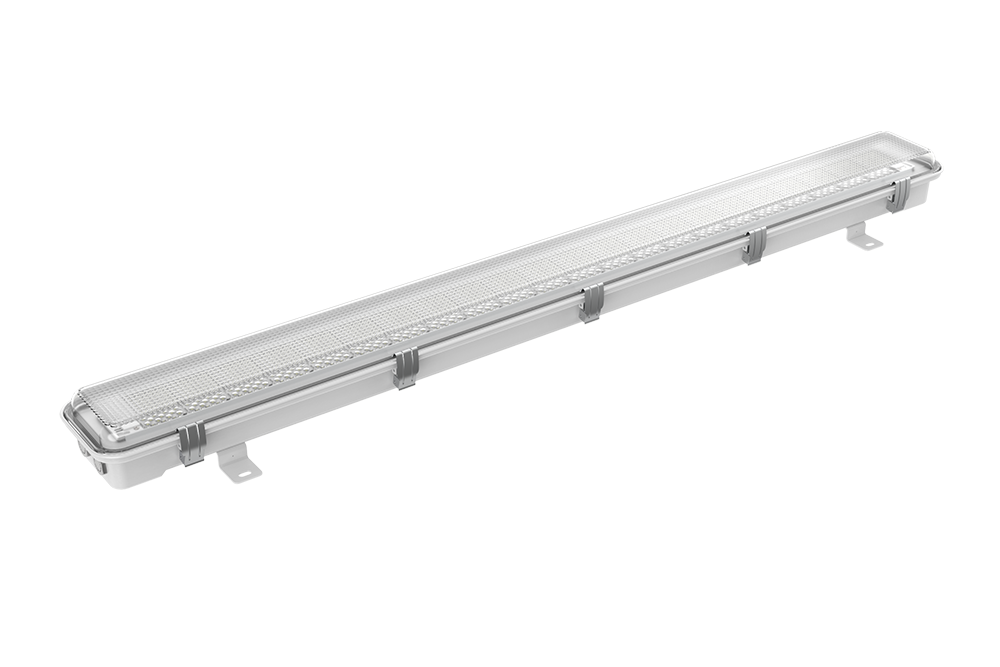
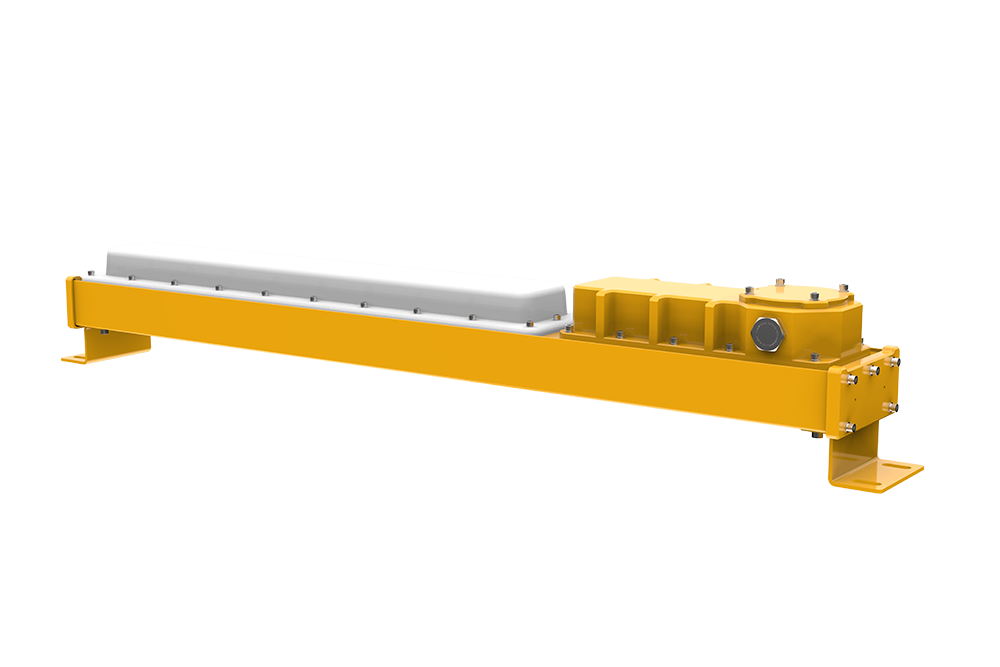
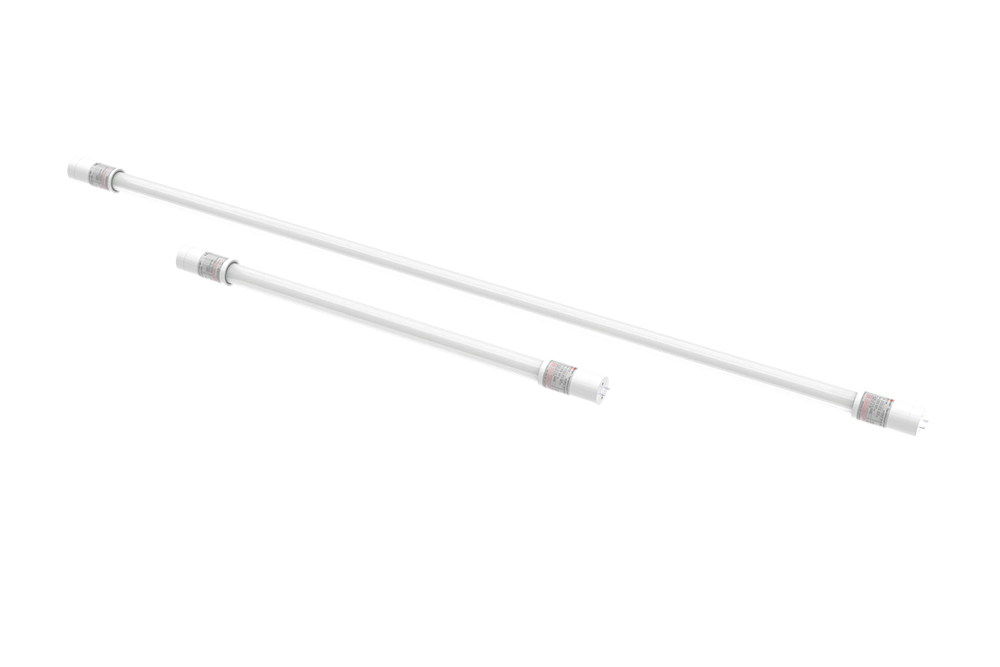
SEEKINGLED LED Linear Explosion Proof Light and Explosion Proof lighting is ATEX and IECEx certified for Zone 1, Zone 2, Zone 21 and Zone 22 hazardous locations, built for long-term industrial use.
LED Linear Explosion Proof Lights and EX Proof lights for Zone 1, Zone 2, Zone 21 and Zone 22 hazardous areas. ATEX & IECEx certified explosion proof LED linear lighting with emergency function, adjustable power and IP67 protection by SEEKINGLED.
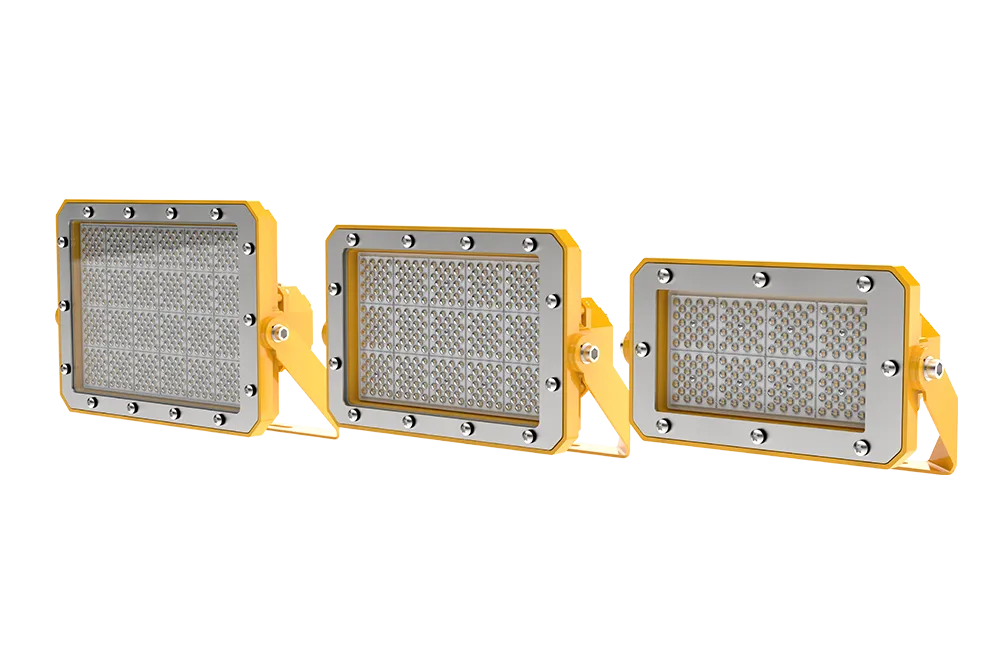
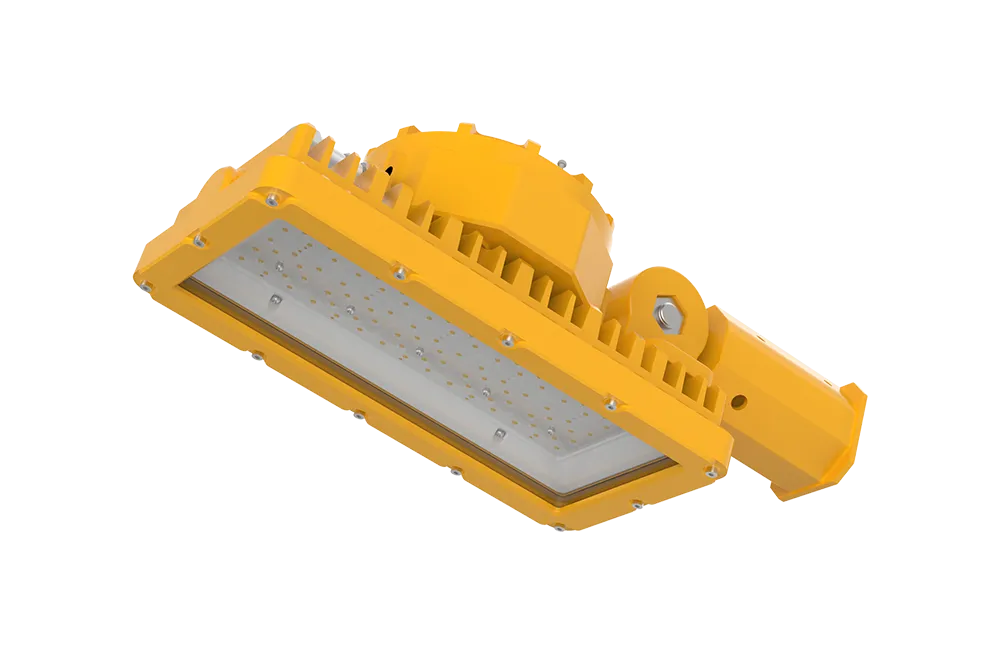
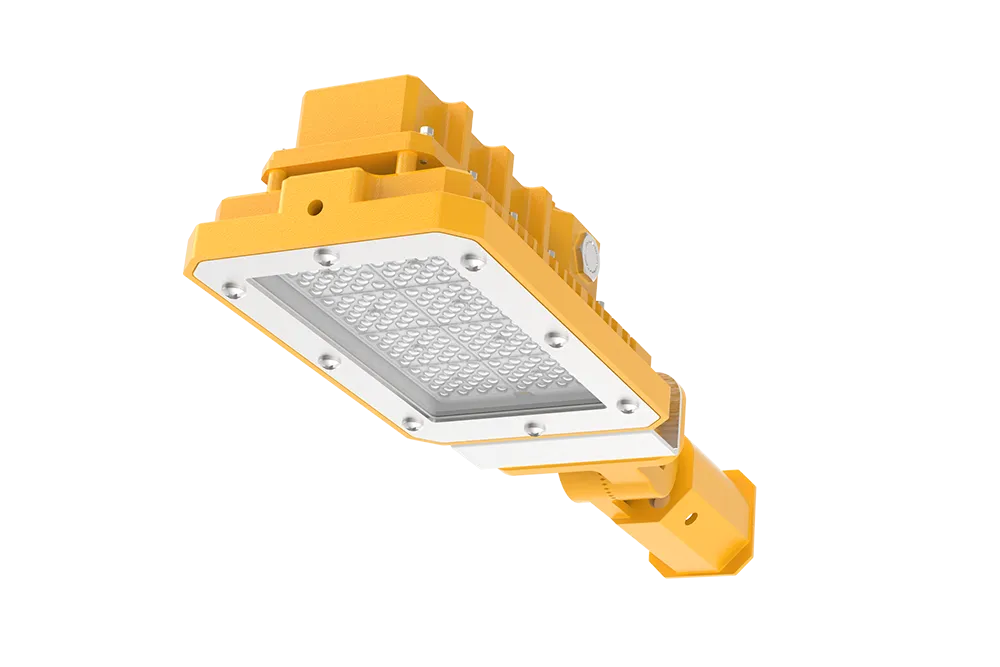
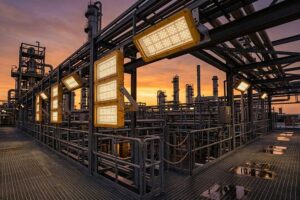
SEEKINGLED LED Explosion Proof Flood Lights are ATEX certified for Zone 2 and Zone 22 hazardous areas, offering high efficiency, adjustable power and integrated junction box.
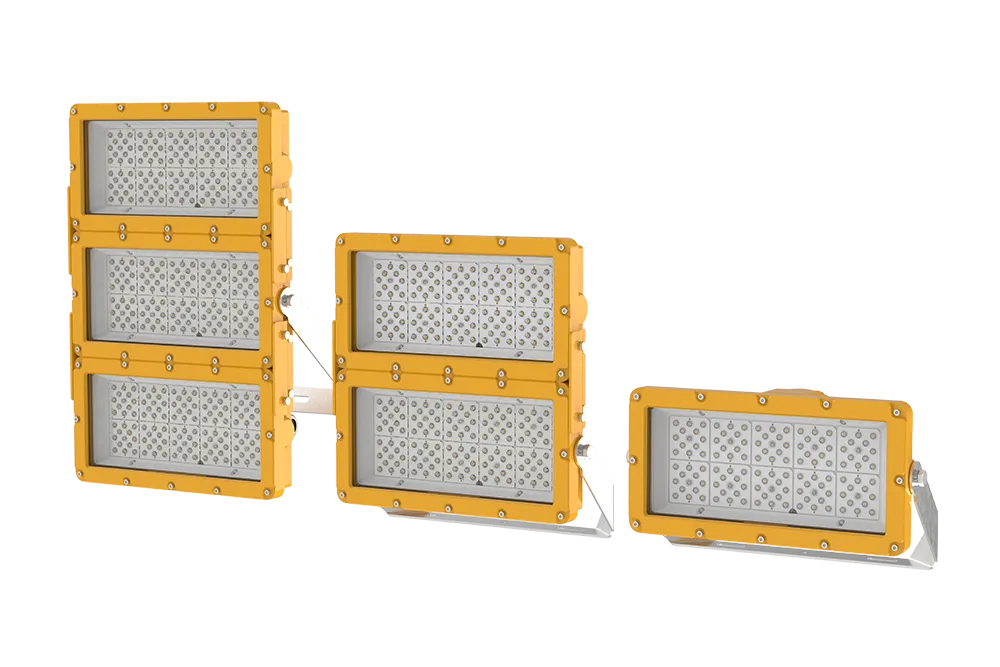
SEEKINGLED LED Explosion Proof Flood Lights are flameproof ATEX and IECEx certified for Zone 1 and Zone 2 hazardous areas, offering high power, adjustable output and long service life.
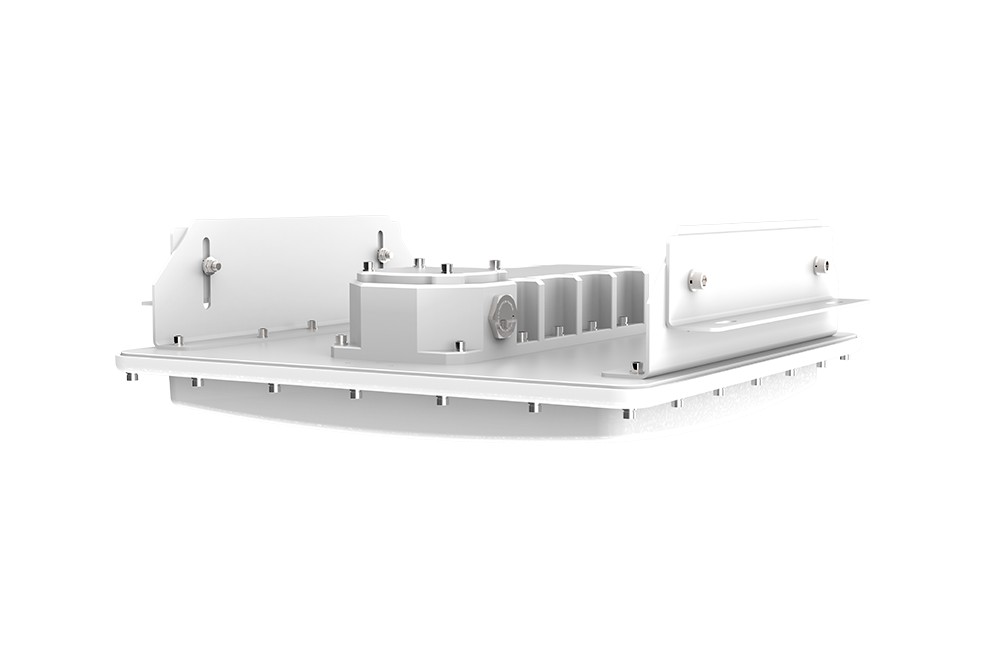
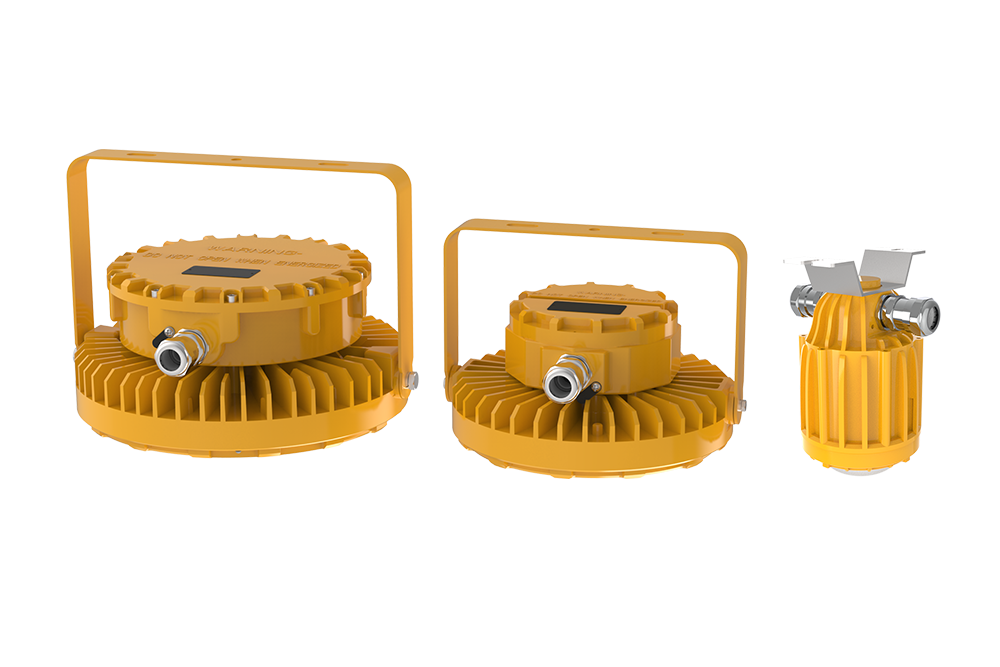
SEEKINGLED LED Gas Station Canopy Lights are ATEX certified for Zone 2 and Zone 22 hazardous areas, featuring adjustable power and built-in explosion-proof junction box.
ATEX: Ex II 2G Ex db IIB T6/T5 GbEx II 2D Ex tb IIIC T80°C/ T95°C Db IECEx Ex db IIB T6 Gb;Ex tb IIIC T80°C Db Feature: ● For Zone 1,2 and Zone 21,22● Flameproof type, the strongest● 100W can replace 250W HID,energy saving● Power:60W,80W,100W Application: Oil and gas, marine, Chemical, pharmaceutical, semiconductor,mining,military industr…
ATEX: II 3G Ex nR ⅡC T5/T6 GcII 3D Ex tc ⅢC T80℃/T95℃Dc ATEX Certificate NO: TÜV CY 26 ATEX 0207611 X Feature: ● For Zone 2 and Zone 22● 150W can replace 250W HID lamps,Energy saving● Power:50W,75W,100W,150W,200W Application: Oil and gas, marine, Chemical, pharmaceutical, semiconductor,mining,military industry, paint booth,power plant ETC…
LED explosion proof high bay lights are designed for Zone 1, Zone 2, Zone 21 and Zone 22 hazardous areas. This page introduces the HB21 Series from SEEKING, including certifications, power options and real application considerations.
LED Linear Explosion Proof Lights from SEEKINGLED. LU Series Flame Proof lights ATEX-certified explosion proof LED linear lighting for Zone 2 gas and Zone 22 dust areas, IP69K, IK10, long lifetime and flexible power options.
Certified explosion proof work lights for Zone 1 & 21 hazardous areas. Portable, ATEX & IECEx approved, built for oil, gas and chemical plants by SEEKINGLED.
ATEX: II 3G Ex nR ⅡC T6 GcII 3D Ex tc ⅢC T80℃ Dc ATEX Certificate NO: TÜV CY 26 ATEX 0207611 X Feature: ● For Zone 2 and Zone 22● Accepts battery-powered supply● indestructible● Power:AC input:50W,75W,100WDC input:15W,25W,35W Application: Oil and gas, marine, Chemical, pharmaceutical, semiconductor,mining,military industry, paint booth,po…
ATEX: Ex II 2G Ex db IIB T6 GbEx II 2D Ex tb IIIC T80°C Db IECEx Ex db IIB T6 Gb;Ex tb IIIC T80°C Db Feature: ● For Zone 1,2 and Zone 21,22● Flameproof type, the strongest Application: Oil and gas, marine, Chemical, pharmaceutical, semiconductor,mining,military industry, paint booth,power plant ETC hazardous area. Technical Specifications:…
ATEX: Ex II 2G Ex db IIB T6 GbEx II 2D Ex tb IIIC T80°C Db IECEx Ex db IIB T6 Gb;Ex tb IIIC T80°C Db Feature: ● For Zone 1,2 and Zone 21,22● Flameproof type, the strongest Application: Oil and gas, marine, Chemical, pharmaceutical, semiconductor,mining,military industry, paint booth,power plant ETC hazardous area. Technical Specifications:…
ATEX: Ex II 2G Ex d e IIB T6 Gb ATEX: Ex d e IIB T6 Gb; Feature: ● For Zone 1,2● 9W can replace 18W fluorescent lamps,50% Energy saving Application: Oil and gas, marine, Chemical, pharmaceutical, semiconductor,mining,military industry, paint booth,power plant ETC hazardous area. Technical Specifications: Standards:60079-0, 60079-1, 60079…
Warehouse LED High Bay Lighting Upgrade projects focus on usable light and energy control. This case records how SEEKINGLED replaced 400W metal halide fixtures with XJ-HBS130W-2 high bays in a factory warehouse near Barcelona.
Discover hazardous area batten lights for Zone 1 and Zone 2 applications. Learn certifications, installation requirements, service life, and LED advantages.
Seeking showcased its latest LED Linear Lighting Solutions at the Hong Kong International Outdoor and Tech Light Expo 2024, featuring the HLS Series LED Linear Trunking System and HLD Series Linear High Bay for industrial and commercial projects.
 Seeking LED