 Seeking LED
How Do You Calculate High Bay Lighting?
2How do you calculate high bay lighting? Learn high bay lighting calculations using lumens, ceiling height, spacing, and industrial lighting factors for better results.
View detailsSearch the whole station
This question usually comes up at night.
Someone notices the light feels brighter than before. Whiter. Sharper. And they ask:
Are LED street lights safe, or did we trade comfort for efficiency?
Short answer first: yes, LED street lights are safe.
But—and this matters—not all LED street lights feel safe if they’re poorly designed or badly installed.
Those are two very different things.
If you grew up with orange sodium street lights, LED lighting can feel abrupt.
LED street lights:
That’s intentional. Cities switched because visibility improves. Pedestrians are easier to see. Road edges are clearer. Cameras work better.
From a traffic safety standpoint, LEDs perform better. That part is settled.
What isn’t settled is comfort, especially when glare isn’t controlled.
This is where rumors take over.
There’s no credible evidence showing modern LED street lights damage eyes under normal use. What people react to is excessive blue light or glare, not danger.
Early LED street lights were sometimes:
That combination made people uncomfortable. Uncomfortable doesn’t mean unsafe—but it does mean poorly specified.
At SEEKINGLED, most municipal projects now specify 3000K–4000K, not the harsh blue-white used a decade ago.
You’ll see claims linking LED street lighting to sleep issues or long-term health risks.
Reality check:
The solution isn’t abandoning LED street lights. It’s proper optics, cutoff angles, and dimming schedules.
Modern systems allow adaptive dimming late at night. Many cities already use it.
Yes. This is where LEDs clearly win.
LED street lights improve:
Police departments and traffic engineers noticed fewer nighttime accidents in upgraded areas. That’s one reason the transition didn’t stop.
From a road safety perspective, LEDs are not just safe—they’re better.
Most complaints trace back to three issues:
None of these are LED problems. They’re specification problems.
A well-designed LED street light is calm, even, and predictable. A bad one feels intrusive.
Cities that rushed early LED rollouts learned fast.
They adjusted:
Manufacturers evolved too. Brands like SEEKINGLED now design fixtures specifically to avoid glare while maintaining uniformity.
The technology didn’t fail. The learning curve just showed.
So—are LED street lights safe?
Yes. For drivers. For pedestrians. For communities.
They’re safer than the old systems they replaced.
They just need to be designed and installed with intention.
When LEDs feel “wrong,” it’s usually not because they’re dangerous. It’s because someone cut corners.

How do you calculate high bay lighting? Learn high bay lighting calculations using lumens, ceiling height, spacing, and industrial lighting factors for better results.
View details
13th-18th- March-2016 Booth NO.:10.2 A61GWe launch the HBG series high bay light, which include 80W, 100W, 120W, 150W, 200W, 240W, UFO appearance, IP65 protection grade. Use Meanwell HBG driver, SMD3030 LED chips, whole la...
View details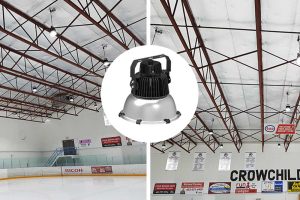
LED high bay lighting upgrade for hockey field in Canada. SEEKINGLED XJ-HBS200W replaced 92 units of 400W metal halide with up to 75% energy savings.
View details
Learn how to stop my high bay LED lights from flickering by identifying wiring, driver, and control issues. Field-based guidance from SEEKINGLED.
View details