 Seeking LED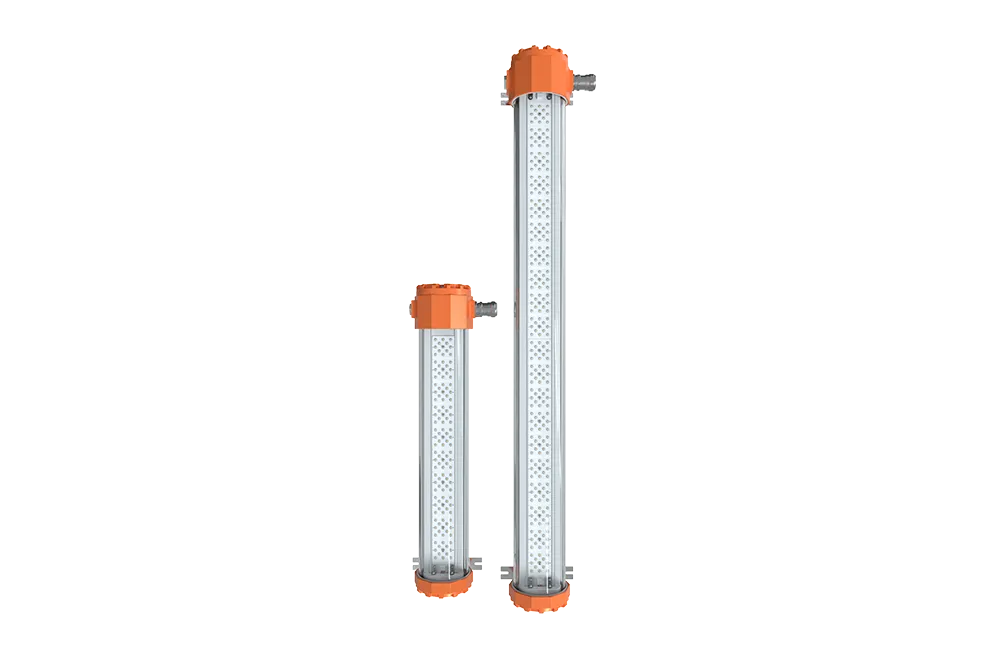
How to Stop My High Bay LED Lights from Flickering?
309Learn how to stop my high bay LED lights from flickering by identifying wiring, driver, and control issues. Field-based guidance from SEEKINGLED.
View detailsSearch the whole station
I’ve spent the last 14 years working with industrial lighting systems in oil terminals, chemical plants, and offshore facilities across Southeast Asia and the Middle East. My background is in electrical engineering, and much of my work has involved hazardous area classification reviews, lighting layout validation, and compliance checks against IEC and NEC standards.
If there is one product category that leaves no room for shortcuts, it’s the ex proof led flood light.
This is not decorative lighting. It is life-safety equipment.
Hazardous locations are defined differently depending on geography. In North America, the National Electrical Code (NFPA 70) defines Class I, Division 1 and Division 2 areas where flammable gases or vapors may be present. In Europe and many global projects, compliance with ATEX Directive 2014/34/EU and IEC 60079 standards is mandatory.
According to the International Electrotechnical Commission (IEC 60079 series), equipment used in explosive atmospheres must prevent ignition through containment (Ex d), increased safety (Ex e), or other protection concepts. These standards are not theoretical—they are the basis of every site audit I’ve attended.
On a refinery upgrade project in 2019, we replaced 400W metal halide luminaires with LED units rated for Zone 1. Besides cutting energy consumption by more than half, the LED fixtures significantly reduced surface temperature risks—critical for maintaining T4 classification (maximum 135°C surface temperature).
An ex proof led flood light must meet these limits consistently, not just in lab conditions but under real outdoor thermal stress.
One fact often overlooked: high temperature is the primary enemy of both LED chips and drivers. The U.S. Department of Energy has reported that LED luminaires convert a greater portion of input energy into visible light compared to HID lamps, reducing waste heat generation. Lower heat output directly supports safer T-rating compliance in explosive atmospheres.
In one petrochemical storage yard, we measured housing temperature differences between old HID fixtures and new LED units during a 38°C afternoon. The LED surface stabilized well below the allowable threshold. That margin matters when volatile gases are present.
SEEKINGLED’s approach emphasizes:
These are not brochure features; they are engineering controls.
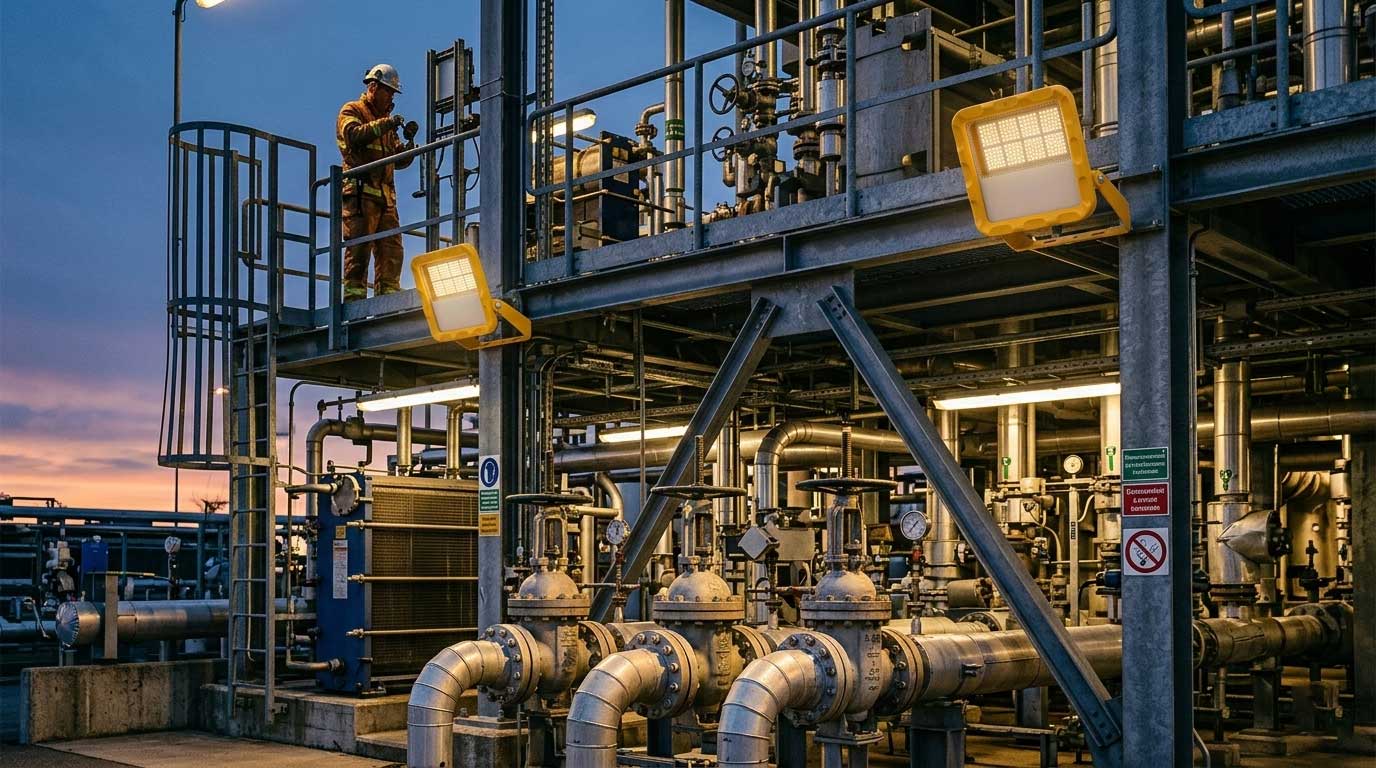
Lighting design in hazardous areas is not about raw lumen output. It is about uniformity and glare control.
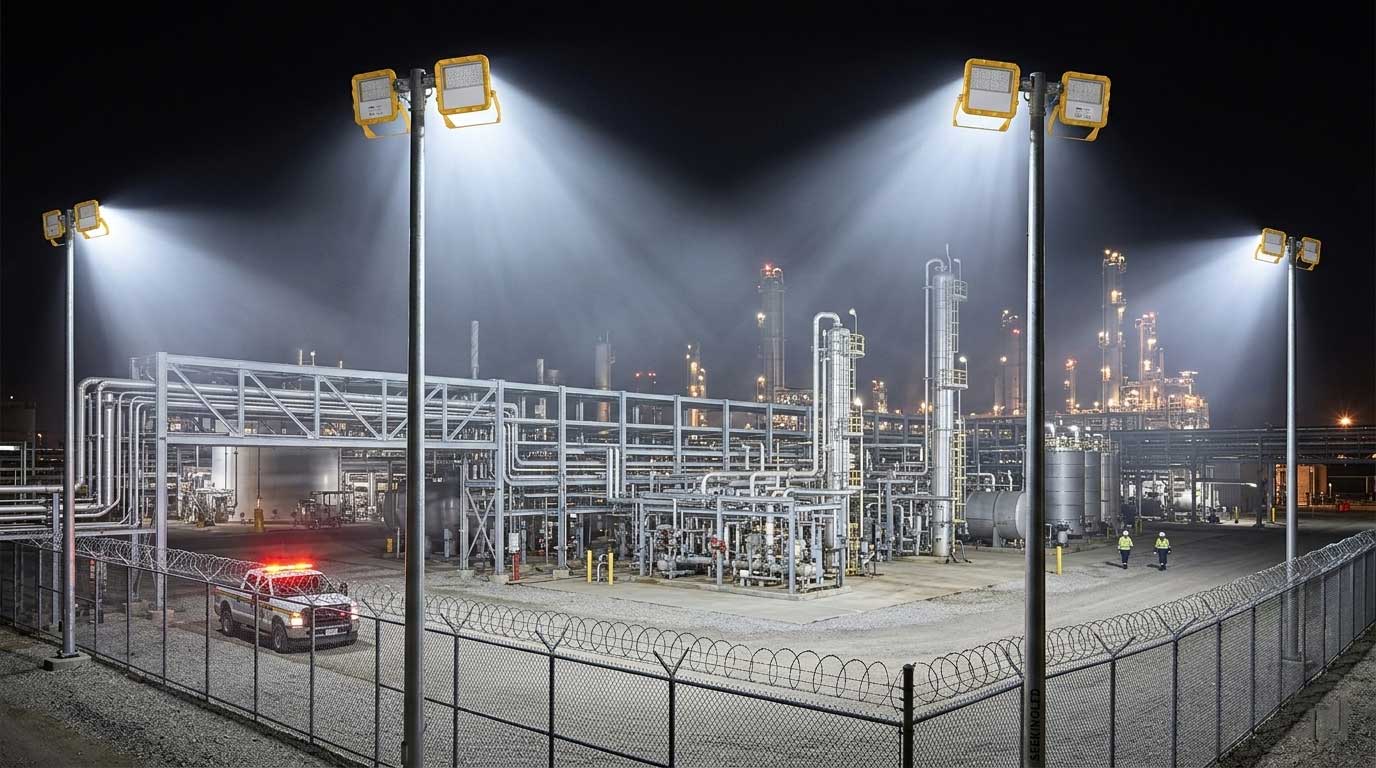
The Illuminating Engineering Society (IES) recommends maintaining appropriate uniformity ratios in industrial environments to reduce visual fatigue and improve worker safety. In a gas compression station project, our lighting simulation improved uniformity from 0.3 to 0.45 by selecting the correct beam distribution.
Narrow beams (20°–30°) suit tall mast mounting. Wider beams (60°–90°) are more effective for perimeter security and equipment zones.
A properly selected Class 1 Division 2 LED flood light improves visibility for inspection work while minimizing glare hazards on metallic surfaces.
Industrial environments are unforgiving. According to IEC 60529, IP66 or IP67 ratings confirm resistance to dust ingress and powerful water jets. Impact resistance per IEC 62262 (IK ratings) ensures survivability in active work zones.
In one LNG coastal terminal, salt corrosion destroyed standard outdoor luminaires within two years. By specifying marine-grade coatings aligned with ISO 12944 C5 corrosion categories, we extended service life significantly.
SEEKINGLED units typically incorporate:
A hazardous area LED lighting solution must be durable enough to justify restricted maintenance access procedures.
Restricted hazardous zones require work permits, gas detection clearance, and production coordination before maintenance. Every avoided failure saves operational downtime.
LM-80 testing standards evaluate LED lumen maintenance over time. Quality LED modules often achieve L70 beyond 50,000 hours. That level of reliability is critical in remote oil fields and offshore platforms.
Driver quality is equally important. I have seen installations fail early not because of LED chips—but because undersized drivers overheated.
That is why, when evaluating an IP66 IP67 explosion proof floodlight, I always ask:
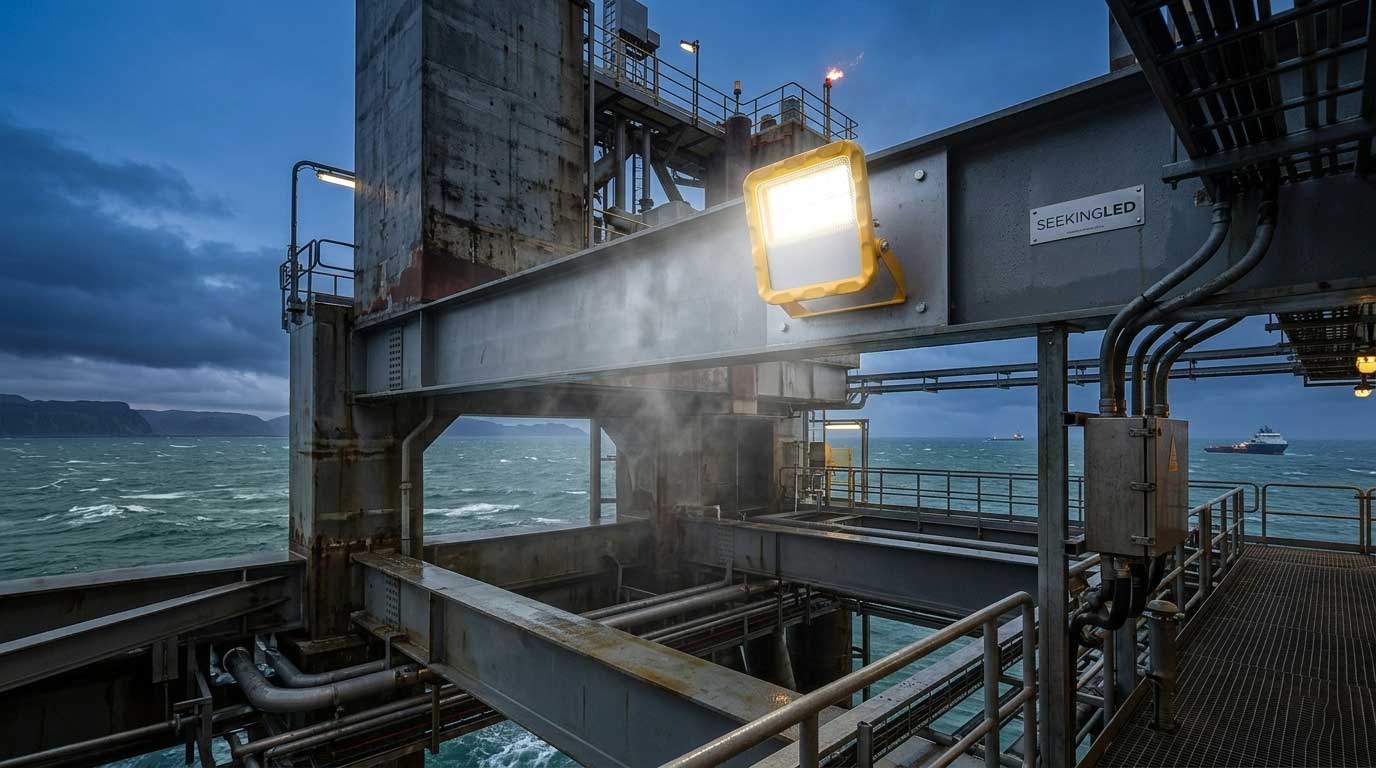
After years of supervising hazardous site lighting upgrades, I can say confidently: an ex proof led flood light is not chosen based on price alone. It is selected based on certification integrity, thermal stability, corrosion resistance, and long-term reliability.
At SEEKINGLED, we build products aligned with IEC and ATEX standards, informed by field experience rather than catalog claims. Every hazardous project teaches the same lesson — compliance and durability must come first.
When installed correctly, a high-quality ex proof led flood light becomes more than illumination. It becomes a safeguard for workers, facilities, and operations.
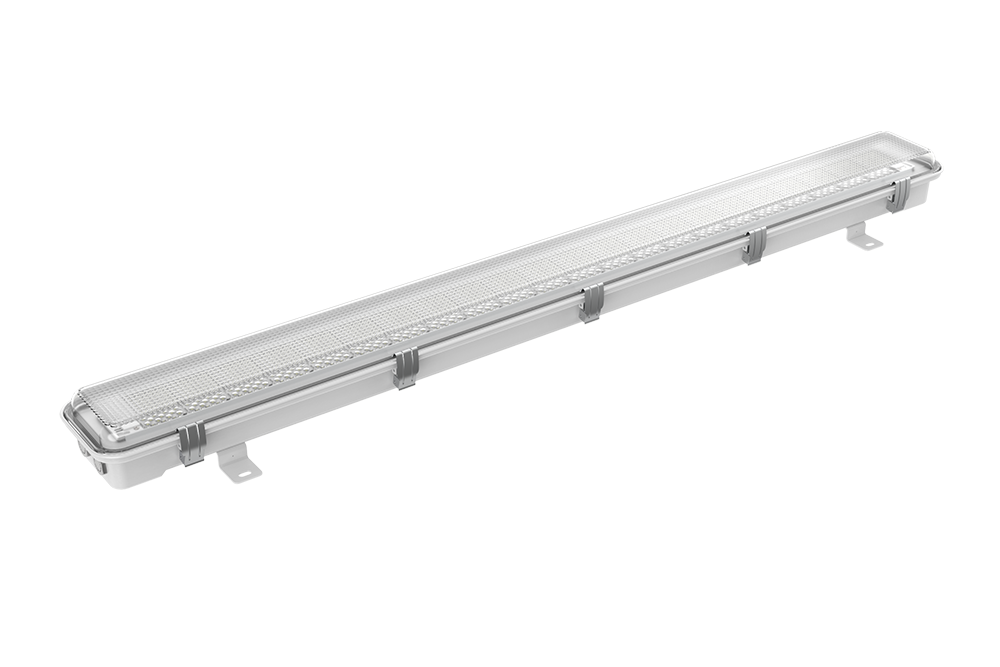
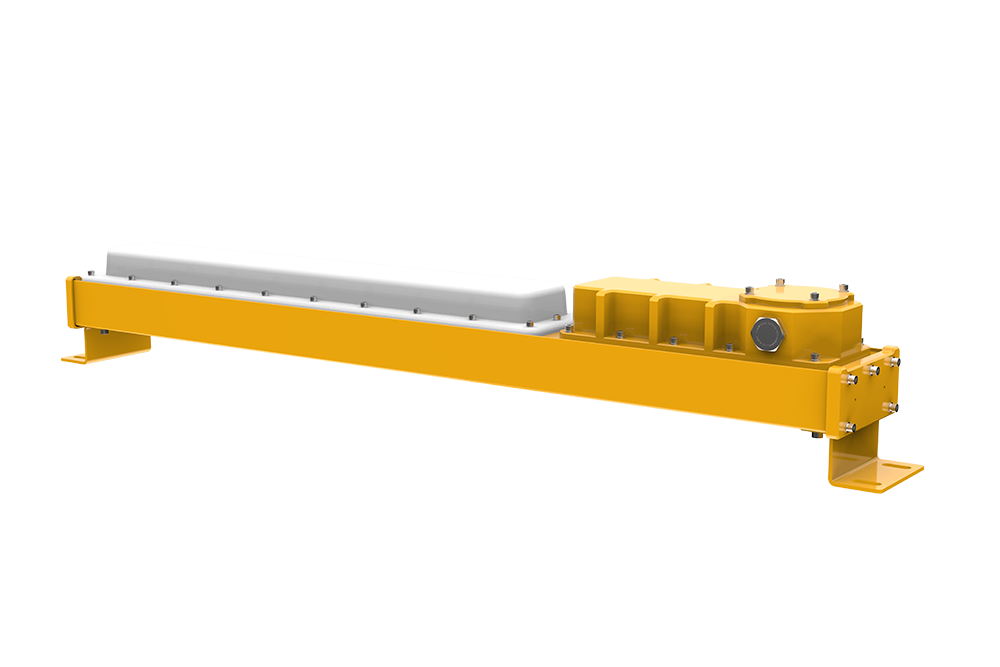
SEEKINGLED LED Linear Explosion Proof Light and Explosion Proof lighting is ATEX and IECEx certified for Zone 1, Zone 2, Zone 21 and Zone 22 hazardous locations, built for long-term industrial use.
LED Linear Explosion Proof Lights and EX Proof lights for Zone 1, Zone 2, Zone 21 and Zone 22 hazardous areas. ATEX & IECEx certified explosion proof LED linear lighting with emergency function, adjustable power and IP67 protection by SEEKINGLED.
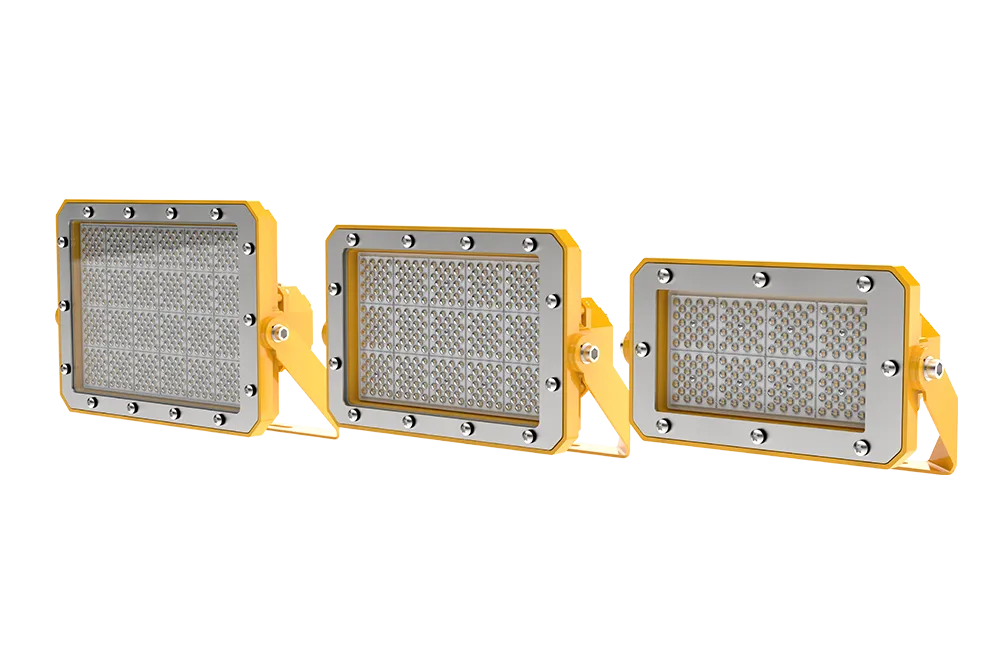
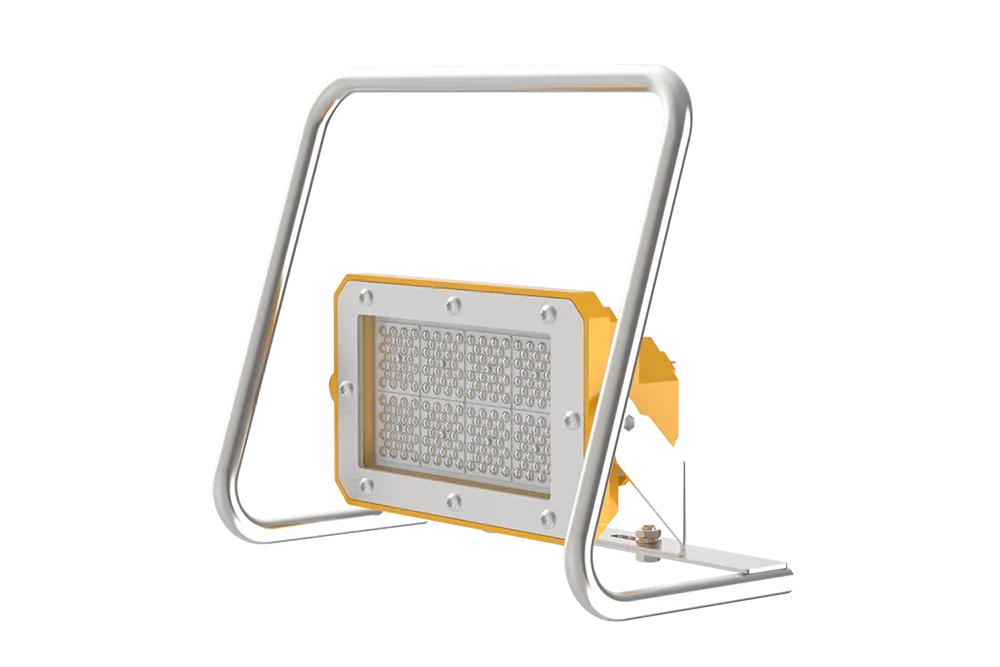
SEEKINGLED LED Explosion Proof Flood Lights are ATEX certified for Zone 2 and Zone 22 hazardous areas, offering high efficiency, adjustable power and integrated junction box.
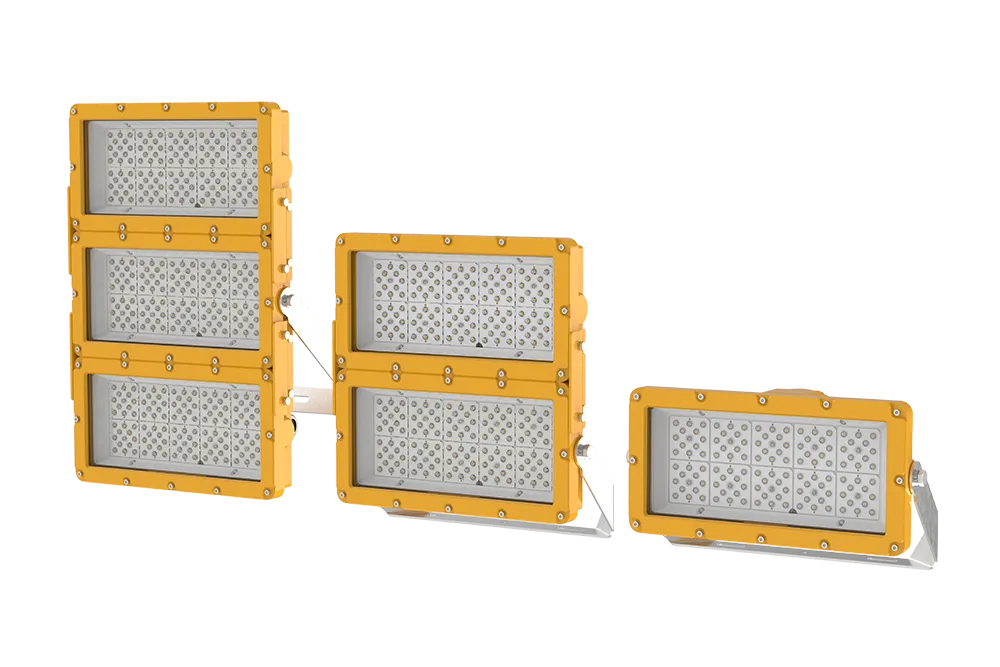
SEEKINGLED LED Explosion Proof Flood Lights are flameproof ATEX and IECEx certified for Zone 1 and Zone 2 hazardous areas, offering high power, adjustable output and long service life.
SEEKINGLED LED Gas Station Canopy Lights are ATEX certified for Zone 2 and Zone 22 hazardous areas, featuring adjustable power and built-in explosion-proof junction box.
ATEX: Ex II 2G Ex db IIB T6/T5 GbEx II 2D Ex tb IIIC T80°C/ T95°C Db IECEx Ex db IIB T6 Gb;Ex tb IIIC T80°C Db Feature: ● For Zone 1,2 and Zone 21,22● Flameproof type, the strongest● 100W can replace 250W HID,energy saving● Power:60W,80W,10…
ATEX: II 3G Ex nR ⅡC T5/T6 GcII 3D Ex tc ⅢC T80℃/T95℃Dc ATEX Certificate NO: TÜV CY 26 ATEX 0207611 X Feature: ● For Zone 2 and Zone 22● 150W can replace 250W HID lamps,Energy saving● Power:50W,75W,100W,150W,200W Application: Oil and gas, m…
LED explosion proof high bay lights are designed for Zone 1, Zone 2, Zone 21 and Zone 22 hazardous areas. This page introduces the HB21 Series from SEEKING, including certifications, power options and real application considerations.
LED Linear Explosion Proof Lights from SEEKINGLED. LU Series Flame Proof lights ATEX-certified explosion proof LED linear lighting for Zone 2 gas and Zone 22 dust areas, IP69K, IK10, long lifetime and flexible power options.
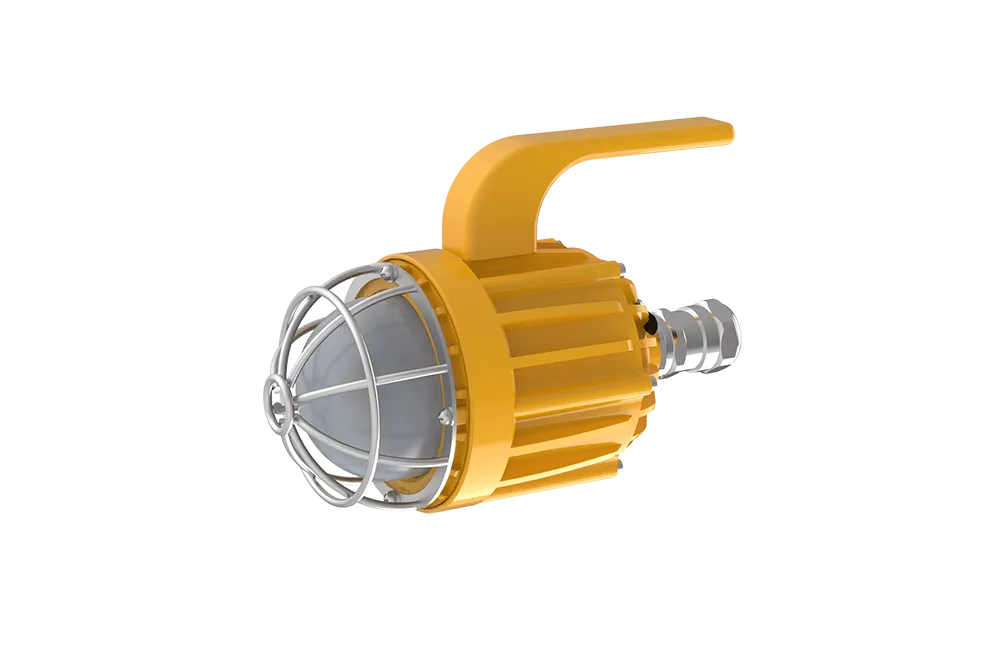
Certified explosion proof work lights for Zone 1 & 21 hazardous areas. Portable, ATEX & IECEx approved, built for oil, gas and chemical plants by SEEKINGLED.
ATEX: II 3G Ex nR ⅡC T6 GcII 3D Ex tc ⅢC T80℃ Dc ATEX Certificate NO: TÜV CY 26 ATEX 0207611 X Feature: ● For Zone 2 and Zone 22● Accepts battery-powered supply● indestructible● Power:AC input:50W,75W,100WDC input:15W,25W,35W Application: O…
ATEX: Ex II 2G Ex db IIB T6 GbEx II 2D Ex tb IIIC T80°C Db IECEx Ex db IIB T6 Gb;Ex tb IIIC T80°C Db Feature: ● For Zone 1,2 and Zone 21,22● Flameproof type, the strongest Application: Oil and gas, marine, Chemical, pharmaceutical, semicondu…
ATEX: Ex II 2G Ex db IIB T6 GbEx II 2D Ex tb IIIC T80°C Db IECEx Ex db IIB T6 Gb;Ex tb IIIC T80°C Db Feature: ● For Zone 1,2 and Zone 21,22● Flameproof type, the strongest Application: Oil and gas, marine, Chemical, pharmaceutical, semicondu…
ATEX: Ex II 2G Ex d e IIB T6 Gb ATEX: Ex d e IIB T6 Gb; Feature: ● For Zone 1,2● 9W can replace 18W fluorescent lamps,50% Energy saving Application: Oil and gas, marine, Chemical, pharmaceutical, semiconductor,mining,military industry, pain…
loading…
This is the last post!

Learn how to stop my high bay LED lights from flickering by identifying wiring, driver, and control issues. Field-based guidance from SEEKINGLED.
View details
The LED Stadium Lights Series is designed for real stadium use, not just specs. High power output, flexible optics, and reliable lighting for professional sports fields.
View details
What Is class 1 division 2 led lighting? Discover how certified LED fixtures improve safety in hazardous areas with Class I Div 2 standards, applications, and expert insights.
View details
Tennis Court High Bay Lighting requires uniform illumination, not only target lux levels. This case records how SEEKINGLED adjusted XJ-HBS beam angles in an Italian tennis court project to improve lighting distribution.
View details