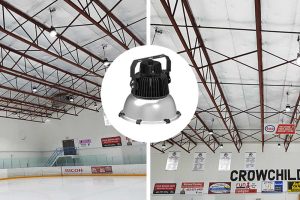
XJ-HBS200W High Bay with Sensor in Australian Warehouse
291Real project record of XJ-HBS200W high bay with motion and daylight sensor installed in an Australian warehouse, focusing on on-site setup and energy-saving results.
View detailsSearch the whole station
Hazardous light fixtures are specially certified luminaires designed for locations where flammable gases, vapors, dust, or explosive atmospheres may exist. They prevent ignition sources while providing reliable illumination in hazardous industrial environments.
People often notice hazardous light fixtures only after they enter a refinery.
The housing looks heavier.
The glass seems thicker.
The mounting brackets appear oversized.
Everything about the fixture feels different.
Years ago, while visiting a chemical plant during a maintenance shutdown, an operations supervisor pointed toward a row of aging luminaires hanging above a solvent transfer area.
He said something I still remember.
“Those lights aren’t here to make the place brighter. They’re here to make sure everyone goes home.”
That sentence explains hazardous light fixtures better than most technical manuals.
Because illumination is only one part of their job.
Safety is the other.
Hazardous light fixtures are lighting products specifically designed and certified for areas where explosive atmospheres may occur.
These atmospheres may contain:
Standard industrial luminaires can potentially generate:
Hazardous light fixtures are engineered to prevent these conditions from igniting surrounding atmospheres.
According to the European Commission’s ATEX Directive 2014/34/EU, equipment intended for explosive atmospheres must satisfy strict safety requirements before entering the market.
Source:
European Commission
https://single-market-economy.ec.europa.eu
This question appears surprisingly often.
After all, modern industrial LED fixtures already offer:
Why not simply use them everywhere?
The answer becomes obvious inside a gas processing facility.
A conventional fixture is designed primarily for:
Hazardous light fixtures must accomplish those goals while also ensuring they cannot become an ignition source.
This additional requirement changes:
The result is a completely different product category.
Hazardous environments exist in more places than many people realize.
Common applications include:
The common factor is not the industry.
It is the presence of potentially explosive atmospheres.
Before selecting hazardous light fixtures, engineers first classify the area.
This step determines everything that follows.
| Zone | Description |
|---|---|
| Zone 0 | Explosive atmosphere continuously present |
| Zone 1 | Explosive atmosphere likely during operation |
| Zone 2 | Explosive atmosphere unlikely and temporary |
Zone classification influences:
Mistakes at this stage often become expensive.
I have seen projects where perfectly functional luminaires were removed because the zone classification had been misunderstood.
The fixtures worked.
The paperwork did not.
Typical examples include:
Gas release may occur during normal operations.
Therefore, equipment protection requirements are higher.
Examples include:
Risk remains present but occurs less frequently.
The certification requirements reflect that lower probability.

Several certification systems govern hazardous lighting globally.
| Certification | Region |
|---|---|
| ATEX | European Union |
| IECEx | International |
| UL844 | North America |
| NEC Class/Division | United States |
According to the IECEx system, equipment must undergo testing and certification to demonstrate compliance with explosive atmosphere requirements.
Source:
IECEx System
https://iecex.com
Certification is not simply a sticker.
It represents:
Experienced inspectors often request certificates before inspecting the fixture itself.
Many hazardous light fixtures display markings such as:
Ex db IIC T6 Gb
At first glance these markings appear complicated.
They are actually very useful.
| Marking | Meaning |
|---|---|
| Ex | Explosion protected |
| db | Flameproof enclosure |
| IIC | Gas group |
| T6 | Surface temperature limit |
| Gb | Equipment protection level |
These markings tell engineers where the fixture can safely operate.
One letter may determine whether a luminaire is approved for a project.
Surface temperature can ignite certain gases.
This is why hazardous light fixtures carry temperature classifications.
| Temperature Class | Maximum Surface Temperature |
|---|---|
| T1 | 450°C |
| T2 | 300°C |
| T3 | 200°C |
| T4 | 135°C |
| T5 | 100°C |
| T6 | 85°C |
Many oil and gas facilities require T4 or T6 ratings.
One engineer once told me:
“The fixture doesn’t need to fail to become dangerous. Sometimes it only needs to get too hot.”
That statement explains temperature classes perfectly.
Twenty years ago, hazardous locations often used:
Today, LED technology dominates.
According to the International Energy Agency, LEDs continue to be the most energy-efficient mainstream lighting technology available globally.
Source:
International Energy Agency
https://www.iea.org
LED hazardous light fixtures provide:
In offshore applications, reducing maintenance can be worth far more than energy savings.
Helicopters, permits, inspections, and work crews all cost money.
A reliable luminaire reduces those costs.
Hazardous locations are often harsh environments.
Fixtures may encounter:
I have inspected facilities where the LED components remained operational while external hardware had already begun deteriorating.
Corrosion often determines service life before electronics do.
This is why material selection matters.
Look for:
Surprisingly, many engineers do not begin with wattage.
Their priorities often include:
Brightness comes later.
A fixture that survives ten years in a refinery often provides greater value than a brighter fixture requiring replacement after three years.
One of the biggest misunderstandings in industrial lighting is the assumption that all hazardous light fixtures work in the same way.
They do not.
The protection concept inside the luminaire often determines where it can be installed and how it performs over the next ten or fifteen years.
Several Ex protection methods are commonly used.
| Protection Type | Description | Typical Application |
|---|---|---|
| Ex d | Flameproof enclosure | Zone 1 and Zone 2 |
| Ex e | Increased safety | Junction areas |
| Ex m | Encapsulation | LED drivers and electronics |
| Ex n | Non-sparking | Zone 2 applications |
| Ex p | Pressurization | Control rooms and cabinets |
The fixture mounted above a loading rack may appear similar to the one installed offshore.
Internally, they may be completely different.
Ex d remains one of the most common protection methods for hazardous light fixtures.
The enclosure is designed to contain an internal explosion.
If ignition occurs inside the luminaire, the flame cannot propagate to the surrounding atmosphere.
Typical applications include:
These fixtures often feature:
Their appearance alone often communicates durability.
Ex e focuses on preventing sparks or excessive temperatures during normal operation.
Rather than containing an explosion, the design minimizes the possibility of one occurring.
This approach emphasizes:
Certification protects against explosive atmospheres.
IP ratings protect against the environment.
Both are equally important.
Most hazardous light fixtures operate in environments exposed to:
The most common ratings include:
| IP Rating | Protection Level |
|---|---|
| IP65 | Dust-tight and water jets |
| IP66 | Powerful water jets |
| IP67 | Temporary immersion |
| IP68 | Continuous immersion |
For most industrial applications, IP66 and IP67 remain the preferred ratings.
An offshore platform is not particularly forgiving.
Neither is a chemical processing plant.

When engineers discuss hazardous lighting failures, electronics usually receive the blame.
The reality is often different.
Corrosion destroys many fixtures long before the LED chips fail.
Years ago, during a site inspection at a coastal fuel terminal, I noticed several luminaires still operating normally.
The LEDs were bright.
The drivers were functional.
The mounting hardware was severely corroded.
The fixtures had to be replaced anyway.
This experience changed how I evaluate hazardous light fixtures.
Today I pay close attention to:
These specifications rarely appear in large font on brochures.
They determine service life.
High-quality hazardous light fixtures often provide:
Actual life depends on:
According to the International Energy Agency, LEDs remain the world’s most energy-efficient mainstream lighting technology.
Source:
International Energy Agency
https://www.iea.org
However, in hazardous locations, maintenance savings may be even more valuable than energy savings.
Maintenance often requires:
Avoiding a maintenance shutdown can save considerably more than reducing electricity consumption.
When specifying hazardous light fixtures, experienced engineers often follow this checklist.
This process is not complicated.
But skipping one item can become expensive.
Several mistakes appear repeatedly.
The cheapest fixture frequently becomes the most expensive after installation.
Coastal environments quickly expose weaknesses.
Certification alone does not guarantee suitability.
Surface temperature matters.
Brightness is important.
Reliability usually matters more.
Always request:
Inspectors frequently ask for paperwork before examining the fixture itself.

Hazardous light fixtures are certified luminaires designed for explosive atmospheres where flammable gases, vapors, or dust may be present.
The terms are often used interchangeably, although hazardous light fixtures may employ several different protection methods.
Common applications include:
Additional costs come from:
Premium hazardous light fixtures commonly achieve 50,000 to 100,000 operating hours depending on environmental conditions.
No.
Standard industrial luminaires generally lack the required certifications and protection systems.
Visit the product page:Explosion Proof Lighting
At SEEKINGLED, hazardous-area projects are treated as safety systems rather than ordinary lighting installations.
Our engineering teams regularly evaluate:
Over the years, one observation remains consistent.
The best hazardous light fixtures rarely attract attention after installation.
They operate quietly.
They pass inspections.
They survive harsh environments.
They simply continue working.
That is ultimately what industrial operators expect.
Hazardous light fixtures are far more than heavy-duty industrial luminaires. They are specialized safety products designed to prevent ignition in environments where explosive atmospheres may exist. Through certification, thermal control, robust construction, and reliable engineering, these fixtures protect facilities, personnel, and operations every day.
Whether installed in a refinery, chemical plant, offshore platform, or fuel terminal, properly selected hazardous light fixtures provide long-term safety, compliance, and operational reliability.
At SEEKINGLED, we believe that successful hazardous lighting projects are not measured solely by brightness. They are measured by years of safe and dependable performance.

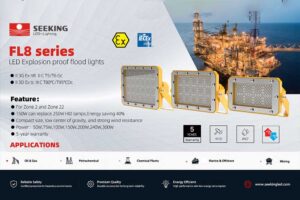
Certified explosion proof floodlights for Zone 2 & 22 hazardous areas. Lightweight, DALI-ready, fast wiring design. Reliable industrial safety by SEEKINGLED.
View details
Certified explosion proof work lights for Zone 1 & 21 hazardous areas. Portable, ATEX & IECEx approved, built for oil, gas and chemical plants by SEEKINGLED.
View details
LED explosion proof high bay lights are designed for Zone 1, Zone 2, Zone 21 and Zone 22 hazardous areas. This page introduces the HB21 Series from SEEKING, including certifications, power options and real application considerations.
View details
LED Linear Explosion Proof Lights and EX Proof lights for Zone 1, Zone 2, Zone 21 and Zone 22 hazardous areas. ATEX & IECEx certified explosion proof LED linear lighting with emergency function, adjustable power and IP67 protection by SEEKINGLED.
View details
SEEKINGLED LED Linear Explosion Proof Light and Explosion Proof lighting is ATEX and IECEx certified for Zone 1, Zone 2, Zone 21 and Zone 22 hazardous locations, built for long-term industrial use.
View details
SEEKINGLED LED Explosion Proof Flood Lights are flameproof ATEX and IECEx certified for Zone 1 and Zone 2 hazardous areas, offering high power, adjustable output and long service life.
View details
SEEKINGLED LED Explosion Proof Flood Lights are ATEX certified for Zone 2 and Zone 22 hazardous areas, offering high efficiency, adjustable power and integrated junction box.
View details
SEEKINGLED LED Gas Station Canopy Lights are ATEX certified for Zone 2 and Zone 22 hazardous areas, featuring adjustable power and built-in explosion-proof junction box.
View details
LED Linear Explosion Proof Lights from SEEKINGLED. LU Series Flame Proof lights ATEX-certified explosion proof LED linear lighting for Zone 2 gas and Zone 22 dust areas, IP69K, IK10, long lifetime and flexible power options.
View detailsReal project record of XJ-HBS200W high bay with motion and daylight sensor installed in an Australian warehouse, focusing on on-site setup and energy-saving results.
View detailsExplosion proof junction boxes engineered for hazardous areas. SEEKINGLED ATEX-certified enclosures ensure safe cable connections in oil, gas, mining and chemical plants.
View detailsLED high bay light UFO designed for large indoor spaces requiring low glare, high efficiency and long-term reliability. SEEKINGLED HB13(GLK) Series delivers up to 170 lm/W, UGR
View detailsDiscover explosion-proof light fixtures engineered for hazardous locations. Learn ATEX ratings, certifications, industrial safety standards, and LED performance.
View details