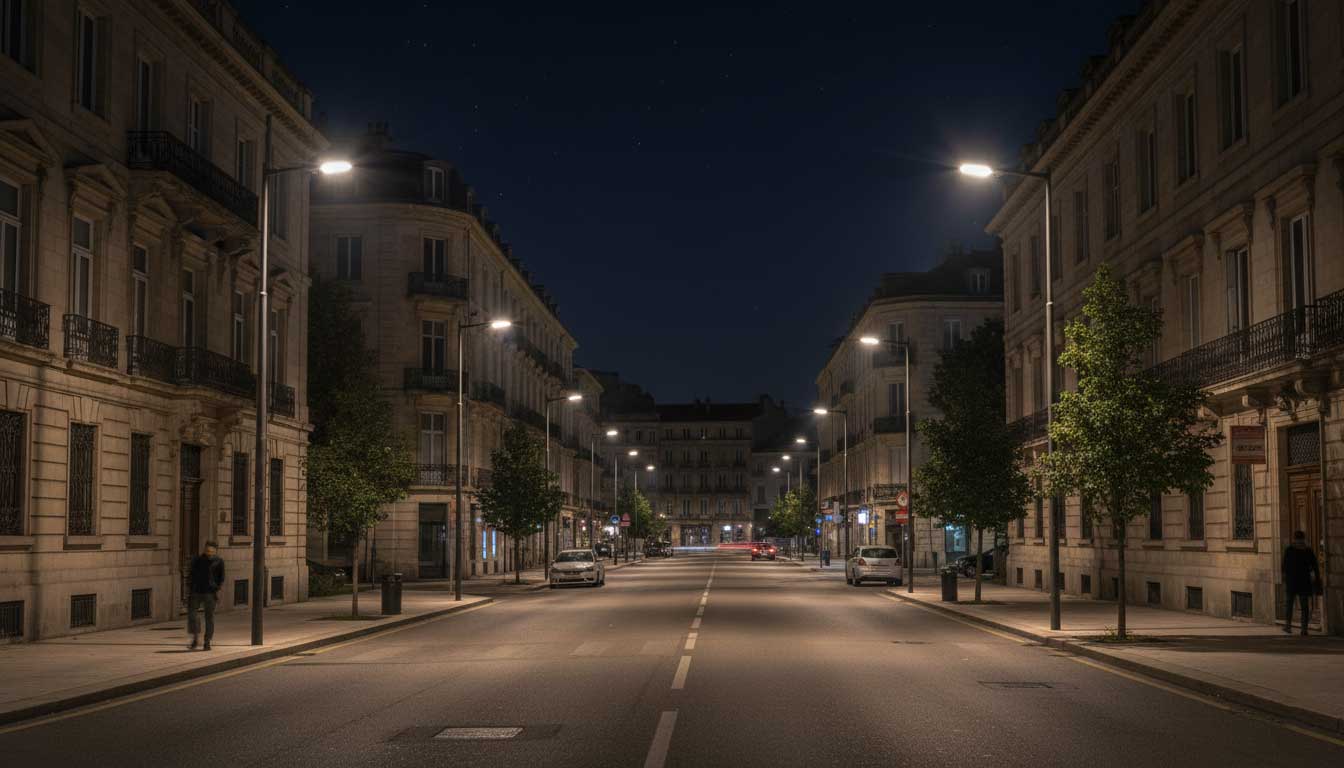
LED optics direct light precisely to the road surface, improving visibility.
Are LED street lights brighter than older street lighting systems? In most modern projects, the short answer is yes—but the real reason is not just higher lumen numbers.
Brightness on the road depends on how efficiently light is delivered to the surface, not simply how powerful the lamp looks on paper. This is where LED street lighting has a clear advantage.
Why LED Street Lights Appear Brighter in Real Use
Traditional street lights such as high-pressure sodium or metal halide scatter a large portion of light in unwanted directions. Even with high wattage, much of that output never reaches the road evenly.
LED street lights use directional optics. Light is shaped, controlled, and aimed exactly where it is needed—road lanes, sidewalks, bike paths, or parking areas. As a result, the same or lower wattage LED fixture often produces noticeably brighter and clearer road visibility.
In practical terms, drivers see sharper lane edges, pedestrians are easier to spot, and shadow-heavy areas are reduced.
Lumens vs. Usable Brightness
A common misunderstanding is equating brightness with raw lumen output alone. While lumens matter, optical efficiency and beam distribution matter just as much.
For example, the SEEKINGLEDSTB Series delivers up to 160 lm/W, meaning more light reaches the ground with fewer fixtures. With beam types like TPⅡM and TPⅢS, illumination stays consistent across different road widths without excessive glare.
This controlled distribution is one of the main reasons LED street lights are perceived as brighter, even when replacing higher-wattage legacy lamps.
Color Temperature Also Plays a Role
LED street lights typically operate at 4000K or 5700K. These cooler white tones improve contrast and color recognition at night.
Older sodium lamps produce yellow-orange light, which reduces clarity and depth perception. Even when those lamps are technically “bright,” the road surface often looks dull and uneven.
This is another reason people often say LED street lights are brighter—they simply allow the human eye to see more detail.
Are Brighter LED Street Lights Always Better?
Not necessarily. Over-bright lighting without proper optics can create glare, which reduces safety instead of improving it.
Well-designed LED street lights balance brightness with uniformity. The STB Series, for instance, combines high output with controlled optics, IP66 sealing, and 10 kV surge protection, making it suitable for long-term urban and commercial use without causing discomfort or excessive light spill.
Where Brighter LED Street Lights Make the Biggest Difference
LED street lighting shows the clearest improvement in:
City roads and residential streets
Parking lots and logistics parks
Industrial zones and port areas
Bike lanes and pedestrian routes
Public squares and commercial districts
In these environments, better visibility directly improves safety and reduces complaints from residents and road users.
A Practical Conclusion
So, are LED street lights brighter? In real-world applications, yes—but more importantly, they are more effective.
By delivering light where it’s actually needed, LED street lights provide clearer roads, better visibility, and improved safety while consuming less energy and requiring less maintenance. That’s why many cities now treat LED street lighting as a long-term infrastructure upgrade rather than a simple lamp replacement.
Since April, SEEKINGLED’s production workshop has been operating at full capacity. Due to rising material prices, lamp manufacturers and overseas buyers have been placing orders aggressively, resulting in a sharp surge in demand. The supply chain ...
How far apart should LED high bay lights be spaced? Learn practical spacing guidelines based on ceiling height, beam angle, and real industrial layouts.
SEEKINGLED delivers a high-efficiency linear high bay lighting solution for South Africa’s first Walmart-branded store, achieving low glare, high lux levels, and 65% energy savings.
A how many led high bay lights do I need calculator helps estimate fixture quantity based on area, height, and lux level. Learn how engineers calculate it.
 Seeking LED