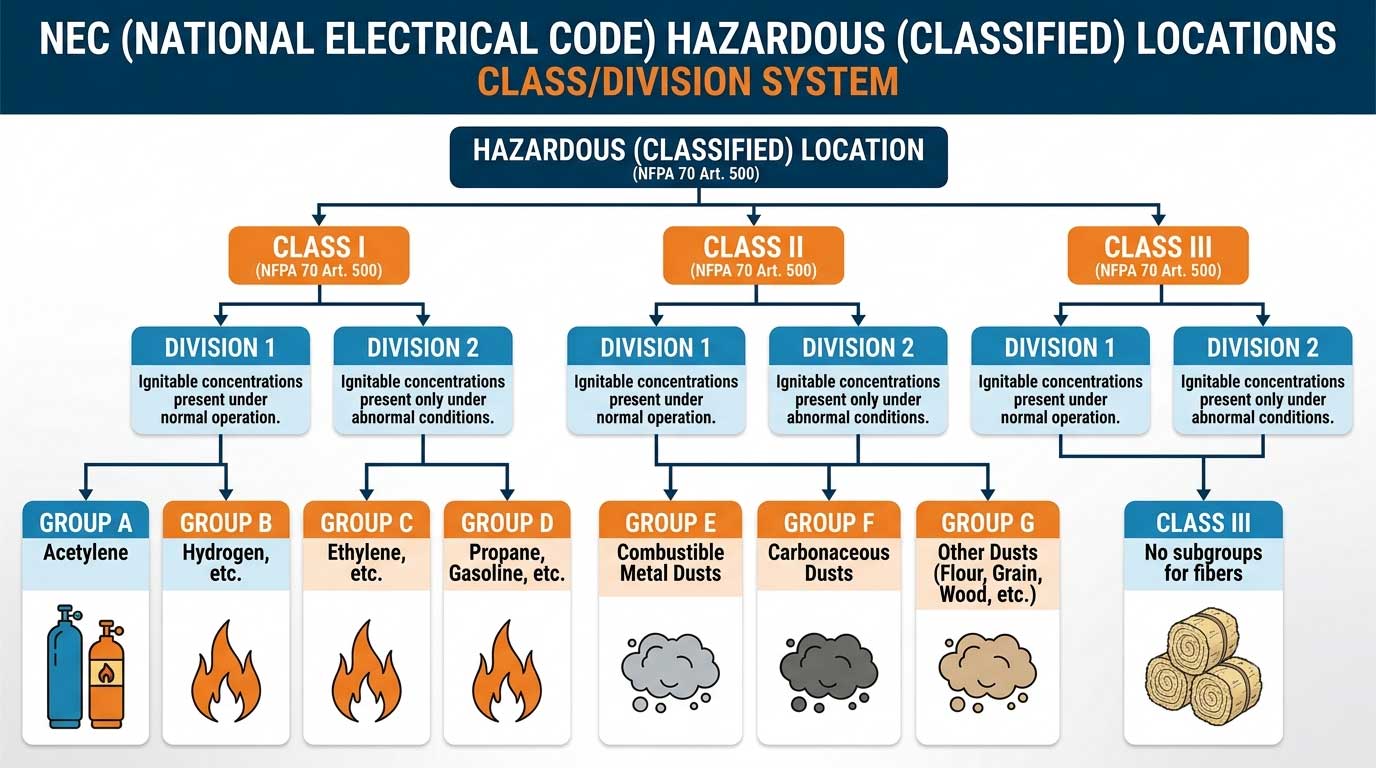
This is the safety classification system used in the United States and Canada (based on the National Electrical Code – NEC) to identify hazardous locations where there is a risk of fire or explosion due to flammable gases, dust, or fibers.
The system uses three main labels: Class (type of hazard), Division (likelihood of the hazard), and Group (specific substance).
1.Class – What is the hazardous material?
Class I = Flammable gases, vapors, or liquids (e.g. natural gas, gasoline vapor, hydrogen)
Class II = Combustible dust (e.g. flour, coal dust, metal dust, grain dust)
Class III = Ignitable fibers or flyings (e.g. textile lint, wood shavings, cotton)
2.Division – How likely is the hazard to be present?
Division 1 (High Risk) = The hazardous material is present or likely to exist in ignitable concentrations under normal operating conditions, during routine maintenance, or due to equipment failure.
Division 2 (Lower Risk) = The hazardous material is not normally present in ignitable concentrations, but could be released if there is an accident, leak, or equipment breakdown.
3.Group – Which specific substance? (For Class I gases/vapors, ordered from most to least hazardous)
Group A = Acetylene
Group B = Hydrogen, butadiene, ethylene oxide, propylene oxide, acrolein
Group C = Ethylene, ethyl ether, cyclopropane
Group D = Propane, methane, gasoline, alcohol, acetone
For Class II (Dust):
Group E = Metal dust (e.g. aluminum, magnesium)
Group F = Carbon-based dust (e.g. coal, coke)
Group G = Grain, flour, wood, or plastic dust
Example Label & Meaning
If a device is marked Class I, Division 1, Group D:
It is suitable for areas with flammable gases/vapors (Class I)
The gas is likely present during normal operations (Division 1)
The gas is like propane or gasoline (Group D)
Simple Rule:
Division 1 = Higher risk (hazard exists under normal conditions) → Requires stronger protection.
Division 2 = Lower risk (hazard only appears during abnormal conditions) → Still needs protection, but less stringent than Division 1.
 Seeking LED