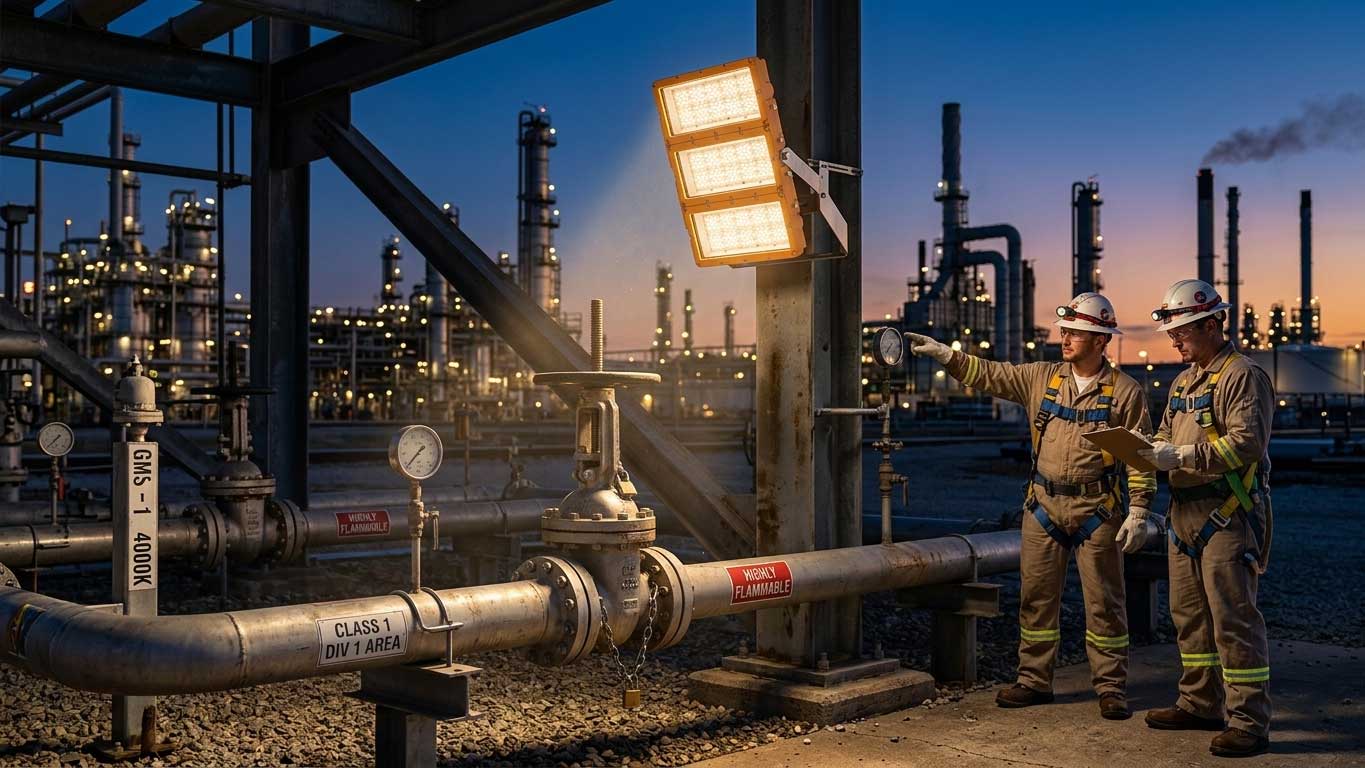
Explosion proof Class 1 Div 1 lighting is a certified hazardous-location lighting system designed to safely operate in areas where flammable gases or vapors are continuously or frequently present. These fixtures contain internal sparks or heat so they cannot ignite the surrounding atmosphere.
That’s the technical definition. In real industrial environments, though, Class 1 Div 1 lighting is less about brightness and more about surviving conditions where one electrical fault could trigger a catastrophic explosion.
I first understood the importance of this standard during a refinery retrofit in Southeast Asia. The client had several non-certified floodlights installed near solvent transfer pumps. The fixtures worked fine for years—until corrosion damaged a cable gland seal. Nothing exploded, fortunately, but the safety audit that followed shut down the entire process line for almost 18 hours. The lighting replacement cost was small. The production loss was not.
What does Class 1 Div 1 mean in hazardous lighting?
Industrial hazardous-area classifications come from the National Electrical Code (NEC) published by the National Fire Protection Association.
According to NFPA 70 NEC Article 500, a Class 1 Division 1 area contains flammable gases or vapors under normal operating conditions. These hazardous substances may exist continuously, intermittently, or during routine maintenance.
Typical gases include:
Hydrogen
Propane
Ethylene
Acetylene
Methane
Gasoline vapors
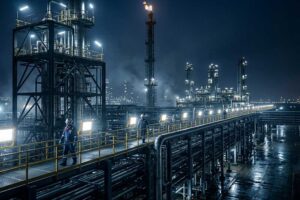
Common Class 1 Div 1 environments
Industry
Typical Hazard Area
Oil & Gas
Drilling rigs, mud tanks, wellheads
Chemical Plants
Solvent mixing rooms
Marine
Fuel transfer stations
Pharmaceutical
Alcohol processing lines
Wastewater
Biogas treatment zones
Aviation
Fuel storage facilities
The Occupational Safety and Health Administration (OSHA) references these classifications under hazardous location electrical safety requirements.
According to OSHA, electrical equipment installed in hazardous locations must prevent ignition of surrounding atmospheres under both normal and abnormal conditions.
Instead of “preventing sparks completely,” the fixture assumes sparks may happen internally. The housing is built thick enough and sealed tightly enough to contain an ignition event without allowing flames or hot gases to escape into the external atmosphere.
This design principle is called flame path containment.
How Class 1 Div 1 explosion proof lights are built
A real Class 1 Div 1 fixture feels noticeably heavier than ordinary industrial lighting. Some high-output floodlights exceed 15–20 kg because enclosure thickness directly affects explosion containment capability.
Internal flame path engineering
One detail many buyers overlook is the flame path machining.
During an internal ignition event, expanding gases must cool before exiting the enclosure. Flame paths create controlled escape routes that reduce gas temperature below ignition thresholds.
Poor machining tolerance can invalidate certification entirely.
That’s why reputable manufacturers rely on precise CNC finishing and third-party testing instead of “self-declared compliance.”
Real certifications that matter
A surprising number of online suppliers advertise “explosion proof style” lighting without legitimate certification.
For North America, true Class 1 Div 1 products normally require certification from recognized testing bodies such as:
UL
FM Approvals
CSA
Relevant standards often include:
Standard
Purpose
UL 844
Hazardous location luminaires
NEC Article 500
Hazardous area classification
NFPA 70
National Electrical Code
ANSI/ISA standards
Industrial hazardous locations
According to the U.S. Chemical Safety Board (CSB), ignition of flammable atmospheres remains a recurring factor in industrial incidents involving electrical equipment failures.
Fifteen years ago, many hazardous facilities still used metal halide fixtures.
They were inefficient. Worse, they ran extremely hot.
Some older 400W metal halide housings reached surface temperatures above 200°C during operation. That matters because gas ignition temperatures vary widely.
LED technology reduced both energy consumption and thermal risk.
The U.S. Department of Energy reports that LED industrial lighting can reduce energy consumption by approximately 50–70% compared to traditional HID systems.
Marine-certified Class 1 Div 1 fixtures typically use:
C4/C5 anti-corrosion coatings
316 stainless steel hardware
IP66 or IP67 sealing
Vibration-resistant mounting
Chemical processing facilities
In solvent-heavy environments, vapor density fluctuates constantly.
I’ve walked facilities where the smell of xylene was noticeable long before instrumentation alarms activated. Lighting installed there cannot rely on “unlikely failure scenarios.”
That’s exactly why Division 1 standards exist.
What temperature class means for explosion proof lighting
Temperature class—or T-rating—is one of the most misunderstood specifications.
A fixture may be explosion proof yet still unsafe for certain gases if its surface temperature becomes too high.
Example:
Temperature Class
Maximum Surface Temperature
T1
450°C
T4
135°C
T6
85°C
Many oil and gas operators now prefer T4 or better for additional safety margins.
Lower surface temperatures reduce ignition risk in volatile atmospheres.
Maintenance mistakes that quietly destroy compliance
This part rarely gets discussed online.
A certified fixture can lose protection if maintenance crews:
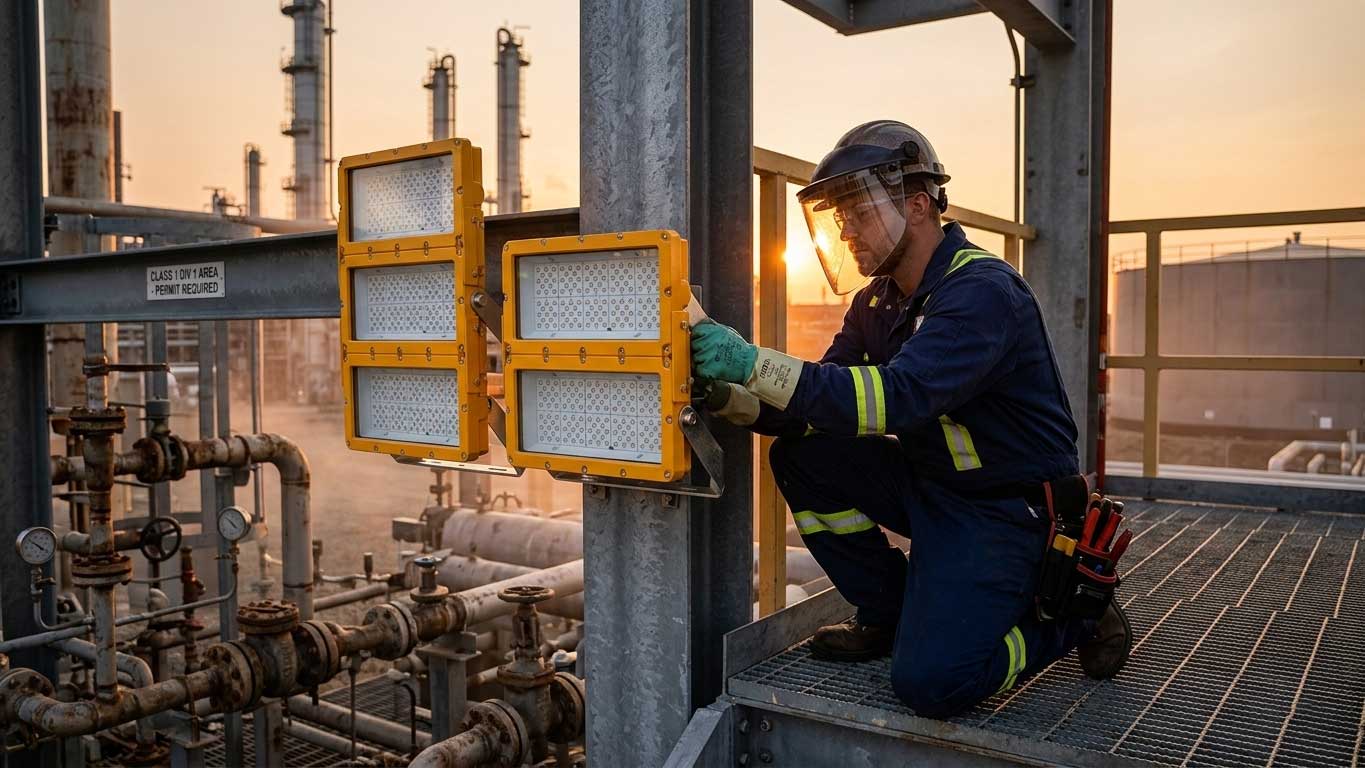
Replace bolts with non-approved hardware
Damage flame paths during cleaning
Use incorrect cable glands
Repaint flame-path surfaces
Open energized fixtures in hazardous zones
I’ve seen maintenance teams unknowingly apply anti-corrosion paint across flame-path joints. The fixture looked cleaner afterward—but technically failed compliance inspection.
LED lifespan versus real-world industrial lifespan
Manufacturers often advertise:
50,000 hours
100,000 hours
L70 ratings
But hazardous environments are harsher than laboratory conditions.
Real service life depends heavily on:
Ambient temperature
Corrosive chemicals
Voltage fluctuation
Vibration
Driver quality
Thermal management
In high-temperature refinery zones above 55°C ambient, driver degradation usually appears before LED chip failure.
That’s one reason premium hazardous lighting uses separated driver chambers and oversized heat sinks.
Difference between Class 1 Div 1 and Div 2 lighting
This confusion causes expensive procurement mistakes.
Classification
Hazard Presence
Class 1 Div 1
Hazard exists during normal operation
Class 1 Div 2
Hazard exists only under abnormal conditions
Division 2 fixtures are generally less robust because explosive atmospheres are not expected continuously.
Using Div 2 fixtures inside Div 1 zones violates code compliance and increases ignition risk.
FAQ:What is explosion proof Class 1 Div 1 lighting?
Is Class 1 Div 1 lighting waterproof?
Most modern fixtures are rated IP66 or IP67, meaning they resist heavy dust and water ingress. However, waterproofing alone does not equal explosion proof certification.
Can LED lights be explosion proof?
Yes. Modern hazardous-area LED fixtures are specifically engineered and certified for explosive gas environments. LEDs now dominate new refinery and chemical plant installations because of lower heat output and higher efficiency.
What is the difference between ATEX and Class 1 Div 1?
ATEX is the European hazardous-area certification framework, while Class 1 Div 1 comes from North American NEC standards. Both address explosive atmospheres but use different classification systems.
Are all industrial LED lights explosion proof?
No. Many industrial LED fixtures are only weather-resistant or dustproof. True explosion proof fixtures require certified hazardous-location testing and approval.
Final thoughts from the field
After years around hazardous-area projects, one pattern keeps repeating: lighting failures rarely happen because facilities choose products that are “too weak.” Problems usually start when buyers underestimate the environment.
Then one failed seal, one loose gland, or one overheated driver suddenly matters.
That’s why What is explosion proof Class 1 Div 1 lighting is not just a technical keyword. In real facilities, it represents a very specific engineering promise: the fixture must fail safely, even when the environment around it cannot.
SEEKINGLED designs hazardous-area LED lighting systems for demanding industrial environments where compliance, durability, and operational safety cannot be compromised.
LED High Bay Lighting for Gym Spaces was required in a German gym to avoid glare and uneven light. This project note records how XJ-HBL series fixtures with frosted glass were selected and verified through Dialux calculation.
Lamp explosion proof explained: real safety design, certifications, and industrial use cases. Learn how explosion proof lamps work from SEEKINGLED experts.
ATEX LED flood light solutions deliver safe, powerful illumination for hazardous zones. Learn certifications, Zone ratings, durability, and industrial uses.
How long should LED lights last in real use? Learn true lifespan, what affects it, and why some LEDs fail early. Practical insights from real installations.
 Seeking LED