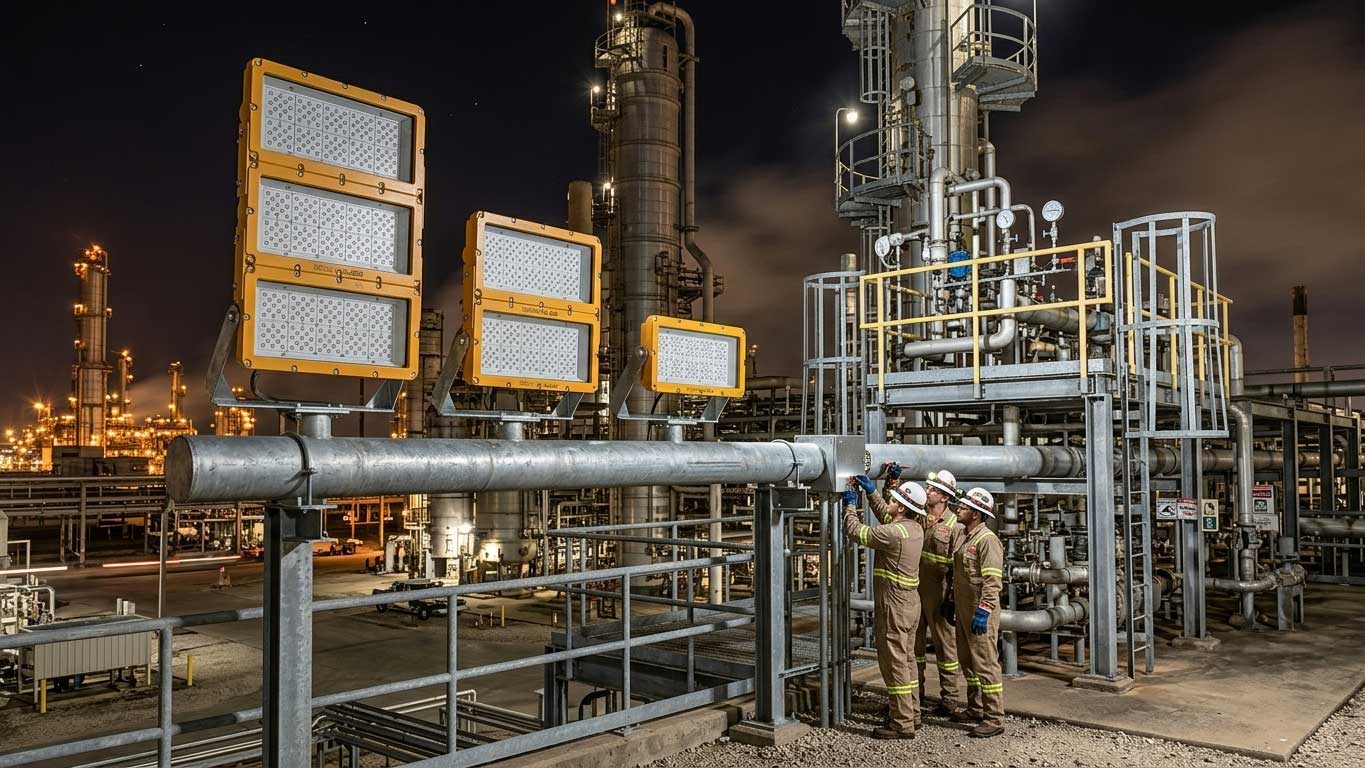
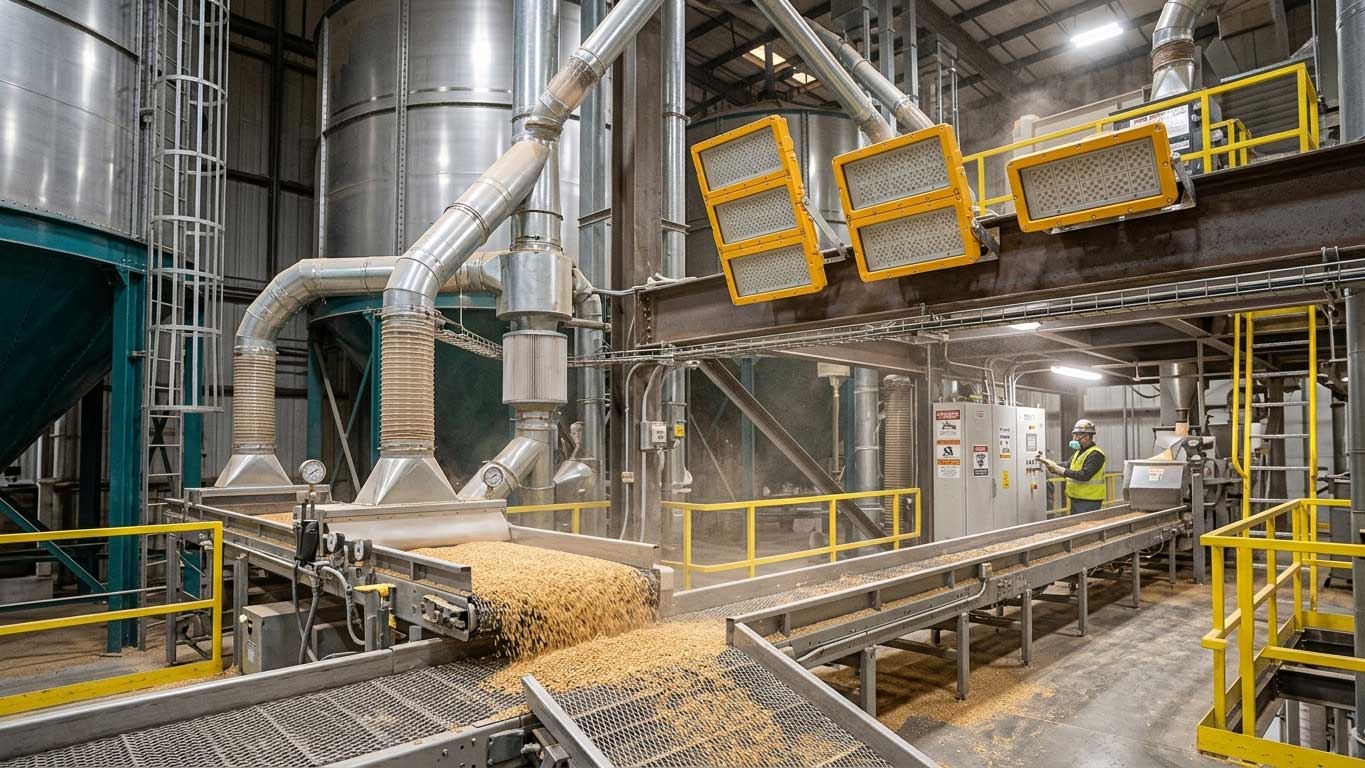
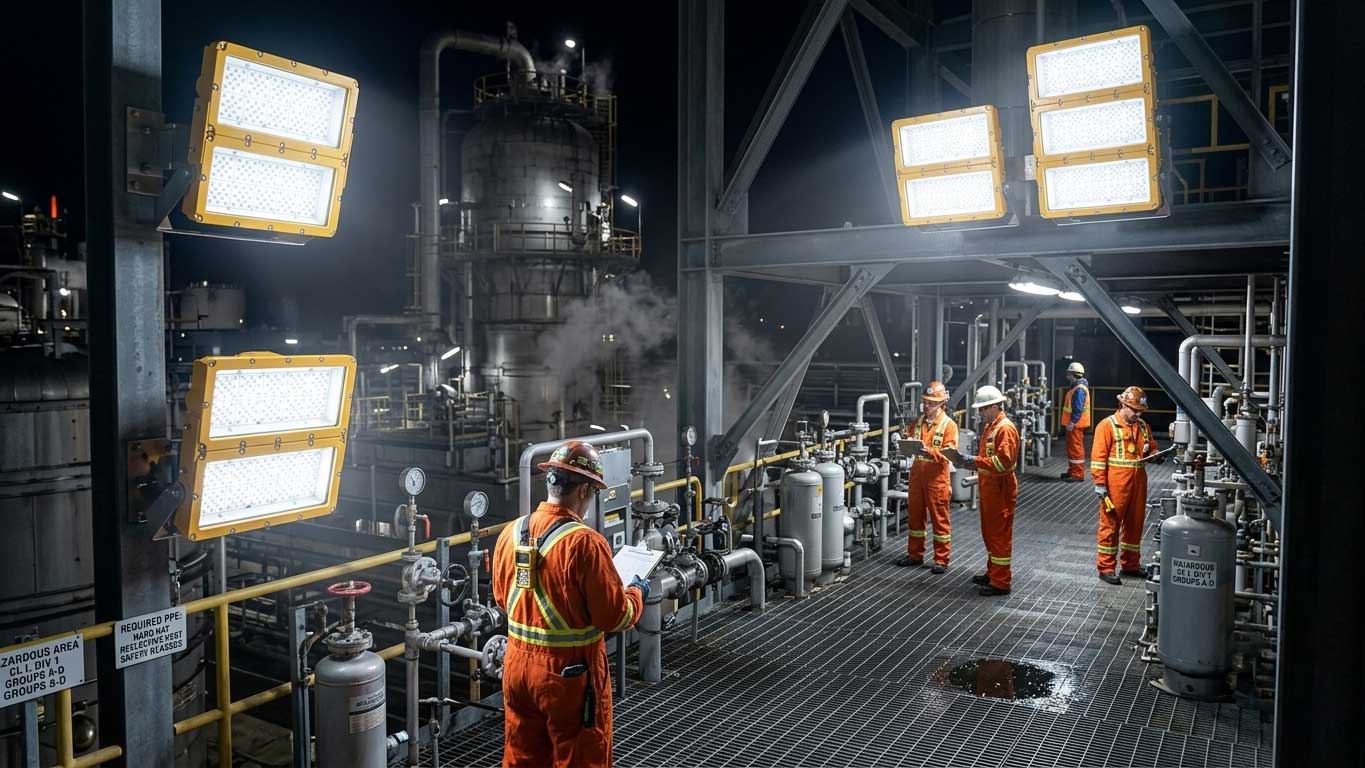
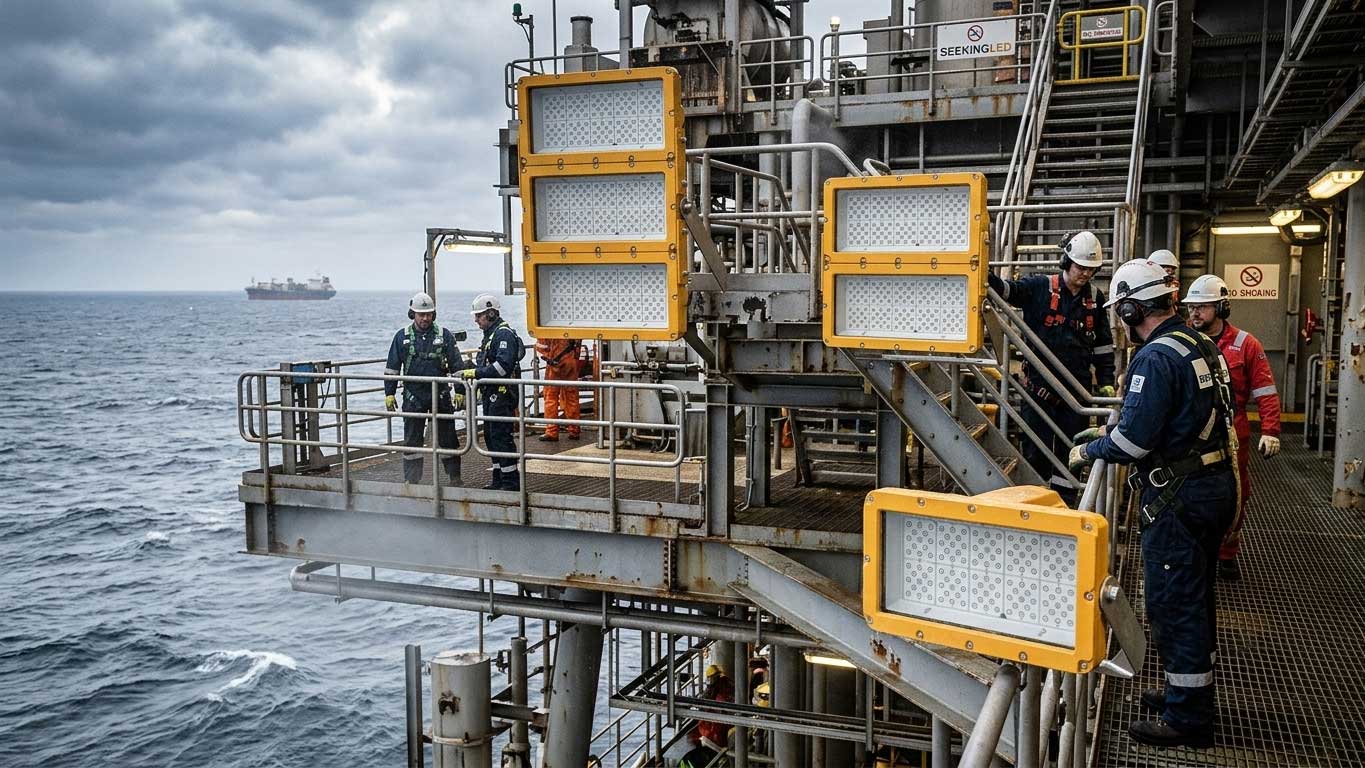
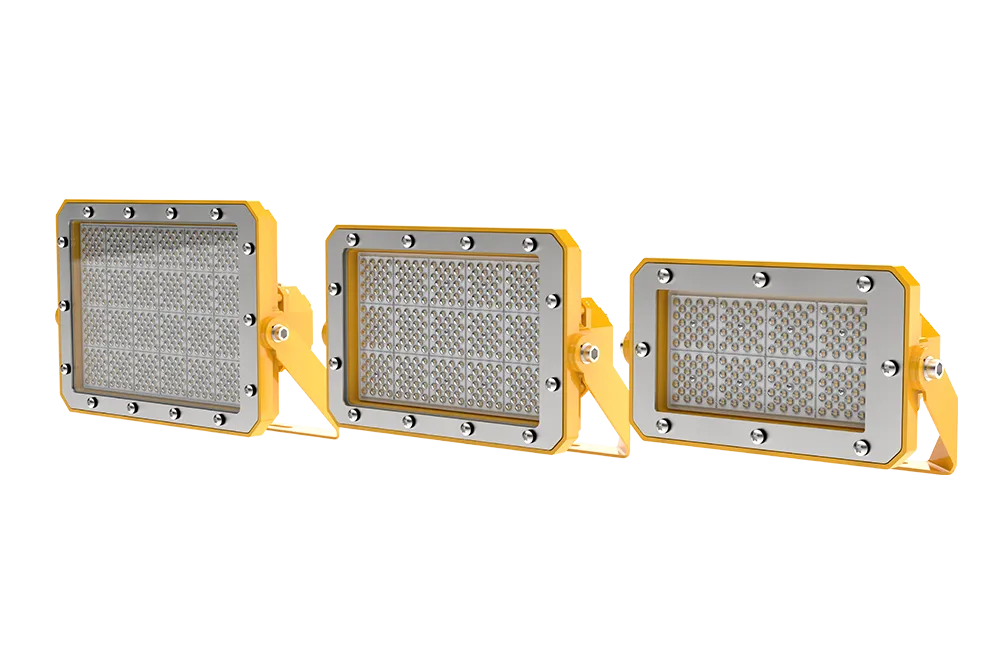
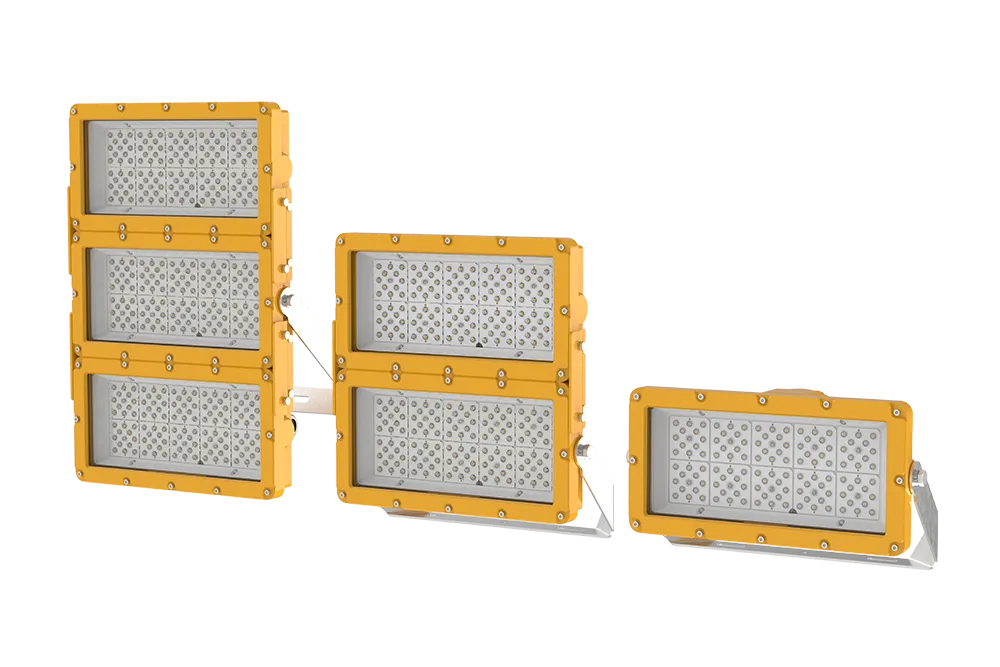
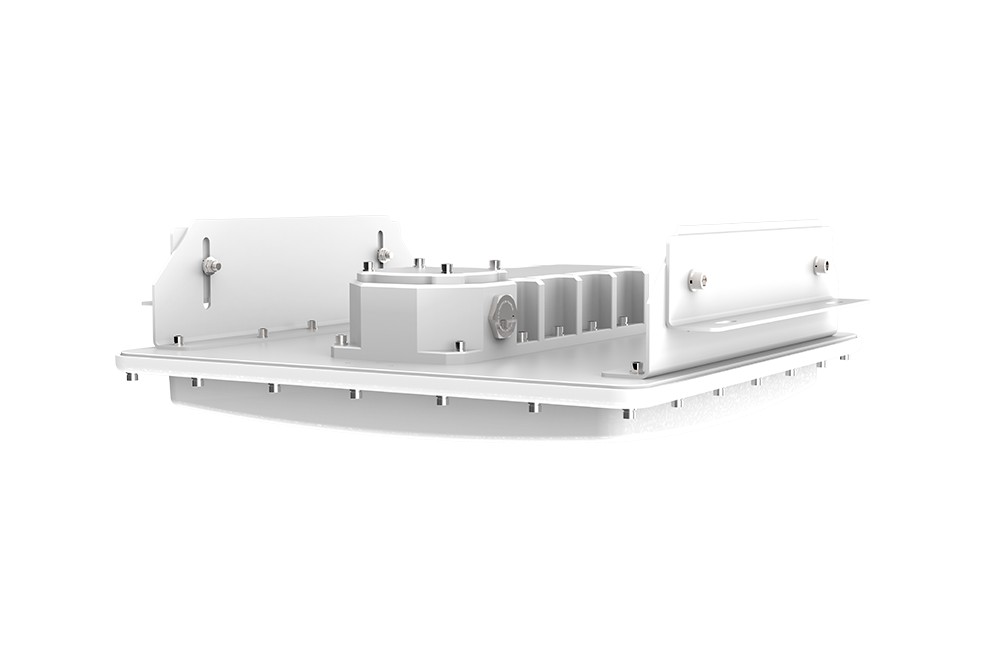
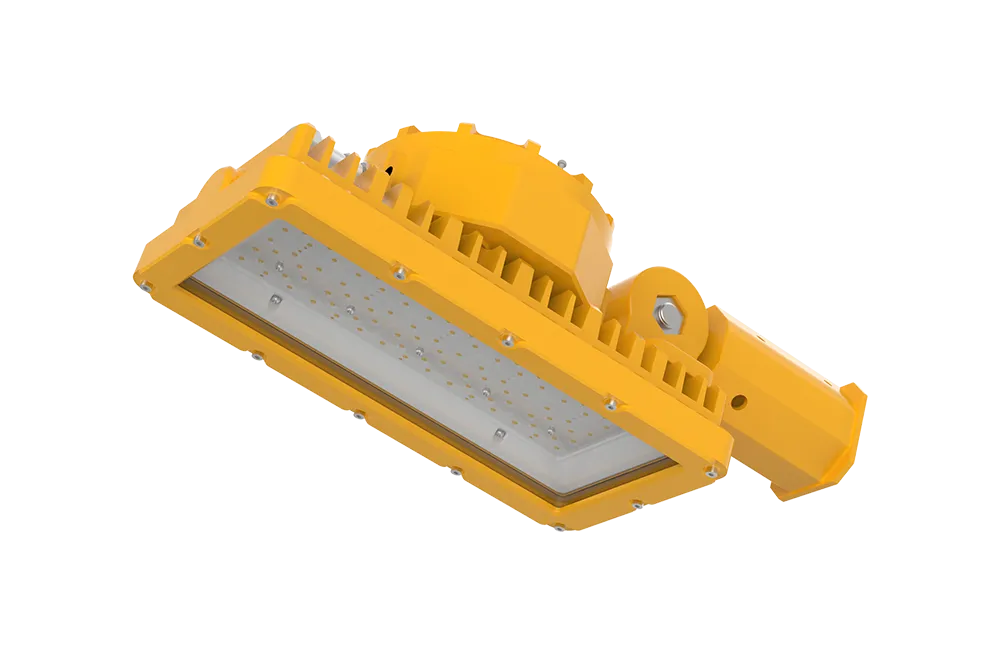
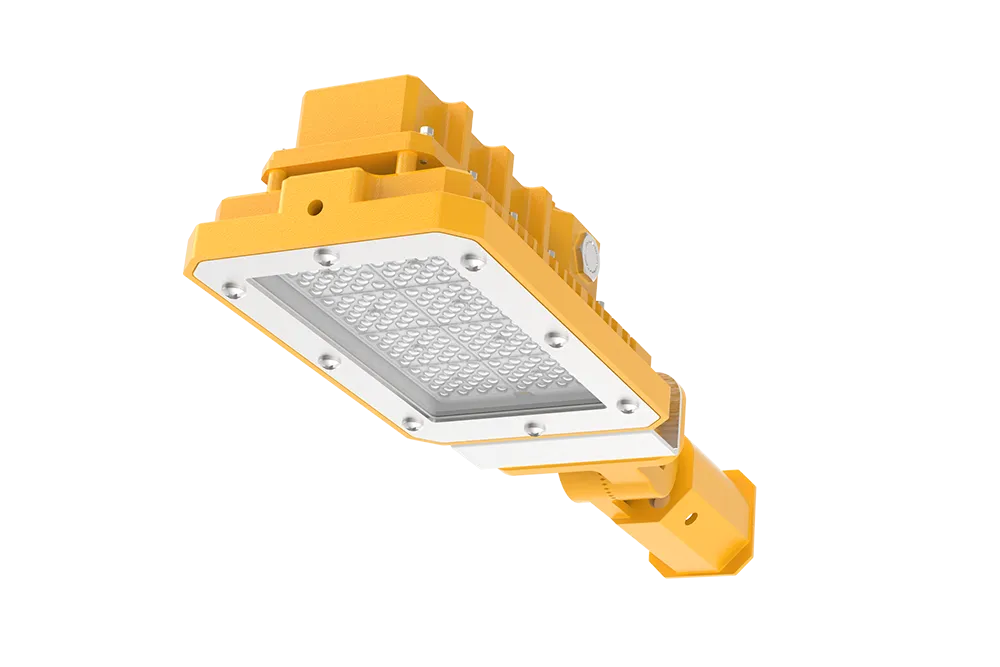
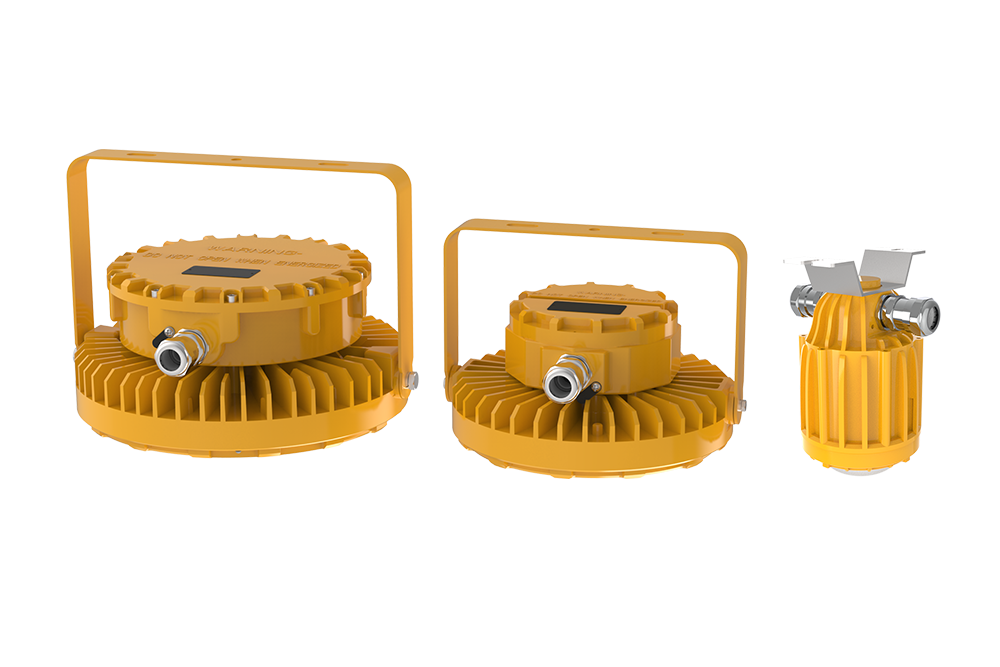
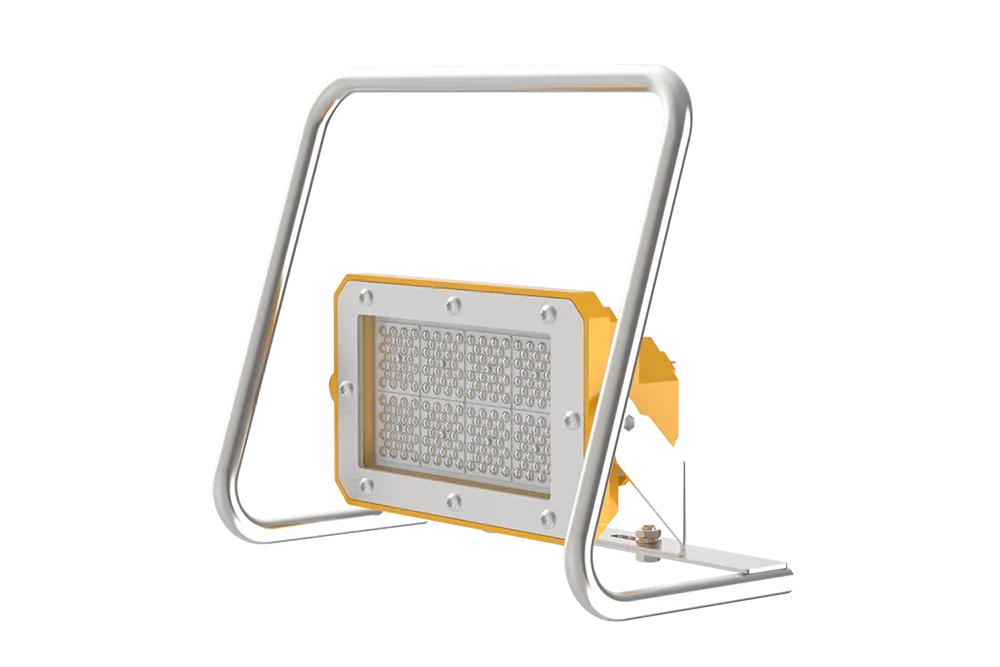
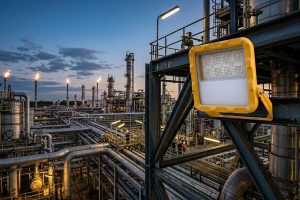
A 100W LED explosion proof flood light is designed to safely illuminate hazardous locations where flammable gases, vapors, dust, or combustible particles may be present. When properly certified and installed, a 100W unit delivers high lumen output, long service life, and significantly lower maintenance costs than traditional HID floodlights while meeting strict hazardous-area safety requirements.
I have spent more than a decade working with industrial lighting projects involving petrochemical terminals, offshore platforms, grain processing facilities, and chemical storage yards. One pattern appears repeatedly: many facilities buy oversized floodlights believing more watts automatically means more safety. In reality, proper certification, beam distribution, thermal management, and installation location matter far more than raw wattage.
For many medium-sized hazardous areas, a 100W LED explosion proof flood light sits in the sweet spot between coverage, efficiency, and installation cost.
Why 100W LED Explosion Proof Flood Lights Have Become an Industry Standard
Twenty years ago, hazardous-area floodlighting was dominated by 250W, 400W, and even 1000W metal halide fixtures.
The problem was obvious.
They consumed enormous amounts of electricity.
They generated excessive heat.
Lamp replacement often required shutting down work zones.
Maintenance crews frequently needed special permits before entering classified locations.
Today, a quality 100W LED explosion proof flood light can produce between 14,000 and 18,000 lumens depending on optical design and LED package efficiency.
According to the U.S. Department of Energy, LED lighting can reduce lighting energy consumption significantly compared with legacy HID technologies while providing longer operational life.
For facility managers, that translates into:
Lower electricity bills
Fewer maintenance shutdowns
Better visibility
Improved worker safety
Lower total ownership costs
Understanding Explosion-Proof Protection
What “Explosion Proof” Actually Means
One misconception I still encounter on industrial sites is that explosion-proof lights prevent explosions from happening.
They do not.
The fixture is designed to contain an internal ignition event and prevent flames or hot gases from igniting the surrounding hazardous atmosphere.
If an electrical fault occurs inside the enclosure:
The housing contains the pressure
Flame paths cool escaping gases
External ignition is prevented
This engineering principle has protected hazardous facilities for decades.
Typical Certifications Found on a 100W LED Explosion Proof Flood Light
Depending on project location, certifications may include:
A floodlight should never be selected based solely on wattage.
The certification must match the hazardous classification of the installation site.
How Much Light Does a 100W LED Explosion Proof Flood Light Produce?
This is where specifications often become misleading.
Some manufacturers advertise wattage.
Others advertise lumens.
The lumen figure is what matters.
Typical performance ranges:
Fixture Type
Power
Typical Lumens
Legacy Metal Halide
250W
15,000–18,000
Legacy Metal Halide
400W
24,000–36,000
Modern Hazardous LED
100W
14,000–18,000
Premium Hazardous LED
100W
18,000–20,000+
The difference comes from optical efficiency.
In a recent chemical terminal retrofit project, replacing 250W metal halide fixtures with certified 100W LED explosion proof flood lights reduced lighting energy consumption by approximately 60%.
What surprised the maintenance team was not the energy reduction.
It was the visibility improvement.
Workers reported better color recognition around valves, gauges, and emergency controls.
Common Applications for 100W LED Explosion Proof Flood Lights
Oil and Gas Facilities
Oil and gas remains one of the largest users of hazardous-area lighting.
Typical installations include:
Tank farms
Loading racks
Pump stations
Refinery process areas
Offshore platforms
Hydrocarbon vapors create ignition risks that require certified equipment.
Chemical Processing Plants
Chemical facilities often contain:
Solvents
Acetone
Ethanol
Hydrogen
Methanol
A properly certified 100W LED explosion proof flood light provides reliable illumination while meeting area classification requirements.
Grain Handling Operations
Many people associate hazardous locations only with oil and gas.
Yet combustible dust explosions remain a serious industrial hazard.
Facilities include:
Grain elevators
Flour mills
Feed mills
Sugar processing plants
According to the U.S. Occupational Safety and Health Administration (OSHA), combustible dust incidents have caused numerous fatalities and facility losses over the years.
This is why dust-certified lighting remains essential.
Key Technical Features Buyers Often Ignore
Thermal Management
Heat is the primary enemy of LED lifespan.
A floodlight may advertise:
100,000 hours
120,000 hours
150,000 hours
But poor thermal design can dramatically shorten real-world life.
When inspecting fixtures, I pay close attention to:
Heat sink mass
Fin geometry
Driver placement
Ambient temperature rating
In desert projects where ambient temperatures exceed 50°C (122°F), thermal design becomes even more critical.
Beam Angle Selection
The wrong beam angle wastes light.
Common options include:
Beam Angle
Application
30°
Long-distance targets
60°
Equipment yards
90°
Medium-area illumination
120°
Wide flood coverage
A narrow beam often outperforms a higher-wattage floodlight when illuminating distant equipment.
Corrosion Resistance
Many hazardous locations are also corrosive locations.
Particularly:
Offshore platforms
Coastal terminals
Fertilizer facilities
Chemical plants
Look for:
Marine-grade aluminum
Powder-coated surfaces
Stainless steel hardware
IP66 or IP67 protection
I have seen inexpensive fixtures fail from corrosion long before the LEDs themselves degraded.
What Separates Premium Floodlights from Low-Cost Alternatives?
Not all 100W LED explosion proof flood lights are equal.
Three units may appear nearly identical externally.
Internally, they can be dramatically different.
Areas where premium products usually stand out:
Certified LED drivers
Better thermal management
Stronger housing construction
Higher surge protection
Superior optical lenses
More rigorous hazardous-area testing
This becomes especially important on offshore projects where replacing a failed fixture may cost far more than the fixture itself.
How to Read Hazardous-Area Certifications Correctly
One of the most expensive mistakes I see during project reviews is assuming all explosion-proof floodlights can be installed everywhere.
They cannot.
A certification is only valid when it matches the hazardous classification of the site.
For example, a floodlight approved for a dust environment may not automatically be suitable for a gas environment.
Likewise, a fixture certified for Zone 2 may not be allowed in Zone 1.
ATEX Marking Example
A typical marking might look like:
Ex db IIC T5 Gb
Breaking it down:
Marking
Meaning
Ex
Explosion-protected equipment
db
Flameproof enclosure
IIC
Hydrogen and acetylene gas group
T5
Maximum surface temperature 100°C
Gb
High protection level for gas atmosphere
For facility engineers, understanding these markings is often more important than understanding wattage.
A 100W LED explosion proof flood light with the wrong certification is simply the wrong product.
Real Cost of Ownership Over Ten Years
Many purchasing teams focus heavily on purchase price.
That approach rarely survives a lifecycle cost analysis.
Several years ago, I participated in a refinery lighting replacement study involving more than 300 hazardous-area floodlights.
The maintenance records revealed something interesting.
The cost of accessing fixtures was often greater than the cost of the fixtures themselves.
Scaffolding.
Work permits.
Shutdown procedures.
Safety supervision.
Technician labor.
All of these expenses accumulate.
Example Cost Comparison
Factor
400W Metal Halide
100W LED Explosion Proof Flood Light
Power Consumption
High
Low
Lamp Replacement
Every 1–2 years
Not required
Warm-Up Time
Several minutes
Instant
Maintenance Visits
Frequent
Minimal
Color Rendering
Moderate
Better
Expected Service Life
15,000–20,000 hours
60,000–100,000+ hours
According to the U.S. Department of Energy, LEDs can deliver substantial reductions in energy and maintenance costs compared with conventional lighting technologies.
In remote oil terminals, the savings become even more dramatic because maintenance access is expensive.
Selecting the Right 100W LED Explosion Proof Flood Light
A specification sheet can look impressive.
That does not necessarily mean the fixture will perform well in the field.
When evaluating products, I normally prioritize the following categories.
Housing Construction
Look for:
Die-cast aluminum housing
Stainless steel fasteners
Corrosion-resistant coating
Reinforced mounting bracket
In coastal facilities, corrosion often destroys hardware long before LEDs fail.
Ingress Protection
Hazardous facilities are rarely clean environments.
Dust, chemicals, rain, washdown procedures, and salt spray all challenge lighting systems.
Recommended ratings:
Environment
Minimum Rating
Indoor Industrial
IP66
Outdoor Industrial
IP66
Offshore Platforms
IP67
Chemical Facilities
IP66/IP67
Surge Protection
Power quality varies significantly.
Large motors, pumps, and switching equipment create voltage spikes.
I generally recommend:
Minimum 6kV surge protection
Preferred 10kV surge protection
Heavy industrial sites: 20kV options when available
Many early LED failures originate from electrical stress rather than LED degradation.
Common Mistakes During Installation
I’ve reviewed hundreds of hazardous-area lighting installations.
Certain mistakes appear repeatedly.
Incorrect Mounting Position
Floodlights designed for specific thermal orientations should not be mounted arbitrarily.
Poor positioning can affect:
Heat dissipation
Driver life
Optical performance
Always follow manufacturer instructions.
Ignoring Beam Layout
A common misconception:
More floodlights = better lighting.
Not necessarily.
I have visited facilities where six fixtures created worse visibility than four properly aimed fixtures.
Excessive overlap creates glare.
Glare reduces visual comfort.
Reduced visual comfort can increase operational risk.
Using Non-Certified Accessories
The floodlight may be certified.
The mounting accessories may not be.
Cable glands, junction boxes, conduit fittings, and connectors must also meet hazardous-area requirements.
This issue frequently appears during audits.
Where a 100W Floodlight Performs Best
A 100W LED explosion proof flood light is particularly effective in medium-sized coverage zones.
Examples include:
Tank Farm Perimeters
Access roads
Valve stations
Loading areas
Emergency routes
Process Equipment Platforms
Pump skids
Compressor stations
Filtration systems
Chemical dosing units
Marine and Offshore Facilities
Helideck support areas
Deck walkways
Crane zones
Service platforms
In many of these applications, a well-designed 100W unit provides adequate illumination without requiring higher-power fixtures.
Why More Engineers Are Switching to LED Technology
The shift is no longer driven only by energy efficiency.
Today’s industrial operators care about:
Reliability
Maintenance reduction
Operational continuity
Worker safety
Sustainability targets
A decade ago, discussions centered on lumen output.
Today, discussions focus on lifecycle performance.
That is a meaningful change.
The facilities achieving the lowest maintenance costs are often the ones investing in higher-quality hazardous-area LED systems from the beginning.
FAQs About 100W LED Explosion Proof Flood Light
Is a 100W LED explosion proof flood light equivalent to a 400W metal halide?
In many applications, yes.
A quality 100W LED explosion proof flood light can often replace a 250W–400W metal halide fixture depending on optics and mounting height.
How long does a 100W explosion proof LED floodlight last?
Most industrial-grade units are rated between 60,000 and 100,000 hours under proper operating conditions.
Actual lifespan depends heavily on ambient temperature and driver quality.
Can a 100W floodlight be used offshore?
Yes, provided it has the appropriate hazardous-area certification and marine-grade corrosion protection.
What is more important, wattage or lumens?
Lumens.
Wattage measures power consumption.
Lumens measure useful light output.
Is ATEX certification enough for every country?
No.
ATEX is widely recognized in Europe.
Many international projects also require IECEx certification, while North America frequently specifies UL or CSA approvals.
Final Thoughts
The best 100W LED explosion proof flood light is rarely the one with the lowest purchase price. In hazardous industrial environments, long-term performance is determined by certification integrity, thermal engineering, optical design, surge protection, and corrosion resistance.
After years of working around refineries, chemical plants, offshore platforms, and grain terminals, I’ve learned that successful lighting projects usually begin with one question:
“Will this fixture still be operating reliably ten years from now?”
The facilities that ask that question first tend to achieve the lowest maintenance costs later.
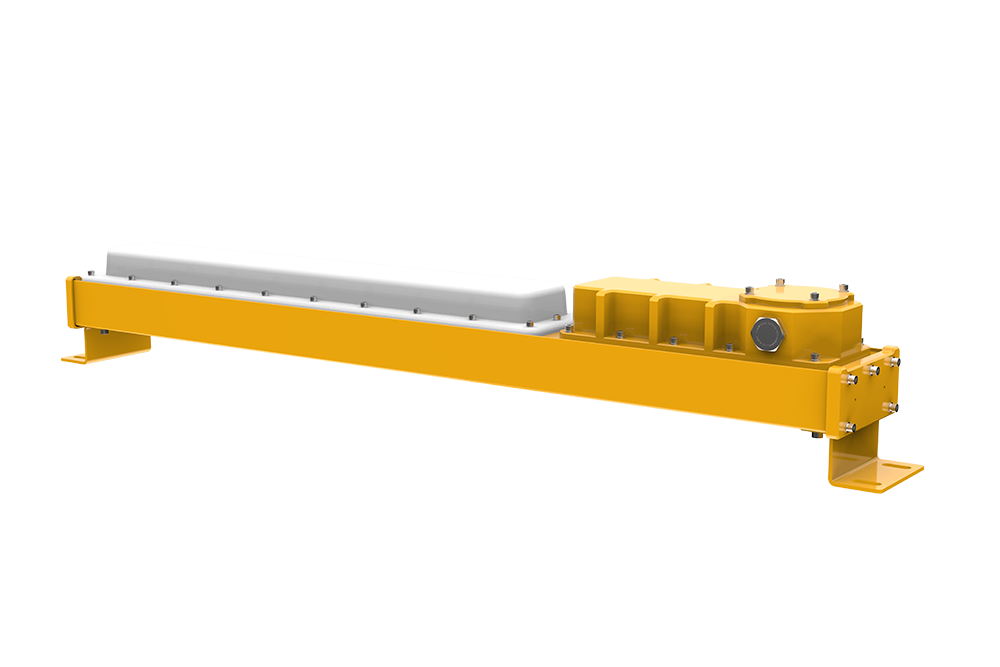
SEEKINGLED LED Linear Explosion Proof Light and Explosion Proof lighting is ATEX and IECEx certified for Zone 1, Zone 2, Zone 21 and Zone 22 hazardous locations, built for long-term industrial use.
LED Linear Explosion Proof Lights and EX Proof lights for Zone 1, Zone 2, Zone 21 and Zone 22 hazardous areas. ATEX & IECEx certified explosion proof LED linear lighting with emergency function, adjustable power and IP67 protection by SEEKINGLED.
SEEKINGLED LED Explosion Proof Flood Lights are ATEX certified for Zone 2 and Zone 22 hazardous areas, offering high efficiency, adjustable power and integrated junction box.
SEEKINGLED LED Explosion Proof Flood Lights are flameproof ATEX and IECEx certified for Zone 1 and Zone 2 hazardous areas, offering high power, adjustable output and long service life.
SEEKINGLED LED Gas Station Canopy Lights are ATEX certified for Zone 2 and Zone 22 hazardous areas, featuring adjustable power and built-in explosion-proof junction box.
ATEX: Ex II 2G Ex db IIB T6/T5 GbEx II 2D Ex tb IIIC T80°C/ T95°C Db IECEx Ex db IIB T6 Gb;Ex tb IIIC T80°C Db Feature: ● For Zone 1,2 and Zone 21,22● Flameproof type, the strongest● 100W can replace 250W HID,energy saving● Power:60W,80W,100W Application: Oil and gas, marine, Chemical, pharmaceutical, semiconductor,mining,military industr…
ATEX: II 3G Ex nR ⅡC T5/T6 GcII 3D Ex tc ⅢC T80℃/T95℃Dc ATEX Certificate NO: TÜV CY 26 ATEX 0207611 X Feature: ● For Zone 2 and Zone 22● 150W can replace 250W HID lamps,Energy saving● Power:50W,75W,100W,150W,200W Application: Oil and gas, marine, Chemical, pharmaceutical, semiconductor,mining,military industry, paint booth,power plant ETC…
LED explosion proof high bay lights are designed for Zone 1, Zone 2, Zone 21 and Zone 22 hazardous areas. This page introduces the HB21 Series from SEEKING, including certifications, power options and real application considerations.
LED Linear Explosion Proof Lights from SEEKINGLED. LU Series Flame Proof lights ATEX-certified explosion proof LED linear lighting for Zone 2 gas and Zone 22 dust areas, IP69K, IK10, long lifetime and flexible power options.
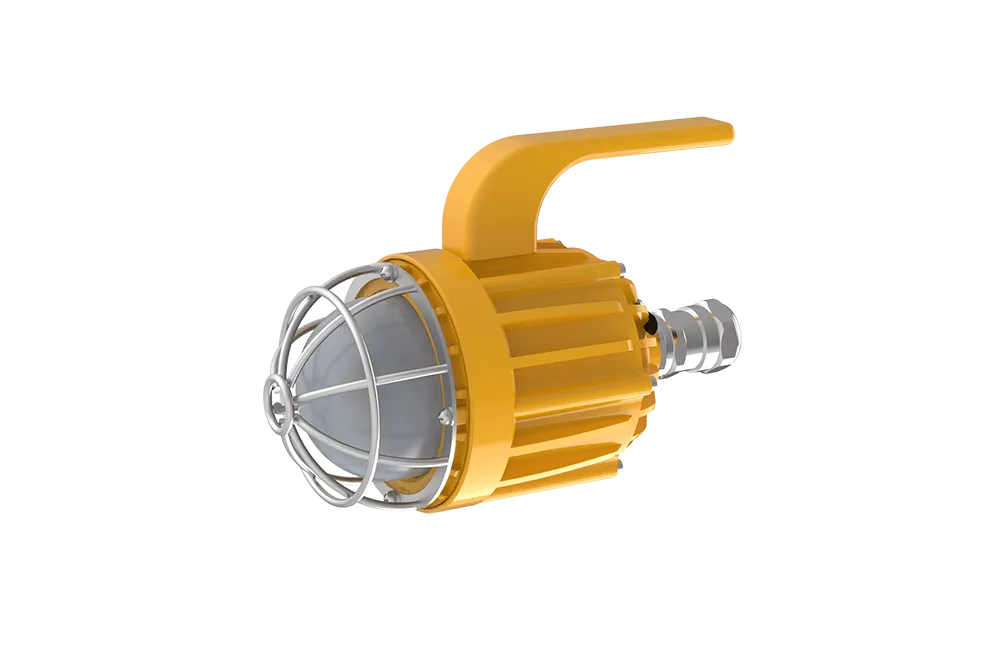
Certified explosion proof work lights for Zone 1 & 21 hazardous areas. Portable, ATEX & IECEx approved, built for oil, gas and chemical plants by SEEKINGLED.
ATEX: II 3G Ex nR ⅡC T6 GcII 3D Ex tc ⅢC T80℃ Dc ATEX Certificate NO: TÜV CY 26 ATEX 0207611 X Feature: ● For Zone 2 and Zone 22● Accepts battery-powered supply● indestructible● Power:AC input:50W,75W,100WDC input:15W,25W,35W Application: Oil and gas, marine, Chemical, pharmaceutical, semiconductor,mining,military industry, paint booth,po…
ATEX: Ex II 2G Ex db IIB T6 GbEx II 2D Ex tb IIIC T80°C Db IECEx Ex db IIB T6 Gb;Ex tb IIIC T80°C Db Feature: ● For Zone 1,2 and Zone 21,22● Flameproof type, the strongest Application: Oil and gas, marine, Chemical, pharmaceutical, semiconductor,mining,military industry, paint booth,power plant ETC hazardous area. Technical Specifications:…
ATEX: Ex II 2G Ex db IIB T6 GbEx II 2D Ex tb IIIC T80°C Db IECEx Ex db IIB T6 Gb;Ex tb IIIC T80°C Db Feature: ● For Zone 1,2 and Zone 21,22● Flameproof type, the strongest Application: Oil and gas, marine, Chemical, pharmaceutical, semiconductor,mining,military industry, paint booth,power plant ETC hazardous area. Technical Specifications:…
ATEX: Ex II 2G Ex d e IIB T6 Gb ATEX: Ex d e IIB T6 Gb; Feature: ● For Zone 1,2● 9W can replace 18W fluorescent lamps,50% Energy saving Application: Oil and gas, marine, Chemical, pharmaceutical, semiconductor,mining,military industry, paint booth,power plant ETC hazardous area. Technical Specifications: Standards:60079-0, 60079-1, 60079…
What is an explosion-proof high bay light fixture? Discover how it safely delivers high-lumen lighting in hazardous areas with certified protection and durability.
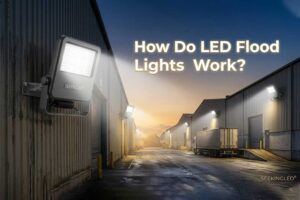
How do LED flood lights work? Learn how LED chips, drivers, and optics create bright, energy-saving outdoor lighting for homes, warehouses, and industrial sites.
 Seeking LED