 Seeking LED
Are LED Lights AC or DC? The Answer Isn’t What Most People Expect
193Are LED lights AC or DC? The short answer hides real-world details. Learn how LED lights actually work, why drivers matter, and what SEEKINGLED uses.
View detailsSearch the whole station
The question “how many amps does a 50w led draw?” usually shows up when someone is planning electrical circuits or replacing older lighting systems with LEDs.
And honestly, it’s a fair question. People see the wattage rating on the fixture and immediately try to translate that into electrical load.
The quick calculation is simple.
Using the relationship explained by Ohm’s Law, electrical power equals voltage multiplied by current:
Watts = Volts × Amps
So to estimate the current draw, you divide the wattage by the supply voltage.
Let’s do the math.
That’s the theoretical current draw. Clean numbers, easy to remember.
But if you’ve ever measured a fixture during installation, you already know something: the clamp meter rarely shows exactly 0.42 amps.
A few years ago during a parking lot lighting upgrade, we installed several mid-power LED fixtures rated around 50 watts. Everything looked straightforward on paper.
Then someone checked the current with a meter.
Instead of 0.42 amps, the reading hovered around 0.45 amps.
Nothing was wrong with the light. The explanation was simple — the LED driver.
Inside every LED Flood Light is a driver that converts AC power into the controlled current required by LED chips. Drivers are efficient, but not perfect. There are small energy losses, and the power factor slightly changes the relationship between voltage and current.
So the real-world number is often a bit higher than the theoretical calculation.
Not dramatically higher. Just enough to notice.
After working on enough lighting projects, you start to recognize realistic ranges.
A 50W LED fixture typically draws:
The variation depends on driver efficiency, input voltage stability, and power factor design.
Organizations such as the U.S. Department of Energy frequently point out that LED lighting is significantly more energy efficient than traditional lighting technologies. In many applications, LED systems reduce electricity consumption by 50–70% compared with older lamp types.
Lower power consumption naturally means lower current.
When someone asks how many amps does a 50w led draw, the real goal usually isn’t understanding a single fixture.
The goal is figuring out how many lights can safely run on one circuit.
Imagine a standard 15-amp circuit used in many commercial buildings.
If each 50W LED fixture draws about 0.45 amps, the theoretical maximum could exceed 30 lights. But electricians rarely push circuits that hard.
Safety guidelines often recommend leaving headroom on continuous loads. Industry groups such as the National Electrical Manufacturers Association highlight proper electrical design practices for lighting systems.
In practice, installers usually plan for fewer fixtures per circuit to keep everything running comfortably below the limit.
More answers
At SEEKINGLED, customers upgrading to LED lighting often worry about electrical capacity. They expect complicated load calculations or panel upgrades.
More often than not, the opposite happens.
Because LED fixtures draw such low current, the total electrical load drops dramatically after installation. Circuits that once powered only a handful of high-wattage lamps can now handle many more LED lights.
So the answer to how many amps does a 50w led draw is fairly straightforward:
roughly 0.4 to 0.5 amps in most 120V systems.
Small number.
But multiply that across an entire building, and the energy savings become very noticeable.
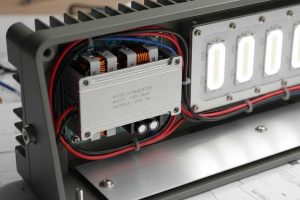
Are LED lights AC or DC? The short answer hides real-world details. Learn how LED lights actually work, why drivers matter, and what SEEKINGLED uses.
View details
This FLE Series flood light is designed, developed, and manufactured by SEEKINGLED. Since its launch in 2023, it has already sold over 100,000 units worldwide, and customer feedback has been very positive.It holds a European Union patent with orig...
View details
Are Class 1 Div 2 fixtures explosion proof? Learn the real difference between hazardous location ratings, explosion-proof lighting, and safe industrial applications from SEEKINGLED.
View details
What is ATEX certified lighting? Learn how ATEX-certified fixtures improve safety in explosive atmospheres and why they are essential for hazardous industrial locations.
View details