 Seeking LED
Explosion Proof Temporary Lighting: Safe Illumination for Hazardous Worksites
0Explosion proof temporary lighting for hazardous zones. Learn how certified portable systems ensure safe shutdowns, maintenance, and emergency operations.
View detailsSearch the whole station
A question that comes up surprisingly often during lighting installations is simple: how many amps does a 50 watt led light draw?
It sounds like basic electrical math. And yes, technically it is. But in real projects the answer isn’t always exactly the number people expect.
Let’s start with the straightforward calculation.
Electrical current follows a basic relationship explained in Ohm’s Law. Power equals voltage multiplied by current:
Watts = Volts × Amps
So if you want to estimate the current draw of a 50 watt LED light, you divide the wattage by the supply voltage.
For example:
That’s the theoretical number. Very clean. Very simple.
Real installations are slightly messier.
When electricians measure the current of a 50 watt LED light in the field, they sometimes see a small variation. Not huge, but noticeable.
The reason is the LED driver.
LED Flood Light don’t run directly from the raw voltage. Inside every modern LED light there is a power driver that converts AC power into the constant current the LED chips require. Drivers introduce efficiency losses and power factor effects.
In practical terms, a 50W LED fixture might pull closer to:
Nothing alarming. Just real-world electronics doing their thing.
I remember a warehouse lighting test where we measured several fixtures during installation. On paper the current should have been around 0.42A. The clamp meter showed 0.46A. Someone immediately thought the product was faulty.
It wasn’t.
The driver had a power factor around 0.9, which explains the difference. Once you work with LED systems long enough, that kind of variation stops being surprising.
Now here’s where the question “how many amps does a 50 watt led light draw?” actually becomes useful.
It’s not about a single light.
It’s about how many lights can run safely on one circuit.
Imagine a lighting circuit rated for 15 amps, which is common in commercial buildings in the United States. If each 50 watt LED light pulls roughly 0.45 amps, you could theoretically power over 30 fixtures on that circuit.
In reality, electricians leave a safety margin. Continuous loads should not exceed about 80% of circuit capacity, according to guidance often referenced from the National Electrical Manufacturers Association standards used in lighting equipment design.
So the safe number ends up lower.
Still — LED lighting dramatically reduces circuit demand compared with older technologies like metal halide or halogen lamps.
The reason LED Flood Light draws such low current comes down to efficiency.
According to research from the U.S. Department of Energy, LED lighting can reduce energy consumption by 50–75% compared with many traditional lighting systems.
That’s why even relatively small fixtures like a 50 watt LED light can produce illumination comparable to much higher wattage legacy lamps.
And because the current draw is low, wiring systems run cooler and electrical infrastructure lasts longer.
More answers
At SEEKINGLED, our engineers often help customers calculate electrical loads when upgrading industrial or outdoor lighting. The amp draw question comes up frequently when someone is replacing older fixtures.
The funny thing is this: once the new LED system is installed, power consumption usually drops far more than expected.
Lower current. Lower heat. Smaller electrical load.
The math behind how many amps does a 50 watt led light draw? is simple, yes. But seeing the reduction across an entire lighting network—that’s where the real impact appears.
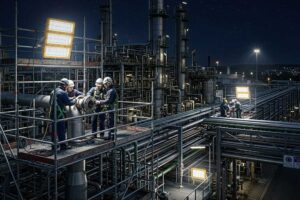
Explosion proof temporary lighting for hazardous zones. Learn how certified portable systems ensure safe shutdowns, maintenance, and emergency operations.
View details
Discover how hazardous location LED lights improve safety, reduce maintenance costs, and meet ATEX, IECEx, and UL requirements for explosive industrial environments.
View details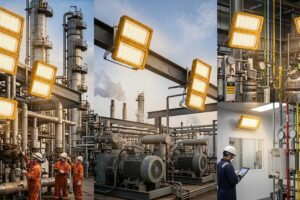
What is Class 1 Div 2 LED lighting? Learn how Class 1 Division 2 hazardous location LED fixtures improve safety in oil, gas, chemical, and industrial facilities.
View details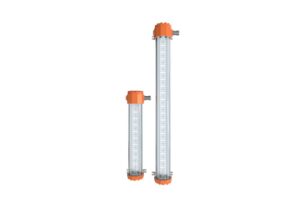
Explosion-proof lighting is essential for spray paint booths. SEEKINGLED LO Series delivers ATEX & IECEx certified safety, IP69K protection, and high efficiency.
View details